

TL;DR:
- Journals help externalize inner experiences to promote present-moment awareness and reduce stress. Structured mindfulness journaling trains attention and shifts focus from reactive thoughts to observation. Consistent short sessions with prompts improve mood and emotional regulation effectively.
Journals serve as the primary tool for translating mindfulness from a mental state into a repeatable, measurable practice. The role of journals in mindfulness is to externalize your inner experience so you can observe it without being consumed by it. Mindful journaling interventions reduce stress by an average of 70% and improve mood by 37% across diverse populations. That is not a minor effect. It places journaling among the most accessible and evidence-backed mental wellness practices available to anyone with a pen and a few minutes.
What is the role of journals in mindfulness practice?
Journaling in the context of mindfulness is not the same as keeping a diary. A diary records events. A mindfulness journal trains attention. The distinction matters because the goal is not to document your day but to notice your present-moment experience with clarity and without judgment.
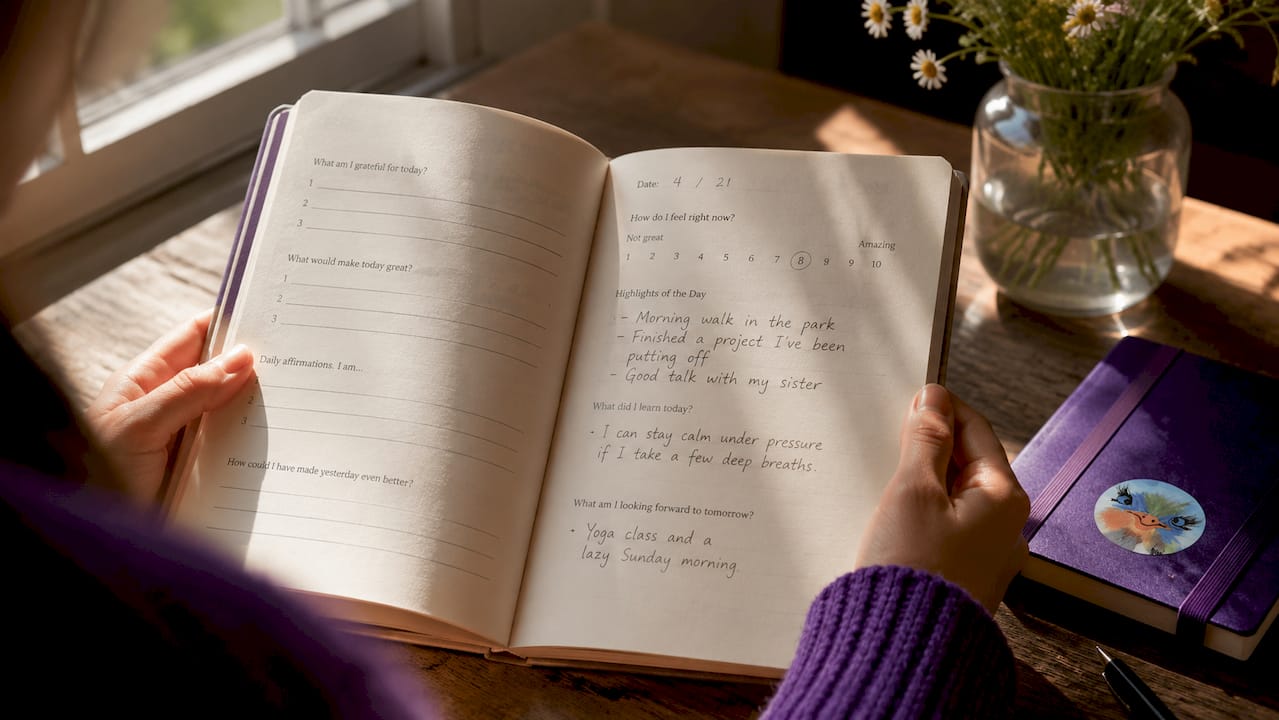
Clinical psychologist Dr. Jeffrey Leichter notes that journaling externalizes worries, making them easier to observe with nonjudgmental awareness. When a thought moves from your head onto a page, it loses some of its emotional charge. You shift from being inside the thought to looking at it from the outside.
This shift is the core mechanism behind mindfulness journaling. Structured mindfulness journals use concise prompts, mood tracking, and reflective questions rather than open-ended narrative writing. The structure trains your attention the same way a meditation session does. It gives your mind a specific, bounded task instead of an open field to wander in.
How does mindfulness journaling reduce stress and improve emotional well-being?
The psychological effects of mindfulness journaling are grounded in neuroscience. Mindful journaling reduces amygdala activity and engages the prefrontal cortex, the brain region responsible for regulated emotional response. The amygdala drives reactive, fear-based thinking. The prefrontal cortex supports calm, deliberate reasoning. Journaling activates the second and quiets the first.
Journaling shifts focus from participation in thoughts to observation, which reduces worry and rumination. This is the observer perspective. Instead of being swept along by anxious thinking, you watch it pass. That single shift reduces the emotional weight of repetitive thoughts significantly.
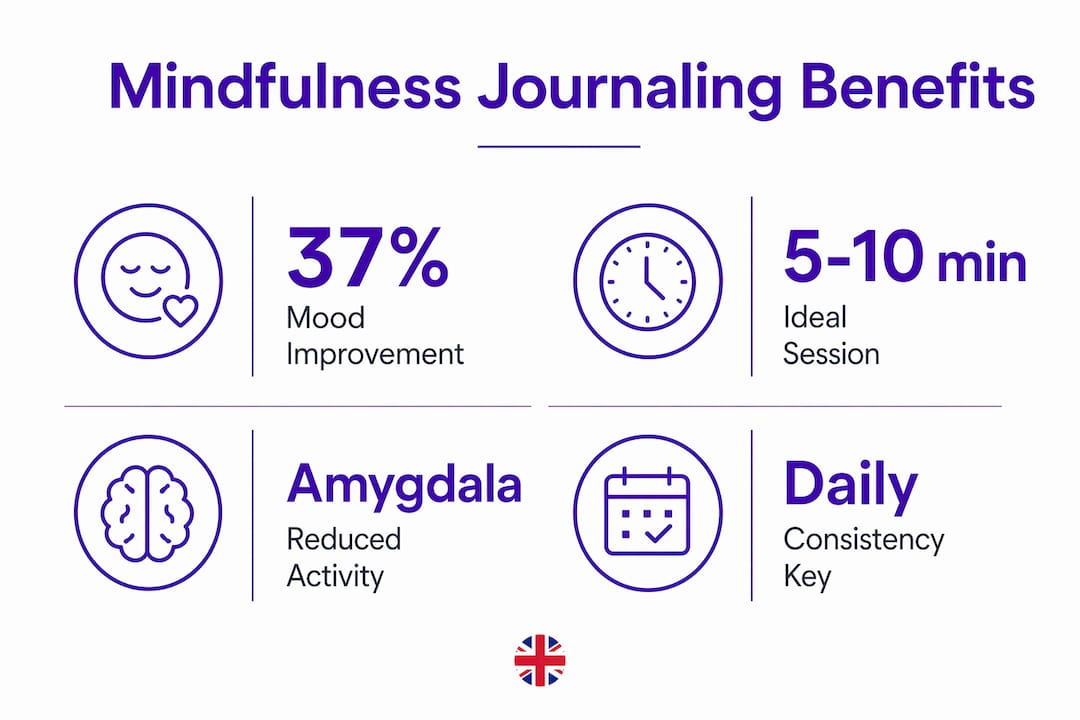
The mood improvement data reinforces this. A 37% improvement in mood is not produced by writing more. It is produced by writing with intention. Venting without reflection does not deliver the same result. Non-mindful journaling can temporarily worsen mood when it becomes a loop of complaint without observation. The difference between helpful and unhelpful journaling is the presence of nonjudgmental awareness.
Pro Tip: Consistency matters more than session length. Building the brain's observer capacity happens through daily short sessions, not occasional long ones.
What are the mindfulness journaling techniques that maximize benefits?
Effective mindfulness journaling follows a repeatable structure. These steps work for beginners and experienced practitioners alike.
- Start with an arrival ritual. A 1–2 minute grounding period before writing, such as three slow breaths or a body scan, shifts your nervous system into a receptive state. Beginners often skip this step and wonder why journaling feels forced.
- Set a timer for 5–10 minutes. Sessions of 5–10 minutes avoid decision fatigue and resistance. A timer also prevents the session from drifting into rumination. When the timer ends, you stop.
- Use the mindful loop: pause, notice, name, repeat. Pause before each sentence. Notice what you actually feel or think right now. Name it in plain language. Repeat the cycle. This keeps writing anchored to the present moment rather than the past.
- Apply linguistic distancing. Writing "the mind is thinking" instead of "I am thinking" creates a small but powerful gap between you and your thoughts. That gap is where mindfulness lives. It reduces emotional reactivity and makes difficult thoughts easier to examine.
- Write slowly and deliberately. Deliberate writing supports emotional regulation and clearer thinking. Speed-writing produces the same mental noise you are trying to quiet. Slow down the pen and the mind follows.
Pro Tip: Avoid ending a session mid-thought. Write one complete observation before the timer ends. Incomplete thoughts tend to loop after you close the journal.
How does mindfulness journaling differ from other types of journaling?
Not all journals serve the same purpose. The format you choose shapes the mental habit you build. The table below compares mindfulness journaling with three common alternatives.
| Journal type | Primary focus | Structure | Mindfulness benefit |
|---|---|---|---|
| Mindfulness journal | Present-moment awareness | Prompts, mood tracking, brief entries | High: trains attention and observation |
| Traditional diary | Event recording | Open narrative, chronological | Low: recounts the past, not the present |
| Expressive writing | Emotional release | Unstructured, stream of consciousness | Mixed: helpful for processing, risky for rumination |
| Productivity planner | Task and goal tracking | Lists, schedules, habit trackers | Low: future-focused, not present-centered |
The key difference is orientation. A mindfulness journal points your attention at what is happening now. A diary points it at what happened then. A productivity planner points it at what should happen next. Only one of those orientations builds present-moment awareness.
Structured mindfulness journals include concise prompts, mood numbers, and reflective actions rather than narrative entries. That structure is not a limitation. It is the mechanism. The prompts do the same job as a meditation teacher's bell: they call your attention back to now.
Readers exploring themed journals for self-expression will find that a well-chosen theme can serve as a built-in prompt system, making it easier to stay present during each session.
How can you incorporate journaling into your mindfulness routine?
Building a journaling habit that sticks requires three things: a consistent time, a physical space, and a format that matches your current practice level.
- Choose a fixed time. Morning journaling captures your mental state before the day's noise accumulates. Evening journaling works well for reflection and mood review. The specific time matters less than keeping it the same each day.
- Create a dedicated space. A specific chair, a specific mug, a specific journal. These environmental cues signal to your brain that a mindfulness session is beginning. The ritual reduces the friction of starting.
- Pick the right journal format. Guided journals provide prompts that remove the blank-page problem. Blank journals offer more freedom for experienced practitioners. Digital formats work for people who type faster than they write, though research consistently shows that handwriting deepens engagement with the content.
- Use prompts designed for mindful reflection. Strong journaling prompts for mindfulness practice include: "What am I noticing in my body right now?", "What thought has repeated itself today?", "What am I grateful for in this specific moment?" These prompts anchor writing to the present rather than the past or future.
- Pair journaling with a brief meditation. Even two minutes of breath-focused meditation before writing primes the prefrontal cortex and makes the journaling session more effective. The combination produces stronger results than either practice alone.
- Review past entries monthly. Patterns in your mood tracking reveal triggers and progress that are invisible in the day-to-day. Monthly review turns individual sessions into a long-term self-awareness practice.
Pro Tip: Personalized journals improve engagement and consistency. A journal that feels like yours, whether through cover design, paper quality, or a specific theme, lowers the psychological resistance to picking it up each day.
Short-term gratitude journaling, such as writing three good things daily for 14 days, produces lasting psychological well-being improvements. This is a practical starting point for anyone who finds open-ended prompts difficult. Three specific observations per day, written slowly, is enough to build the habit and begin seeing results.
Key Takeaways
Mindfulness journaling works because it trains the brain to observe thoughts rather than react to them, and consistency in that practice produces measurable reductions in stress and improvements in mood.
| Point | Details |
|---|---|
| Journaling reduces stress significantly | Mindful journaling interventions reduce stress by an average of 70% across diverse populations. |
| Session length should be short | Keep sessions to 5–10 minutes to avoid fatigue and prevent rumination from taking over. |
| Structure beats free writing | Prompts, mood tracking, and linguistic distancing produce stronger mindfulness benefits than open narrative. |
| Consistency outweighs duration | Daily short sessions build the brain's observer capacity more effectively than occasional long ones. |
| Format choice shapes the habit | Guided journals reduce blank-page resistance; personalized journals improve long-term engagement. |
Why journaling changed how I think about mindfulness
Most people approach mindfulness as something they do during a meditation session and then leave behind. Journaling broke that pattern for me. The page became a place where mindfulness continued after the cushion.
What surprised me most was how the observer perspective transferred. After a few weeks of writing "the mind is noticing anxiety" instead of "I am anxious," I started hearing that same linguistic distance in my daily thinking. The journal had trained a reflex. That is not something a meditation app delivers on its own.
The hardest part is not the writing. It is the consistency. There will be mornings when the journal sits unopened. The practice is not ruined by that. What I have found is that treating a missed day as data rather than failure, noting it briefly and moving on, keeps the habit alive far longer than self-criticism does. Mindfulness journaling must pair observation with self-compassion to be genuinely helpful. That applies to how you treat yourself when the habit slips, too.
The readers who get the most from journaling are the ones who stop waiting to feel ready and start with two sentences. Two honest sentences about what is happening right now is a complete mindfulness session. Build from there.
— Mark
Journals that support your mindfulness practice
Munkterproducts offers a range of handcrafted journals and self-help journals designed to support exactly this kind of intentional, present-moment writing.

Whether you are starting with a guided format or looking for a beautifully made blank journal to carry your daily practice, the right physical journal makes a real difference in how often you return to it. Wellbeing-focused gift programs, like those offered through employee wellbeing gift boxes, have recognized the same thing: a quality journal given with intention gets used. Browse the full collection at Munkterproducts and find the format that fits where you are in your practice right now.
FAQ
What is the role of journals in mindfulness?
Journals serve as tools for externalizing thoughts so you can observe them without reacting. They train present-moment awareness through structured writing, prompts, and mood tracking.
How long should a mindfulness journaling session be?
Sessions of 5–10 minutes are recommended to avoid decision fatigue and prevent sessions from drifting into rumination. Consistency across short sessions matters more than occasional long ones.
What makes mindfulness journaling different from a regular diary?
A mindfulness journal focuses on present-moment awareness using prompts and structured reflection. A regular diary records past events in narrative form and does not train attention the same way.
Can journaling actually reduce anxiety?
Mindful journaling reduces amygdala activity and engages the prefrontal cortex, which regulates emotional response. Research shows it reduces stress by an average of 70% across diverse populations.
What are good journaling prompts for mindfulness practice?
Effective prompts include: "What am I noticing in my body right now?", "What thought has repeated itself today?", and "What am I grateful for in this specific moment?" These anchor writing to the present rather than the past.