

TL;DR:
- Starting with a short, actable list helps readers find accessible fantasy books today.
- Choosing books by mood, worldbuilding, and time commitment ensures a satisfying reading experience.
The best place to start is a short list you can act on today. The Hobbit (J.R.R. Tolkien) is the classic entry point for any age, Neverwhere (Neil Gaiman) is the perfect standalone for adults, and The Fifth Season (N.K. Jemisin) is the most decorated modern fantasy of the past decade. Round that out with Harry Potter and the Sorcerer's Stone for kids and families, The Night Circus (Erin Morgenstern) for atmospheric standalone readers, and Mistborn: The Final Empire (Brandon Sanderson) for anyone ready to commit to a series. Here is the full TL;DR:
- The Hobbit — Tolkien | Timeless adventure, all ages | Standalone (prequel to a trilogy)
- Harry Potter and the Sorcerer's Stone — Rowling | Beloved coming-of-age magic | Kids/YA, series
- Neverwhere — Neil Gaiman | Urban fantasy, dark and witty | Adult/crossover, standalone
- The Night Circus — Erin Morgenstern | Lush, romantic, atmospheric | Adult, standalone
- The Fifth Season — N.K. Jemisin | Award-winning, literary, intense | Adult
- Mistborn: The Final Empire — Brandon Sanderson | Intricate magic system, heist plot | Adult, series
- Uprooted — Naomi Novik | Fairy-tale tone, fast-paced | Adult/crossover, standalone
- Howl's Moving Castle — Diana Wynne Jones | Whimsical, warm, funny | Kids/YA/crossover, standalone
Table of Contents
- What are the top fantasy books for readers, organized by subgenre?
- How do you choose the right fantasy book for your taste?
- Series vs. standalone: how much reading time do you actually need?
- What should you read based on how you feel right now?
- Key Takeaways
- The case for reading fantasy across every age
- Physical editions and fantasy gifts from Munkterproducts
- Useful sources for deeper exploration
What are the top fantasy books for readers, organized by subgenre?
Literary critics advise matching subgenre to personal taste rather than picking whatever sits at the top of a generic list. Fantasy is not one thing. Here is how the major categories break down, with the strongest picks in each.
Epic and high fantasy
High fantasy features invented worlds, distinct magical systems, and hero's journeys that feel complete and lived-in. These are the books that built the genre.
- The Lord of the Rings — Tolkien | Adult/crossover | Series (3 volumes) | The foundational epic; dense worldbuilding, slow burn, enormous payoff
- The Hobbit — Tolkien | All ages | Standalone | Lighter and faster than LOTR; the best entry point in the genre
- A Game of Thrones — George R.R. Martin | Adult | Series (5+ books) | Political, brutal, morally complex; not for younger readers
- The Name of the Wind — Patrick Rothfuss | Adult | Series (2 published, 1 pending) | Lyrical prose, unreliable narrator, exceptional voice
- The Priory of the Orange Tree — Samantha Shannon | Adult | Standalone | Epic scope in a single volume; female-led, dragon-heavy, diverse cast
- Mistborn: The Final Empire — Brandon Sanderson | Adult | Series | Heist-driven plot with one of fantasy's most original magic systems
Urban and contemporary fantasy
Urban fantasy drops magic into the modern world. The tone shifts from grand to gritty or darkly comic.
- Neverwhere — Neil Gaiman | Adult | Standalone | London Below is one of the most inventive settings in the genre; reviewers consistently recommend it as a low-barrier entry for readers nervous about long series
- Jonathan Strange & Mr Norrell — Susanna Clarke | Adult | Standalone | Slow, literary, and deeply strange; Regency England meets fairy magic
Fairy-tale and mythic fantasy
- Uprooted — Naomi Novik | Adult/crossover | Standalone | Eastern European folklore, fast pacing, a genuinely surprising plot
- Howl's Moving Castle — Diana Wynne Jones | Kids/YA/crossover | Standalone | Playful and subversive; critics note it rewards adult rereaders as much as it delights younger ones
- The Night Circus — Erin Morgenstern | Adult | Standalone | More mood than plot; the prose itself is the spectacle
YA and coming-of-age fantasy
- Harry Potter and the Sorcerer's Stone — J.K. Rowling | Kids/YA | Series (7 books) | The most widely read fantasy series of the past 30 years; accessible from age 8
- Tamora Pierce's Song of the Lioness series | YA/crossover | Female knight protagonist, progressive themes; critics highlight Pierce for bridging youth and adult readers with layered storytelling
- The Fifth Season — N.K. Jemisin | Adult | Trilogy | Technically adult, but widely read by older teens; won three consecutive Hugo Awards
Accessible standalones for new readers
- Uprooted, Neverwhere, The Night Circus, and Howl's Moving Castle all deliver complete, satisfying stories with no follow-up required. The Priory of the Orange Tree is the rare epic that fits in one book.
How do you choose the right fantasy book for your taste?
Pick by mood first, then check worldbuilding intensity, then confirm the time commitment. Those three factors will narrow a list of hundreds down to two or three real candidates.
Mood and tone is the fastest filter. Dark and morally complex? Go to A Game of Thrones or The Fifth Season. Warm and whimsical? Howl's Moving Castle or The Hobbit. Atmospheric and romantic? The Night Circus. Witty and strange? Neverwhere.
Worldbuilding intensity separates readers who love deep lore from those who want story first. High fantasy like The Lord of the Rings or The Name of the Wind rewards readers who enjoy learning a world's rules. Urban fantasy like Neverwhere assumes a world you already know and adds the weird on top. Fairy-tale fantasy sits in the middle: familiar archetypes, original twists.
Time commitment is where most readers go wrong. A 1,000-page epic is not a better book than a 300-page standalone. It is just a different kind of investment. Curated lists are useful anchors, but personal match and available time should govern the final pick.
Pro Tip: Read the first 50 pages before committing. If the prose does not pull you forward by then, try a different subgenre. Audiobook samples work just as well. One non-obvious shortcut: alternate a long epic with a short standalone after every major series. It prevents the burnout that kills reading momentum.
For a deeper look at fantasy subgenres and worldbuilding, the Munkterproducts blog has an extended breakdown.
Series vs. standalone: how much reading time do you actually need?
Start with standalones or short series if you want low risk. Commit to epics only when you know you love an author's voice.
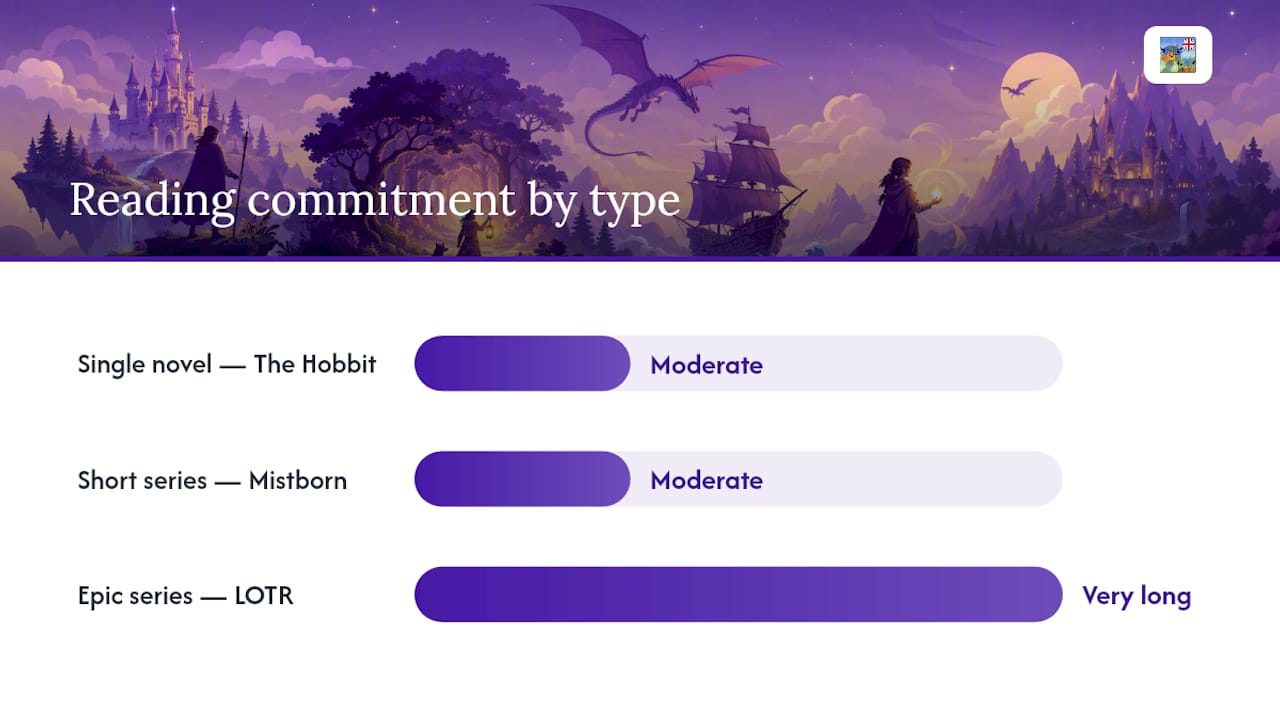
| Commitment level | Typical length | Sample titles |
|---|---|---|
| Single short novel | Moderate length | The Hobbit, Howl's Moving Castle, Uprooted |
| Short series | Moderate length | Tamora Pierce's Song of the Lioness, Mistborn trilogy |
| Long epic series | Very long reading commitment | The Lord of the Rings, A Game of Thrones, The Name of the Wind |
Reviewers recommend standalones like Neverwhere and Jonathan Strange & Mr Norrell as low-barrier ways to experience high-quality fantasy without the multi-year commitment.
A simple plan for sampling a new series:
- Read Book 1 all the way through before deciding anything.
- By the halfway point, you should feel invested in at least one character. If you do not, the series probably is not for you.
- Finish Book 1, then wait a week. If you find yourself thinking about the world, continue. If not, move on without guilt.
Experienced readers prevent burnout by alternating: one long epic, then one short standalone, then back. It keeps the reading habit alive without turning every book into a project.
For building a balanced genre collection, the same principle applies across fantasy and science fiction.
What should you read based on how you feel right now?
- Cozy comfort: Howl's Moving Castle — warm, funny, and never threatening
- Cinematic action: Mistborn: The Final Empire — heist pacing, big set pieces, satisfying twists
- Literary depth: The Fifth Season or Jonathan Strange & Mr Norrell — both reward slow, attentive reading
- Romance-forward: The Night Circus — the love story is the spine of the whole book
- Quick escape (one weekend): Uprooted or Neverwhere — both read fast and land hard
- Dark and morally complex: A Game of Thrones — no clean heroes, no guaranteed survival
- Whimsical fairy-tale feeling: Uprooted or The Hobbit — folklore roots, light touch
- Cross-age pick for families: The Hobbit or Harry Potter and the Sorcerer's Stone — genuinely enjoyable for adults reading aloud with kids
For readers who enjoy short, high-stakes standalone fiction in adjacent genres, that list offers single-sitting picks worth bookmarking.
Key Takeaways
The fastest path to a great fantasy read is matching mood to subgenre, then checking commitment level before you start.
| Point | Details |
|---|---|
| Match mood to subgenre first | Dark, whimsical, romantic, or literary tone narrows the field faster than any ranked list. |
| Check commitment before starting | Standalones like Uprooted and Neverwhere carry zero series risk; epics like LOTR reward patience. |
| Alternate long and short reads | Switching between epics and standalones prevents burnout and keeps reading momentum strong. |
| Try standalones if unsure | The Hobbit, The Night Circus, and Howl's Moving Castle are complete stories with no follow-up required. |
| Munkterproducts for physical editions | Munkterproducts carries curated physical books, themed journals, and reading gifts for fantasy fans. |
The case for reading fantasy across every age
The conventional wisdom treats fantasy as a genre you age out of. That is exactly backwards. The books that hold up longest, from The Hobbit to The Fifth Season, are the ones that treat fantasy as a vehicle for genuine literary and philosophical weight, not just escapism. Ursula K. Le Guin's Earthsea cycle is the clearest proof: it reads differently at twelve than it does at forty, and both readings are correct.
What actually separates a must-read from a forgettable fantasy novel is not length or world complexity. Great fantasy creates political systems, moral stakes, and history that persist after the last page. A Game of Thrones does that. So does The Fifth Season. So, quietly, does Howl's Moving Castle.
My curation principle is simple: balance epics with standalones, prioritize voice and emotional stakes over page count, and never dismiss a book because it was written for younger readers. The best ones were written for everyone.
Physical editions and fantasy gifts from Munkterproducts
Reading lists are one thing. Having a beautiful physical copy on your shelf is another. Munkterproducts offers curated physical books, handcrafted journals perfect for tracking your reading, themed stationery, and gift sets that pair well with any fantasy title on this list.

Whether you are buying for yourself or looking for a gift for a fantasy reader in your life, the shop carries editions and accessories that make the reading experience tangible. Journals for notes and annotations, puzzle books for downtime between chapters, and curated gift bundles ship across the U.S. with postage included.
Browse the full catalog and place your order at munkterproducts.com.
Useful sources for deeper exploration
Every recommendation above draws on established critical sources. These are the most reliable places to go next.
| Source | Why it is useful |
|---|---|
| TIME's 100 Best Fantasy Books of All Time | Panel of leading fantasy authors; chronological, cross-age, authoritative |
| Fantasy Book Review — Top 100 | Community and critic consensus; strong for series and standalone comparisons |
| The Book Club Review — Best Fantasy Books | Editorial curation with subgenre guidance and personal reading notes |
| Penguin Random House — High Fantasy | Publisher-level definitions and curated reading paths for high fantasy |
| Ursula K. Le Guin — A Wizard of Earthsea | Primary source for one of fantasy's most literary and philosophical works |
| Collider — Fantasy Masterpieces | Critical essays on what elevates a fantasy title to must-read status |