

TL;DR:
- Educational publishing creates curriculum-aligned textbooks, assessments, and digital tools for schools and institutions. Success depends on rigorous peer review, timely permissions clearance, and adherence to standards, especially for self-publishers. It shapes education by providing accessible, credible materials tailored to diverse learning environments.
Educational publishing is defined as the specialized sector of the publishing industry focused on producing textbooks, assessments, instructional guides, and digital learning tools for schools, colleges, and training programs. Unlike trade publishing, which targets general consumer audiences, educational publishing serves institutional markets where curriculum alignment and pedagogical design determine whether a title gets adopted or shelved. The materials produced must meet specific learning standards, serve defined age groups, and pass rigorous quality reviews before reaching classrooms. Munkterproducts operates within this broader publishing ecosystem, offering curated educational books and activity materials that reflect these same principles of purposeful content design.

What is educational publishing and how does it work?
Educational publishing is the process of creating, producing, and distributing instructional content tailored to institutional education markets. The industry serves three primary segments: K–12 schools, higher education institutions, and professional training programs. Each segment demands different content formats, reading levels, and pedagogical structures. A college-level biology textbook requires peer-reviewed accuracy and detailed lab guides, while a K–12 math workbook needs age-appropriate scaffolding and visual learning cues.
The scope of educational publishing extends well beyond printing books. Publishers produce assessments, teacher guides, digital learning platforms, and supplementary resources that support full curriculum delivery. As of late 2025, publishers increasingly integrate traditional textbook content with online platforms to meet global demand. That shift reflects how deeply the industry has moved from a print-only model toward hybrid content ecosystems.
What separates educational publishing from general book publishing is its relationship with institutions. Adoption decisions are made by school boards, curriculum committees, and university departments, not individual readers. That means a title's commercial success depends on institutional approval, not bestseller lists.
What are the main stages of the educational publishing process?
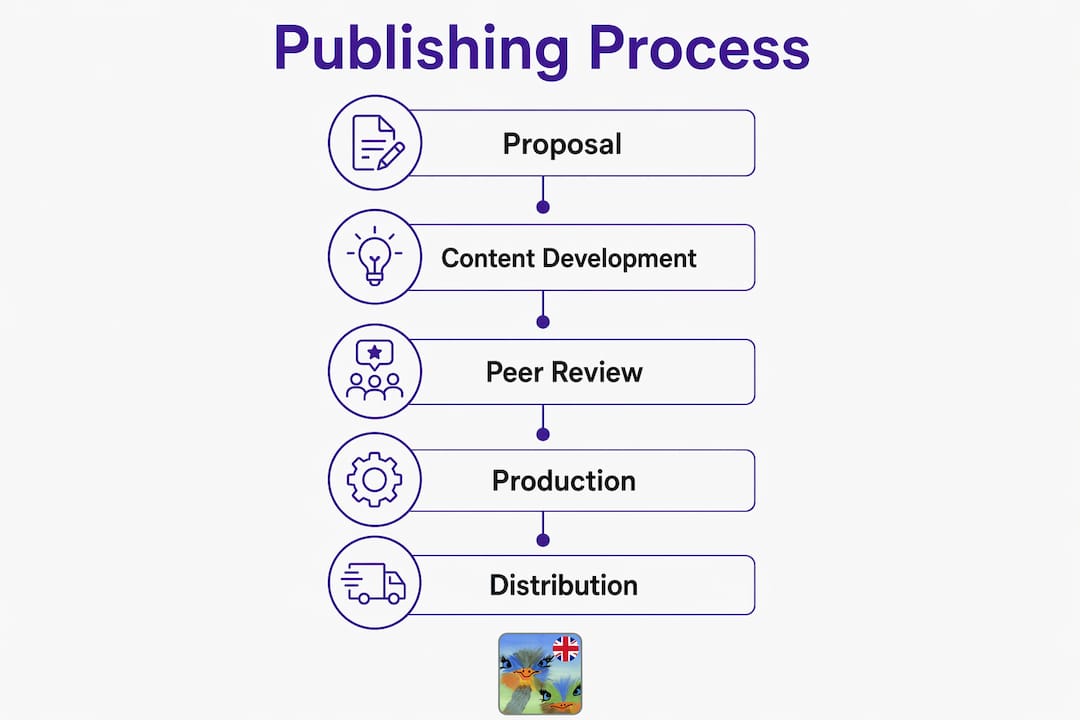
The formal publishing process follows seven defined stages, each with specific quality gates and timelines.
- Proposal submission. The author submits a detailed outline, sample chapters, and a market rationale. Publishers assess whether the content fills a curriculum gap.
- Peer review. Subject-matter experts evaluate the manuscript for accuracy, pedagogical soundness, and curriculum fit. This stage typically takes 4–6 weeks.
- Editorial evaluation. The editorial board reviews peer feedback and decides whether to proceed, request revisions, or decline.
- Contract signing. Once approved, the author and publisher formalize rights, royalties, and delivery timelines.
- Manuscript development. The author refines the content with editorial guidance, aligning chapters to syllabus requirements and learning objectives.
- Production. This phase covers copyediting, typesetting, permissions clearance, and proofreading. Production typically requires 5–6 months to finalize a manuscript into a published work. That timeline reflects the complexity of formatting, rights management, and accessibility compliance.
- Publication and marketing. The finished work is distributed to institutional buyers, often through adoption campaigns targeting curriculum coordinators.
Pro Tip: Map your manuscript to specific curriculum standards before submitting a proposal. Publishers evaluate syllabus alignment as a primary adoption signal, and a clear mapping document accelerates editorial review.
The production stage is where most delays occur. Permissions clearance for third-party content, such as charts, images, or quoted passages, can stall a project for weeks if not handled early. Securing permissions early in the development process is one of the most practical steps an author can take to protect their timeline.
What types of educational materials does publishing produce?
Educational publishing produces a wide range of content formats, each serving a distinct function within the learning process.
- Textbooks form the core of most curricula. They present subject matter in a structured sequence aligned to learning standards.
- Instructional guides and teacher editions provide educators with lesson plans, discussion prompts, and assessment strategies.
- Assessments include standardized tests, formative quizzes, and diagnostic tools used to measure student progress.
- Digital learning programs deliver interactive content, adaptive exercises, and multimedia resources through online platforms.
- Supplementary materials such as workbooks, flashcards, and coloring activity books reinforce core concepts through varied practice formats.
The types of educational books that reach consumers span a wide spectrum, from structured academic texts to creative activity formats that build foundational skills through play.
| Material Type | Primary Audience | Key Function |
|---|---|---|
| Textbooks | K–12, higher education | Core curriculum delivery |
| Teacher guides | Educators | Lesson planning and instruction |
| Assessments | All levels | Measuring learning outcomes |
| Digital learning tools | Higher education, training | Interactive and adaptive learning |
| Activity and coloring books | Early childhood, K–12 | Skill reinforcement through creative practice |
| Professional training manuals | Adult learners | Workplace competency development |
The distinction between K–12 and higher education materials goes beyond reading level. K–12 content must align tightly with state or national curriculum standards. Higher education materials allow more authorial flexibility but still require peer review and academic rigor. Professional training materials prioritize competency outcomes over theoretical depth.
What unique challenges and standards shape educational publishing?
Educational publishing operates under constraints that general trade publishing never faces. Understanding these challenges helps authors and educators navigate the process more effectively.
- Curriculum alignment mandates. Content alignment with state or territory curriculum standards largely determines institutional adoption. A well-written book that does not map to the required standards will not be purchased, regardless of its quality.
- Accessibility and inclusivity requirements. Publishers must meet accessibility standards for readers with disabilities, including screen-reader compatibility for digital formats and appropriate reading-level adjustments.
- Permissions clearance. Using third-party content without proper licensing is a major cause of project delays. Publishers require authors to clear all permissions before production begins.
- Adoption cycles. Schools and universities review and adopt new materials on fixed cycles, often every three to five years. Missing an adoption window means waiting years for the next opportunity.
- Peer review as a credibility gate. At least one external subject-matter expert review is required before publication. This applies to both traditionally published and self-published works seeking institutional credibility.
Pro Tip: Self-published educational materials can achieve institutional acceptance. The requirement is meeting the same standards as traditional publishers: peer review, accessibility statements, proper indexing, and complete front and back matter.
The digital transition adds another layer of complexity. Students often prefer physical books over digital alternatives, perceiving free online content negatively when it carries a price tag. That preference creates a market tension publishers must manage carefully when pricing digital resources.
How does educational publishing impact learning and the broader ecosystem?
Educational publishing functions as critical infrastructure. It does not simply produce content. It makes educational knowledge legible, retrievable, and transmissible across time and learning contexts. A well-produced textbook can shape how an entire generation of students understands a subject.
Educational publishers act as market researchers, recruiting educators to identify gaps in existing materials and incorporating those insights into new titles. That collaboration between publishers and classroom practitioners is what keeps educational content relevant to actual teaching needs. Publishers analyze where existing textbooks fall short and build new offerings around those findings.
"Educational publishing acts as critical infrastructure ensuring educational content is legible, retrievable, and transmissible across time and learning contexts, beyond simple content creation."
The industry's move toward digital and hybrid models reshapes how learning resources reach students. Digital-first publishing reduces distribution costs and allows faster content updates, which matters in fast-moving fields like technology and medicine. Print remains dominant in many markets, but the industry's transition toward digital-first models challenges traditional print-distribute frameworks at every level.
Educational equity is also at stake. Accessible, affordable, and standardized learning materials reduce the knowledge gap between well-funded and under-resourced schools. Publishers who prioritize open-access formats and affordable pricing directly affect how many students can access quality content.
Key Takeaways
Educational publishing succeeds when curriculum alignment, rigorous peer review, and accessible content formats work together from the proposal stage through distribution.
| Point | Details |
|---|---|
| Curriculum alignment drives adoption | Content that maps to state or national standards gets adopted; content that does not gets passed over. |
| Seven-stage process governs quality | From proposal to publication, each stage adds a quality gate that protects institutional credibility. |
| Permissions clearance prevents delays | Securing rights for third-party content early in development protects the production timeline. |
| Print and digital serve different needs | Students often prefer physical materials, so hybrid publishing models serve the broadest audience. |
| Standards apply to self-publishers too | Self-published educational works must meet peer review and accessibility requirements to gain institutional acceptance. |
My honest read on educational publishing today
The most common mistake I see from first-time educational authors is treating the publishing process like general book publishing. It is not. The moment you target a school district or university department as your buyer, you are operating in a procurement system with fixed cycles, committee decisions, and non-negotiable standards. Writing a great book is necessary but not sufficient.
The permissions issue deserves more attention than it gets. Authors routinely underestimate how long rights clearance takes, especially for images, data tables, and quoted passages from other academic works. Starting permissions research at the outline stage, not the final draft stage, is the single most practical change an author can make. I have seen strong manuscripts delayed by six months or more because this step was left until the end.
The digital-versus-print tension is real, but I think it is often framed incorrectly. The question is not whether to publish digitally or in print. The question is which format serves your specific audience's learning context. A professional training manual used in a corporate setting may work well as a digital resource. A K–12 science workbook used in a classroom with limited device access needs to be print-ready. Knowing your distribution context before you write your first chapter saves significant rework later.
For educators considering self-publishing, the credibility gap with institutions is closeable. The requirement is meeting the same standards that traditional publishers enforce: peer review, proper indexing, accessibility statements, and complete front and back matter. Professional publishing standards are not gatekeeping. They are the mechanism that makes educational content trustworthy enough for institutions to stake their curriculum on.
— Mark
Munkterproducts and the educational publishing world
Educators and authors who want to put quality educational content into readers' hands need more than a manuscript. They need materials that reflect genuine pedagogical thinking and reach the right audience.

Munkterproducts curates and sells a range of educational books and activity materials designed for both children and adults, from structured learning workbooks to creative coloring books that build foundational skills. The catalog reflects the same principles that define professional educational publishing: purposeful content, clear learning outcomes, and accessible formats. Whether you are an educator looking for classroom-ready resources or an author exploring how educational content reaches consumers, Munkterproducts offers a direct path from quality content to engaged readers.
FAQ
What is the definition of educational publishing?
Educational publishing is the sector of the publishing industry that produces textbooks, assessments, instructional guides, and digital learning tools for schools, colleges, and training programs. It differs from trade publishing because content must align with curriculum standards and pass institutional review.
How long does the educational publishing process take?
The full process from proposal to publication typically spans many months. Peer review alone takes 4–6 weeks, and the production phase requires 5–6 months for copyediting, typesetting, and proofreading.
What types of materials does educational publishing produce?
Educational publishing produces textbooks, teacher guides, assessments, digital learning programs, workbooks, and supplementary activity materials. Each format serves a specific function within K–12, higher education, or professional training contexts.
Can self-published authors enter the educational publishing market?
Self-published educational works can achieve institutional acceptance when they meet professional standards, including peer review, accessibility statements, proper indexing, and complete front and back matter.
Why does curriculum alignment matter so much in educational publishing?
Curriculum alignment determines institutional adoption. A title that does not map to state or national standards will not be purchased by schools or universities, regardless of its writing quality or pedagogical value.