

TL;DR:
- Book publishing involves multiple collaborative stages, from manuscript editing to marketing and distribution.
- Choosing between traditional, self, or hybrid publishing affects costs, control, and potential earnings.
- Professional quality in editing, design, and distribution is crucial for a book’s success and reach.
Most people think publishing a book means sending a manuscript to a printer and waiting for copies to arrive. That belief misses about 90% of what actually happens. Book publishing is a layered, collaborative industry that moves a raw idea through editing, design, legal contracts, distribution networks, and marketing campaigns before a single reader ever holds the finished product. Understanding this process matters whether you are an aspiring author deciding which path to take, a librarian selecting titles for your collection, or a literary enthusiast who wants to understand how the stories you love actually reach you.
Table of Contents
- Defining book publishing: Beyond printing pages
- The stages of book publishing: From manuscript to marketplace
- Traditional, self, and hybrid publishing: Comparing your options
- Costs, rights, and royalties: What every author needs to know
- Distribution and getting books in readers' hands
- An insider's view: Why publishing's complexity is essential
- Explore tools and support for your publishing journey
- Frequently asked questions
Key Takeaways
| Point | Details |
|---|---|
| Book publishing is multi-stage | Turning a manuscript into a published book involves development, editing, design, distribution, and marketing. |
| Multiple paths to publish | Authors can choose from traditional, self, or hybrid publishing models, each with distinct benefits and challenges. |
| Understand costs and royalties | Knowing the financial realities and rights before starting helps authors make informed decisions. |
| Distribution matters | Successfully reaching readers requires mastering distribution channels and discoverability strategies. |
Defining book publishing: Beyond printing pages
Book publishing is the full system that transforms a creative idea into a finished, distributed product that readers can actually find, buy, and experience. It is not a single act. It is an ongoing collaboration among authors, editors, designers, marketers, and distributors, each contributing specialized skills at different stages of the process.
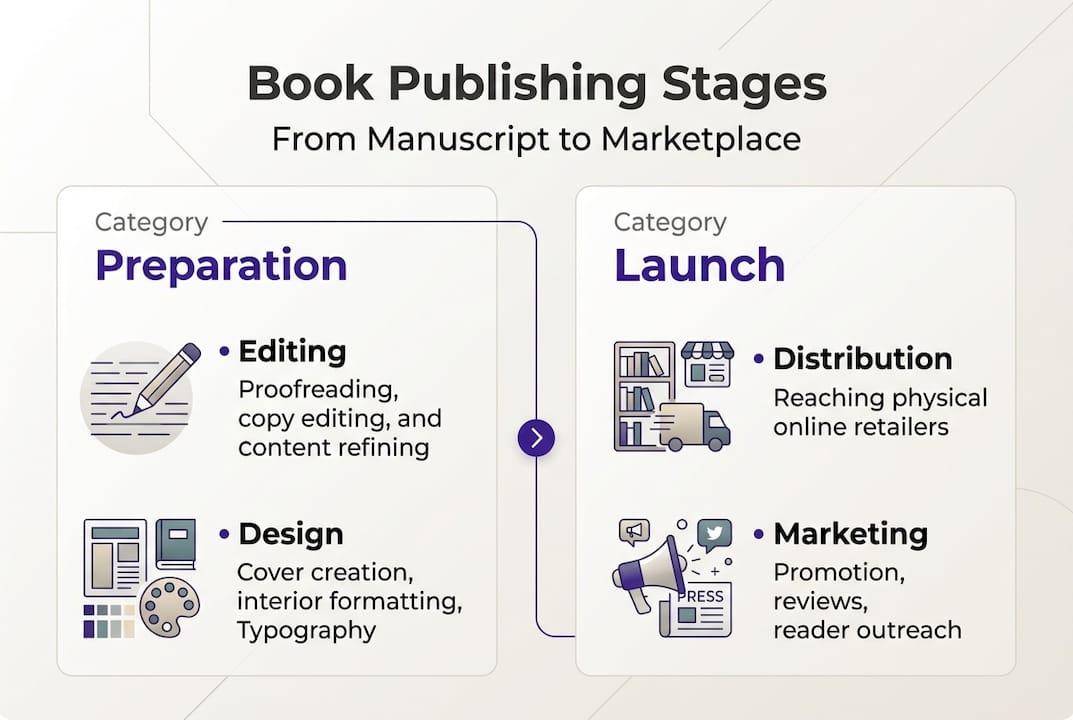
The core publishing stages include manuscript development and polishing, querying literary agents, acquisition and contract negotiation, multi-stage editing, cover and interior design, production and formatting, distribution setup including ISBN registration, and marketing and launch. Every stage feeds into the next, and skipping one creates problems downstream.
Here is what those stages cover at a high level:
- Manuscript development: Shaping the raw writing into a coherent, polished draft
- Editorial process: Developmental editing, line editing, copyediting, and proofreading
- Design and production: Cover art, interior layout, and file formatting for print and digital
- Distribution: Getting the book into catalogs, bookstores, libraries, and online platforms
- Marketing: Building awareness and driving readers toward purchase
"Publishing is not just about making books. It is about deciding which ideas enter public conversation and how those ideas are presented to the world."
This is why book publishing's cultural impact reaches far beyond commerce. The books that get published, and how they are packaged and distributed, shape what stories communities share and what knowledge gets passed down.
The stages of book publishing: From manuscript to marketplace
Now that you know publishing is more than printing, here is how the professional book journey usually unfolds. The sequence matters because each stage builds directly on the previous one.
- Manuscript development and polishing — The author refines the work, often with beta readers or a developmental editor
- Querying literary agents — For traditional publishing, authors pitch agents who then pitch publishers
- Acquisition and contract — A publisher offers a deal, rights are negotiated, and advances are set
- Multi-stage editing — Developmental, copy, and proofreading passes happen in sequence
- Cover and interior design — Visual identity is created to attract the target reader
- Production and formatting — Files are prepared for print and digital distribution
- Distribution setup — ISBN registration and platform placement happen here
- Marketing and launch — Publicity, reviews, and promotional campaigns drive discoverability
Self-publishing compresses some of these stages and shifts responsibility entirely onto the author. You still need editing, design, and distribution. You simply manage them yourself or hire freelancers. Hybrid presses blend elements of both models, sometimes offering services for a fee while providing some distribution support.
| Stage | Traditional | Self-Published |
|---|---|---|
| Editing | Publisher provides | Author hires freelancer |
| Design | Publisher handles | Author commissions |
| Distribution | Publisher's network | Author sets up via platforms |
| Marketing | Shared with publisher | Mostly author-driven |
| Cost to author | Usually none upfront | $2,000–$5,000+ |
Pro Tip: Even if you self-publish, treat every stage as non-negotiable. Authors who skip professional editing or proper distribution setup consistently struggle with sales and credibility, regardless of how strong the writing is. The connection between publishing and e-commerce is now tighter than ever, so discoverability online depends on getting those early stages right.
Traditional, self, and hybrid publishing: Comparing your options
Understanding the path is only part of the puzzle. Your choice of publishing model shapes your entire journey, from how much money you spend upfront to how much creative control you keep.
Traditional publishing means a publisher acquires your book, funds production, and distributes it through established retail channels. You receive an advance and earn royalties of 10–15% on print and 25% on ebooks. The tradeoff is lower earnings per copy and less control over cover design, pricing, and release timing.
Self-publishing puts you in charge of everything. You hire your own editor and designer, set up your own distribution, and keep royalties of 40–70% per sale. The financial risk is real. Professional self-publishing costs typically run $2,000–$5,000 for editing and design alone.

Hybrid and vanity presses occupy a middle ground. Hybrid presses charge fees that can exceed $10,000 and vary widely in legitimacy. Some offer genuine distribution and editorial support. Others are essentially paid printing services with inflated promises. Research any hybrid press carefully before signing.
| Model | Upfront cost | Royalty rate | Author control |
|---|---|---|---|
| Traditional | None | 10–25% | Low |
| Self-published | $2K–$5K+ | 40–70% | High |
| Hybrid | $10K+ | Varies | Medium |
- Traditional publishing offers prestige and established distribution networks
- Self-publishing gives you speed, flexibility, and higher per-unit earnings
- Hybrid models can work but require careful vetting of the publisher's track record
- Small presses often do not require a literary agent, making them accessible to debut authors
Pro Tip: Before choosing a model, ask yourself honestly how much time you can invest in marketing and business management. Traditional publishing offloads many tasks. Self-publishing multiplies them. The right choice depends on your goals, not just your royalty preference. Understanding publishing impact across models helps clarify what kind of reach you are aiming for.
Costs, rights, and royalties: What every author needs to know
Once you have chosen your model, it is critical to understand the financial realities and the legal terms that govern your book's life in the marketplace.
Here is a clear breakdown of what publishing costs and returns typically look like:
| Item | Traditional | Self-Published |
|---|---|---|
| Editing costs | Covered by publisher | $500–$3,000 |
| Cover design | Covered by publisher | $300–$1,500 |
| Advance (debut) | $5,000–$25,000 | None |
| Print royalty | 10–15% | 40–60% |
| Ebook royalty | 25% | 60–70% |
Debut author advances typically range from $5,000 to $25,000, but advances are recouped from future royalties before you see additional earnings. Many debut authors never earn past their advance, which makes understanding your contract essential.
For self-publishers, professional production costs of $2,000–$5,000 are realistic for a quality result. Cutting corners on editing or design almost always shows in reviews and sales.
Key legal concepts every author should understand:
- Copyright — You own your work from the moment it is created, but contracts can transfer or license specific rights
- Publishing rights — Your contract specifies territories (North America, world rights) and formats (print, digital, audio)
- Reversion clauses — These allow rights to return to you if the publisher lets the book go out of print
- Subsidiary rights — Film, translation, and merchandise rights can be retained or sold separately
"Your contract is not just a formality. It defines who controls your book, for how long, and in what formats. Read every clause."
If you are building a collection or selecting books for a library or school, understanding book acquisition steps and educational book selection criteria can help you make more informed choices.
Distribution and getting books in readers' hands
With costs and rights sorted, next comes the step that many authors underestimate: actually getting your book into the world. A finished book that no one can find or buy is not a published book. It is a document.
Books reach readers through a layered chain:
- Distributors — Companies like Ingram or Baker and Taylor supply bookstores and libraries at scale
- Retailers — Physical bookstores, online platforms like Amazon, and specialty shops
- Libraries — Require specific catalog listings and often purchase through library-focused distributors
- Digital platforms — Kindle Direct Publishing, Apple Books, Kobo, and others for ebook distribution
Distribution setup, including ISBN registration, is a core publishing stage, not an afterthought. Your ISBN links your book to its metadata: title, author, genre, price, and format. Without accurate metadata, your book becomes invisible to search algorithms and retail catalogs.
Marketing drives discoverability after publication. Reviews, author platforms, social media, and email lists all contribute. Indie authors face real distribution challenges because they lack the sales force and retail relationships that major publishers maintain.
Pro Tip: Register your book with multiple distribution channels simultaneously. Relying on a single platform limits your reach. A thoughtful holiday book selection or a niche title can find its audience through specialty retailers and bookstore alternatives that major platforms overlook.
An insider's view: Why publishing's complexity is essential
After seeing the full landscape, it is worth pausing on a question that many aspiring authors ask: does publishing really need to be this complicated?
The honest answer is yes, and here is why. Every layer of the publishing process exists to protect someone. Editing protects readers from unclear, inaccurate, or poorly structured content. Design protects the author's credibility by presenting their work professionally. Distribution systems protect booksellers and libraries by ensuring reliable supply chains. Contracts protect both parties when commercial relationships evolve.
Shortcuts feel appealing, especially when you are eager to share your work. But books that skip professional editing, proper design, or real distribution rarely find the audience they deserve. They get buried in search results, dismissed by reviewers, and ignored by libraries.
The rigor of the publishing process, though daunting, is what separates a book that influences people from a file that sits unread on a server. We have seen firsthand how well-curated, thoroughly prepared books enrich readers and communities in ways that rushed releases simply cannot. The publishing industry's evolution has made self-publishing more accessible, but it has not made quality optional.
Explore tools and support for your publishing journey
Whether you are writing your first manuscript, curating a library collection, or simply trying to understand the books you love, knowing the full publishing process changes how you engage with literature.

At Munkter Products, we combine a passion for storytelling with a carefully selected catalog of books, journals, and creative stationery that reflects the craft behind every published page. From children's educational titles to science fiction novels and self-help journals, our collection is built with the same attention to quality that the publishing process demands. If you want to learn more about publishing and how it shapes the books worth reading, our blog is a great place to start.
Frequently asked questions
What does a book publisher actually do?
A book publisher oversees editing, production, design, distribution, and marketing of a manuscript to turn it into a market-ready book available through retail and library channels.
How much can new authors earn from publishing a book?
Debut authors in traditional publishing may earn advances of $5,000–$25,000, with royalties that vary significantly depending on the publishing model and contract terms.
What are the main costs involved in publishing a book?
Self-publishing professionals typically spend $2,000–$5,000 on editing and design, while hybrid publishing arrangements can cost over $10,000 depending on the services included.
Is self-publishing a good alternative to traditional publishing?
Self-publishing offers greater creative control and higher royalty rates, but it requires the author to manage and fund every stage of production, distribution, and marketing independently.