

TL;DR:
- Building literary confidence enhances children's reading, writing, and overall learning abilities.
- Fostering belief in literacy through low-pressure practice and positive reinforcement drives academic success.
Literary confidence is the belief that you can read, understand, and express ideas through writing, and self-confidence influences essay writing achievement by up to 38.5%. That single statistic tells parents and educators everything they need to know about why promote literary confidence matters as a priority, not an afterthought. Children who believe in their own literacy skills read more, write more willingly, and perform better across every subject. The NAEP and the Child Mind Institute both point to confidence as a core driver of literacy outcomes, yet most classroom strategies still focus on skill drills over belief-building.
Why promote literary confidence in children's development
Literary confidence, known in educational research as reading self-efficacy, is the conviction that effort in literacy tasks will produce results. Children who hold this belief approach books and writing assignments with persistence rather than avoidance. Those who lack it shut down at the first sign of difficulty, creating a cycle that widens the gap between strong and struggling readers.
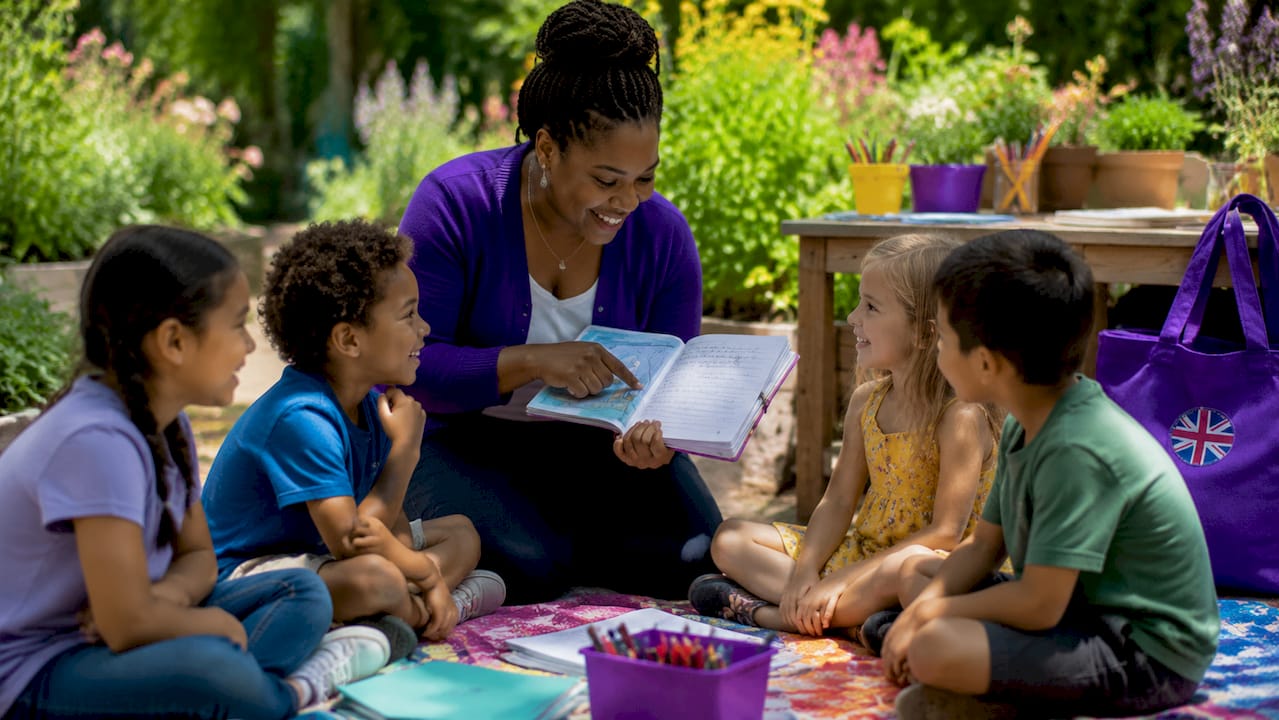
The numbers confirm the urgency. Only 31% of fourth-grade students scored proficient or above in reading on the 2024 NAEP report. That means roughly two out of three American fourth graders are not reading at grade level. Low reading confidence is both a cause and a result of that gap, which is why addressing belief comes before addressing skill.
Reading self-efficacy also predicts behavior beyond the classroom. Children who feel capable as readers choose books voluntarily, practice more, and build vocabulary faster than peers who avoid reading out of fear. Confidence is the engine; skill is the fuel it burns.
How does literary confidence impact cognitive and academic development?
Regular reading does more than teach words. Childhood reading strengthens neural networks linked to reasoning and behavioral control, and its developmental impact often outweighs that of parental educational background. That finding should reframe how parents and educators think about reading time. It is not a supplement to development. It is a primary driver of it.
"Reading is much more than a pastime for children and teens. It actively shapes the brain structures responsible for focus, empathy, and logical thinking." — The Conversation
The cognitive benefits extend across every subject. Effective reading comprehension instruction builds critical thinking, memory, and problem-solving skills that children carry into math, science, and history classrooms. A child who reads confidently is not just a better reader. They are a better learner overall.
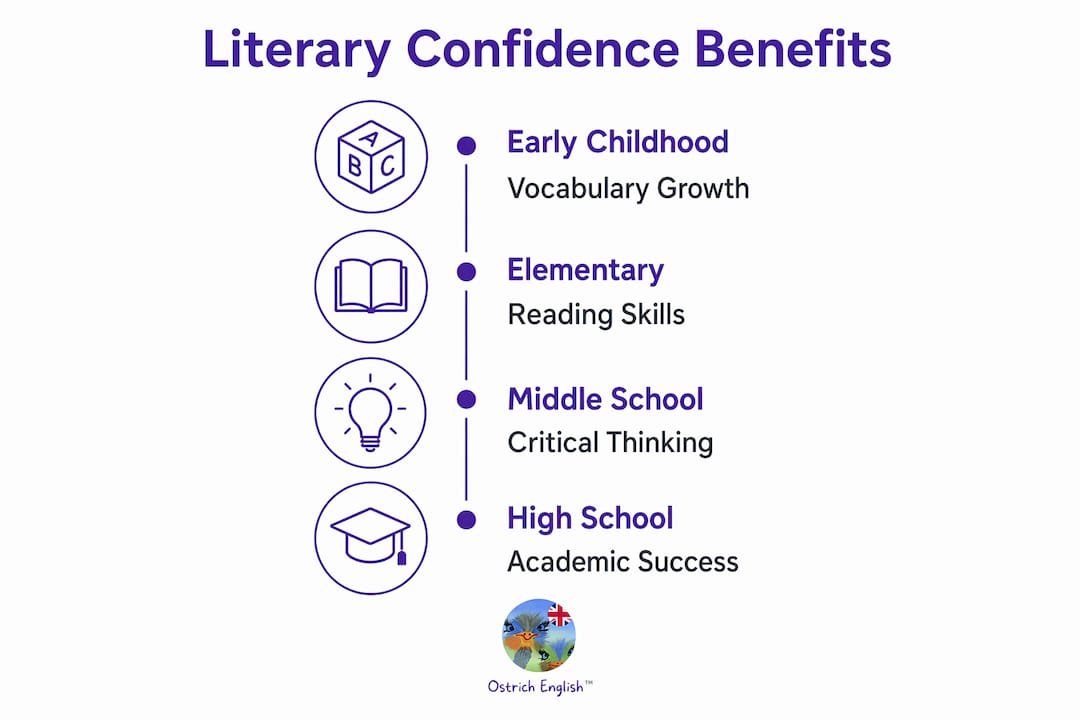
Cognitive benefits by developmental stage
| Stage | Key benefit | What it means in practice |
|---|---|---|
| Early childhood (ages 3–6) | Vocabulary acquisition | Children exposed to books learn words not found in everyday conversation |
| Middle childhood (ages 7–10) | Neural network strengthening | Reading builds reasoning and focus circuits in the developing brain |
| Pre-adolescence (ages 11–13) | Critical thinking | Comprehension tasks train children to analyze, infer, and evaluate |
| Adolescence (ages 14–17) | Behavioral regulation | Sustained reading practice supports impulse control and emotional management |
Each stage builds on the last. A child who misses early reading confidence struggles to access the deeper cognitive gains that come later.
What are effective strategies parents and educators can use?
Building literary confidence requires consistent, low-pressure practice. The following strategies are grounded in research and work in both home and classroom settings.
-
Read aloud early and often. Reading aloud before children can speak builds vocabulary and exposes them to complex sentence structures they would never encounter in daily conversation. Start before age one. The Child Mind Institute confirms that early read-aloud sessions lay the neural groundwork for later reading success.
-
Celebrate small writing wins. Small writing achievements build sustainable confidence through neurological proof of capability. Ask a child to finish one paragraph, not a full essay. Completion creates evidence that they can do it, and that evidence is what confidence is made of.
-
Create low-stakes writing environments. Low-stakes creative environments reduce fear of judgment and help children trust their own creative instincts. Remove grades from early drafts. Let children write in journals without correction. Fear of red ink kills more writing voices than lack of skill ever does.
-
Give children choice in what they read and write. A child who picks their own book reads longer and with more focus than one assigned a text they dislike. Personal interest is the fastest path to building reader's confidence in reluctant readers.
-
Use structured reading routines. Consistent daily reading, even for 15 minutes, builds the habit loop that makes literacy feel normal rather than effortful. Predictable routines lower resistance and increase the total hours of practice a child accumulates over a school year.
Pro Tip: Keep a "writing wins" jar in the classroom or at home. Each time a child completes a piece of writing, they add a slip of paper naming what they finished. Seeing the jar fill up gives children visible proof of their growing capability.
Why does focusing on clarity rather than perfection enhance literary confidence?
Perfectionism is the single biggest threat to developing writing self-esteem in children. When children believe their writing must be flawless before it is worth sharing, they stop writing altogether. The solution is to shift the goal from perfection to clarity.
Clarity in expression helps children approach writing as an objective task rather than a measure of their self-worth. When the question changes from "Is this good enough?" to "Does this say what I mean?", writing becomes a problem to solve rather than a judgment to survive.
- Teach children that a first draft is a thinking tool, not a finished product.
- Normalize the phrase "ugly first draft" so children expect imperfection and move through it.
- Encourage "writing without permission," meaning writing without waiting to feel ready or confident first.
- Separate the drafting stage from the editing stage so children do not self-edit before they have finished a thought.
Confidence follows courageous action, not the other way around. Children do not become confident writers by waiting until they feel confident. They become confident by writing badly, finishing anyway, and discovering they survived it.
Pro Tip: Tell children: "Your job in a first draft is to get it wrong on paper so you can fix it later." This reframe removes the pressure to perform and replaces it with permission to think.
What are common challenges in promoting literary confidence?
The inner critic is the most persistent obstacle parents and educators face when encouraging creative expression in children. It shows up as "I'm not a good writer," "I don't know what to say," and "My ideas are stupid." Left unchecked, it shuts down literacy engagement faster than any skill gap.
- Negative self-talk often reflects a child's fear of being judged, not an accurate assessment of their ability. Reframe it directly: "That thought means you care about doing well. That's a good sign."
- Low motivation usually signals that tasks feel too large or too high-stakes. Break assignments into smaller steps and remove the grade from early attempts.
- Avoidance behaviors like "forgetting" to read or write are confidence problems, not laziness. Consistent encouragement and achievable goals address the root cause.
"Confidence is accumulated through many small achievements rather than innate talent." — Author's Pathway
Adults play a decisive role here. A single dismissive comment about a child's writing can set back their confidence by weeks. Specific, honest praise, such as "I liked how you described the color of the sky in that sentence," builds far more than generic encouragement like "Good job."
Which literacy products and routines support literary confidence at home?
The right materials make daily literacy practice easier to sustain. Parents and educators who build reading routines around confidence-themed books and guided writing tools see stronger engagement than those who rely on assigned texts alone.
Family reading sessions create shared experiences that normalize reading as a pleasurable activity rather than a chore. When children see adults reading for enjoyment, they internalize reading as a valued behavior. Structured sessions, even short ones, produce more consistent results than unscheduled reading time.
Educational books that connect literacy with self-esteem are particularly effective for children who already feel behind. Confidence-themed books build real self-esteem by giving children characters who struggle and persist, which mirrors their own experience and makes the act of reading feel personally relevant.
| Resource type | Best for | Key benefit |
|---|---|---|
| Confidence-themed picture books | Ages 4–8 | Builds identity as a reader through relatable characters |
| Guided reading journals | Ages 8–14 | Structures reflection and builds writing self-esteem |
| Family read-aloud sessions | All ages | Normalizes literacy as a shared, enjoyable activity |
| Educational activity books | Ages 5–12 | Combines skill practice with low-stakes creative play |
Routine matters as much as the resource. A good book used inconsistently produces less growth than a simple journal used every day.
Key takeaways
Literary confidence is the single most underinvested factor in children's reading and writing success, and building it requires consistent low-stakes practice, adult encouragement, and a shift from perfection to clarity.
| Point | Details |
|---|---|
| Confidence drives achievement | Self-confidence influences essay writing achievement by up to 38.5%, making it a measurable academic factor. |
| Reading shapes the brain | Regular childhood reading strengthens neural networks for reasoning and focus, often more than parental education does. |
| Small wins build belief | Completing short writing tasks creates neurological proof of capability that sustains long-term confidence. |
| Clarity beats perfection | Teaching children to aim for clear expression removes the fear of failure that blocks creative writing. |
| Routine and resources matter | Consistent reading sessions and confidence-themed materials produce stronger engagement than sporadic skill drills. |
What I've learned from watching literary confidence grow
I have watched children transform their relationship with reading and writing, and the change rarely starts with a skill. It starts with a moment when an adult says, "That sentence you wrote was really specific. I could picture it." That one comment does more than a month of grammar worksheets.
The mistake I see most often is adults waiting for a child to feel confident before giving them harder tasks. That is backwards. Confidence comes from doing the hard thing and surviving it. The child who writes a terrible first paragraph and gets praised for finishing it will write a better second paragraph. The child who is told to wait until they are ready may never start.
The other trap is treating literary confidence as a soft skill, something nice to have but secondary to phonics or grammar instruction. The research does not support that view. A child who cannot decode words needs phonics instruction. A child who can decode but refuses to read needs confidence work first. Skill without belief produces children who can read but choose not to.
My practical advice: prioritize completion over quality in early drafts, read aloud together at least three times a week, and let children pick their own books at least half the time. These three habits, done consistently, produce more confident readers and writers than any single curriculum or program.
— Mark
Munkterproducts resources for building literary confidence
Parents and educators who want to put these strategies into practice immediately will find a strong starting point at Munkterproducts.

Munkterproducts offers a curated range of children's educational books and confidence-themed activity materials designed to make daily literacy practice engaging rather than pressured. From guided journals that build writing self-esteem to educational activity books that combine skill practice with creative play, the catalog is built around the same principles covered in this article. Products ship with postage included, and the range covers children and adults alike, making it easy to build a whole-family reading culture at home.
FAQ
What is literary confidence and why does it matter?
Literary confidence is the belief that you can read, understand, and express ideas through writing. It matters because self-confidence influences essay writing achievement by up to 38.5%, making it a direct driver of academic outcomes.
How can parents build reading confidence at home?
Reading aloud daily, celebrating small writing completions, and letting children choose their own books are the three most effective home strategies. Consistent low-stakes practice builds belief faster than corrective feedback alone.
What role does the inner critic play in writing confidence?
The inner critic creates avoidance behaviors that prevent children from practicing writing. Reframing doubt as a sign of caring rather than failure, and normalizing imperfect first drafts, reduces its impact significantly.
Does reading confidence affect subjects other than English?
Reading comprehension skills build critical thinking, memory, and problem-solving that children apply across math, science, and history. A confident reader is a stronger learner in every subject.
At what age should parents start building literary confidence?
The Child Mind Institute confirms that reading aloud before children can speak builds vocabulary and neural pathways critical for later literacy. Starting before age one produces measurable developmental benefits.