

How to support indie authors right now
The fastest way to make a real difference is to act on several fronts at once. Buying a book, leaving a review, and sharing a post each do something distinct for an author's career. Here is a practical list of what actually moves the needle:
- Buy directly from the author or an indie bookstore. Purchasing directly lets authors keep a much larger share of earnings than major retail platforms typically provide. Platforms like Bookshop.org split profits so local stores earn about 30% of the list price while authors still receive royalties.
- Request indie books at your local library. Libraries take reader requests seriously. When a library purchases a title, the author earns a sale, and future browsers can discover the book for free.
- Write and post reviews on Amazon and Goodreads. Even two sentences count. Reviews drive Amazon's recommendation algorithms, pushing indie titles into search results, "also bought" lists, and curated recommendations.
- Promote indie authors on social media. BookTok and Bookstagram have become genuine discovery engines. Social media buzz can put an indie book in front of thousands of potential readers overnight.
- Attend indie author events and book signings. A full room signals to venues that indie authors draw audiences, making it easier for those authors to book future events.
- Give indie books as gifts. Every gifted copy is a new reader who might review, recommend, or buy the next book in the series.
- Support indie author merchandise. Bookmarks, stickers, and tote bags spread awareness in the physical world, putting an author's name in front of people who have never heard of them.
- Include indie books in book clubs or reading groups. When a book club commits to a title, multiple people buy it at once, creating a small but real sales spike that can lift a book's ranking.
- Keep indie books visible. Carry one to a coffee shop, display it on your shelf, or post an unboxing photo. Curious strangers notice covers, and that curiosity sometimes converts to a purchase.
- Read indie books on Kindle Unlimited all the way through. Authors enrolled in KDP Select earn royalties based on pages read, so finishing the book directly increases their income.
Pro Tip: When you request a title at your library, include the author's name and ISBN. That specificity makes it far easier for the librarian to place the order quickly.
Why indie authors need your support to survive and thrive
Independent authors operate without the financial cushion or distribution muscle of the Big Five publishers (Penguin Random House, HarperCollins, Simon & Schuster, Hachette, and Macmillan). That structural gap shapes everything about how they work and why reader support is so consequential.

What "indie author" actually means
An indie author self-publishes or works with a small press, retaining creative and business control over every decision. They choose their cover, set their price, pick their distribution channels, and own their rights permanently. Traditional publishers, by contrast, control cover design, pricing, and release schedules while keeping 85–90% of revenue. The tradeoff is real: traditional publishing offers editorial support and bookstore placement, but the author gives up most of the financial upside and creative authority.
The challenges indie authors face
The freedom of independent publishing comes with a steep workload. Indie authors write the manuscript, hire and pay for editing and cover design, handle all marketing, and build their readership from scratch. Reader purchases directly finance those professional services, so every sale is not just income; it is the budget for the next book's quality. Without a publisher absorbing those costs, an author who cannot sell enough copies simply cannot afford to keep publishing at a professional level.
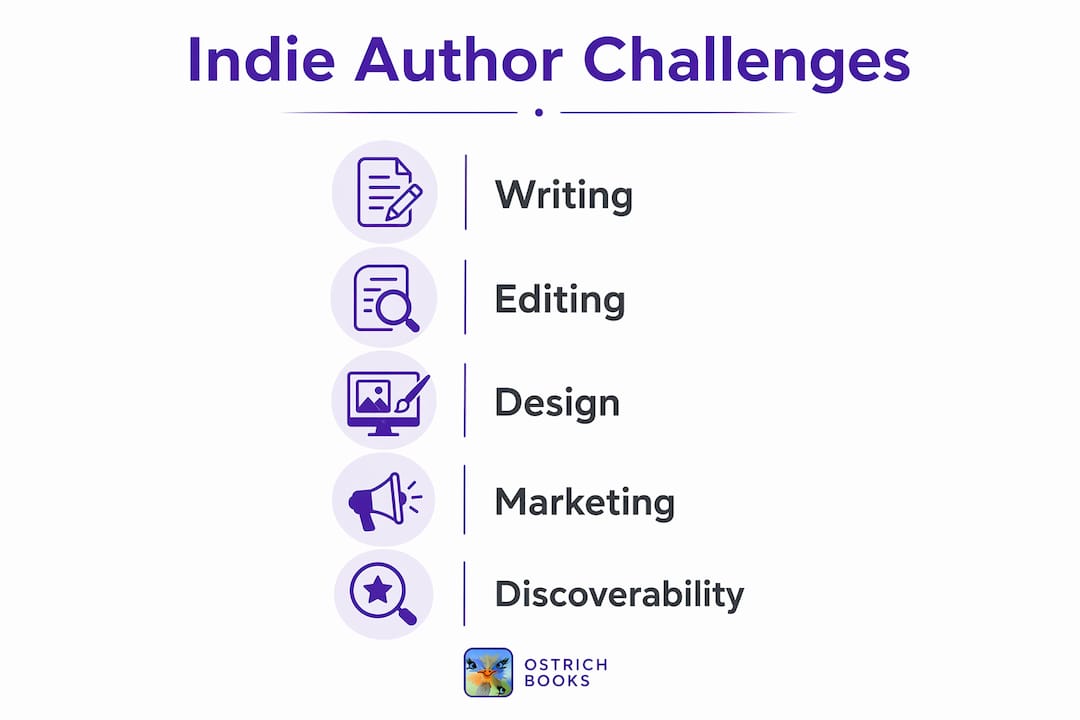
Discoverability is the other wall. Thousands of new titles appear on Amazon every day. Without algorithmic momentum or a publisher's marketing team, an indie book can vanish into the catalog before most readers ever see it. That is why each individual action from readers, whether a purchase, a review, or a social share, carries disproportionate weight.
What supporting indie authors does for literature
Indie publishing is where literary risk-taking actually happens. Traditional publishers tend to favor proven formulas and commercially safe bets. Indie authors freely experiment with unconventional structures, niche genres, underrepresented cultures, and bold ideas that a committee would reject. Supporting them keeps those voices funded and productive. The importance of indie publishing extends beyond any single book: it sustains the diversity and creative range of the entire literary ecosystem.
Modern indie authors also treat their readers as genuine partners. They own their contact lists, build direct communities, and adapt quickly when platforms shift. That reader-author relationship is something traditional publishing rarely enables, and it makes the support you give feel personal in a way that buying a bestseller from a major house simply does not.
How reviews and social proof shape an indie author's career
Reviews are the single most leveraged action a reader can take. They cost nothing and take five minutes, yet their effect on an author's visibility compounds over time.

Why algorithms reward reviewed books
Amazon's recommendation engine weighs review count and recency heavily when deciding which books to surface in search results, "customers also bought" carousels, and email recommendations. An indie title with 25 or more reviews becomes eligible for promotion on book discovery platforms like BookBub, which can expose it to hundreds of thousands of readers at once. Below that threshold, the algorithm largely ignores the book. That is not a minor inconvenience; it is the difference between a book that sells and one that stagnates.
Goodreads operates similarly. Readers use it to decide what to read next, and a book with active ratings and written reviews signals credibility. Positive Goodreads activity feeds word-of-mouth recommendations, book club selections, and organic discovery in a community that skews toward exactly the kind of engaged reader indie authors need.
The economic chain that reviews set in motion
A single honest review does more for an indie author's long-term income than almost any other free action a reader can take.
When reviews lift a book's visibility, sales follow. Those sales fund the editing, cover design, and marketing for the author's next release. Indie authors earn per-book royalties that are 3–7 times higher than those of traditionally published authors, which means each incremental sale genuinely moves the needle on their ability to keep writing professionally. A review is not just a compliment; it is a catalyst for that entire chain.
How to write a review that actually helps
You do not need to write a literary essay. A few specific sentences work better than vague praise.
- Name one thing you loved: a character, a plot twist, a writing style.
- Mention who else might enjoy the book ("fans of cozy mysteries" or "anyone who loved The Martian").
- Post it on both Amazon and Goodreads if you can; the two platforms serve different discovery audiences.
- Star ratings with no text still count on Goodreads and help the book's overall score.
Social media amplifies reviews further. Sharing a post on BookTok or Bookstagram, tagging the author, and using relevant hashtags puts the book in front of readers who trust peer recommendations far more than any ad. Word of mouth remains the most effective form of book marketing, and you are the one who can generate it.
Munkterproducts brings indie literary creativity to your bookshelf

If you want to support independent literary creativity beyond buying a single novel, Munkterproducts offers a different kind of entry point. The store carries handcrafted and curated books, journals, puzzles, coloring books, and novelty stationery, all designed for readers who value creative, artisanal printed materials over mass-produced alternatives. Products range from children's educational activity books and holiday titles to adult coloring books, self-help journals, and the science fiction "Noah" series, giving you a wide range of gifts that directly support independent creative work.
Buying from Munkterproducts puts money into the hands of independent creators rather than large publishing conglomerates, and the straightforward purchasing process allows creators to retain a significant share of earnings from each sale. Whether you are looking for a thoughtful literary gift for a book lover or a creative journal for yourself, each purchase contributes to the kind of indie literary ecosystem this article is about. Explore the full catalog at Munkterproducts.com and find something worth giving.
Key Takeaways
Supporting indie authors through purchases, reviews, and social sharing creates a compounding effect that funds better books, raises visibility, and sustains literary diversity.
| Point | Details |
|---|---|
| Buy direct for maximum impact | Purchasing directly from authors or indie bookstores enables authors to retain up to 70% to nearly 100% of the earnings from each sale, avoiding third-party platform fees. |
| Reviews unlock algorithmic reach | Books with a sufficient number of reviews gain eligibility for promotion platforms like BookBub and rank higher in Amazon search. |
| Royalty advantage is real | Indie authors earn per-book royalties substantially higher than traditionally published authors, so each sale matters more. |
| Social sharing drives discovery | BookTok and Bookstagram recommendations reach thousands of potential readers and remain the most trusted form of book marketing. |
| Munkterproducts supports indie creativity | Munkterproducts offers handcrafted books, journals, and literary gifts that put spending directly into independent creative work. |