

TL;DR:
- Joining book fandoms transforms solitary reading into a shared, participatory experience that deepens understanding and boosts enjoyment. These communities foster creative expression, critical thinking, and meaningful social bonds, making reading more engaging and reflective of personal growth. Starting with small, familiar steps allows readers of all ages to overcome barriers and discover lasting benefits in connected storytelling.
Most readers treat books as a private pleasure, something enjoyed alone with a cup of coffee and a quiet room. Yet only 7% of U.S. adults have participated in a book club in the past year, which means the vast majority of book lovers are missing an entire layer of the reading experience. Fandoms, those passionate, creative, and deeply social communities built around beloved books and series, offer something a solo read simply cannot: the electric feeling of sharing a story with people who love it just as much as you do. This article explores exactly how joining a book fandom can transform your reading life from a quiet habit into a rich, ongoing adventure.
Table of Contents
- What is a book fandom and why it matters
- How book fandoms turn solitary reading into shared joy
- Choosing your ideal fandom space: From passive to creative engagement
- Overcoming barriers: Making fandoms accessible for all ages
- Our perspective: Why joining book fandoms transforms reading for you
- Discover more and join the community
- Frequently asked questions
Key Takeaways
| Point | Details |
|---|---|
| Collective experience | Book fandoms transform solitary reading into shared discussion, bonding, and creativity. |
| Emotional connection | Fandoms foster emotional engagement with books and connect you to passionate communities. |
| Accessible for all | Any reader—regardless of age or experience—can join and benefit from book fandoms. |
| Flexible participation | Fandom spaces offer passive or active roles, so you control your level of engagement. |
What is a book fandom and why it matters
The word "fandom" gets thrown around a lot, but it means something specific and genuinely exciting. A book fandom is not simply a group of people who enjoyed the same novel. It is a living, breathing social ecosystem built around a shared text, character, or author. To understand why this matters, it helps to separate two related ideas: fanship and fandom.
Fanship is the individual attachment you feel toward a book. It is that private thrill when a plot twist lands perfectly, or the quiet sadness when a beloved series ends. Fandom, by contrast, is what happens when that attachment goes social. Media scholar Henry Jenkins distinguishes fanship from fandom by noting that fandom includes shared rituals, critique, creativity, and community, and functions as a collective arena where people can "speak together" and even "speak back to power." That is a meaningful distinction. It means fandom is not passive. It is participatory, creative, and often transformative.
When you step into a book fandom, you are joining a space where readers debate character motivations, write fan fiction, design fan art, organize read-alongs, and celebrate publication anniversaries as if they were holidays. These shared rituals deepen your connection to the text in ways that solitary reading simply cannot replicate. The publishing and cultural impact of fandoms is also significant, influencing everything from author careers to sequel decisions.
Here is a quick comparison of what separates fandom from more casual engagement:
| Feature | Casual reader | Fandom participant |
|---|---|---|
| Engagement type | Solo, private | Collective, social |
| Discussion | Rare or informal | Regular, structured |
| Creative output | None | Fan fiction, art, reviews |
| Emotional investment | Personal | Shared and amplified |
| Community rituals | Absent | Read-alongs, anniversaries |
| Influence on culture | Minimal | Measurable and documented |
Beyond the table, fandom participation typically involves several distinct activities:
- Discussion threads where readers analyze plot, theme, and character in real time
- Fan fiction archives where community members extend or reimagine beloved stories
- Social media communities on platforms like Tumblr, Reddit, and Discord
- Live events such as author signings, conventions, and virtual book launches
- Creative challenges including fan art contests and themed reading sprints
"Fandom is not just about loving a book. It is about building something together around that love." This idea captures why deepening reading habits through community participation is so rewarding.
How book fandoms turn solitary reading into shared joy
Reading a book alone is wonderful. Reading it alongside a community of passionate fans is something else entirely. When you participate in a fandom, the text itself becomes richer because other readers reveal angles you never noticed, challenge interpretations you took for granted, and celebrate moments you thought only you cared about.
Research backs this up in a compelling way. A study examining fan communities on Archive of Our Own (AO3) found that commenting strengthens community ties and identifies emotion-related discourses in fandom reception. In plain terms, the act of leaving a comment or responding to one is not trivial. It is a social bond being formed in real time. The same research confirms that discussion and critique within fandoms can enhance enjoyment and even shift how you process the text itself.
Think about what this means practically. You finish a chapter feeling confused about a character's choice. You post your reaction in a fandom forum. Within hours, three other readers have offered interpretations you never considered, one of which suddenly makes the entire subplot click into place. That is not just discussion. That is collaborative reading, and it genuinely changes the experience.
Here is a look at how different types of fandom participation affect the reading experience:
| Participation type | Emotional benefit | Cognitive benefit |
|---|---|---|
| Reading fan discussions | Validation, belonging | New interpretations |
| Leaving comments | Connection, expression | Articulating thoughts |
| Writing fan fiction | Creativity, confidence | Deep text analysis |
| Joining read-alongs | Accountability, fun | Structured engagement |
| Attending fan events | Excitement, friendship | Cultural awareness |
To get the most out of fandom participation, especially if you are new, consider these steps:
- Start by reading, not posting. Spend a week or two reading existing discussions to understand the community's tone and interests before jumping in.
- React to something specific. A comment like "I loved how the author handled grief in chapter seven" invites more meaningful responses than a generic "great book."
- Join a read-along event. These structured community reads give you built-in conversation partners and a shared timeline.
- Respond to others' posts. Engagement is a two-way street. Replying to someone else's analysis builds relationships faster than posting alone.
- Celebrate the small moments. Fan communities love enthusiasm. Sharing a favorite quote or a scene that moved you is always welcome.
Pro Tip: If you are exploring book clubs and family traditions with younger readers, fandom participation can be a wonderful bridge. Many young readers already engage with fandoms around their favorite series, and joining them in that space strengthens both your bond and their reading confidence. Fandoms also connect naturally to books and self-improvement, since discussing what a story means to you is itself a reflective, growth-oriented practice.
Choosing your ideal fandom space: From passive to creative engagement
One of the biggest misconceptions about book fandoms is that you have to be deeply involved to belong. The truth is that fandom participation exists on a wide spectrum, from quietly reading fan discussions to actively writing fan fiction or organizing community events. There is a place for every level of engagement, and knowing where you fit makes the experience far more enjoyable.
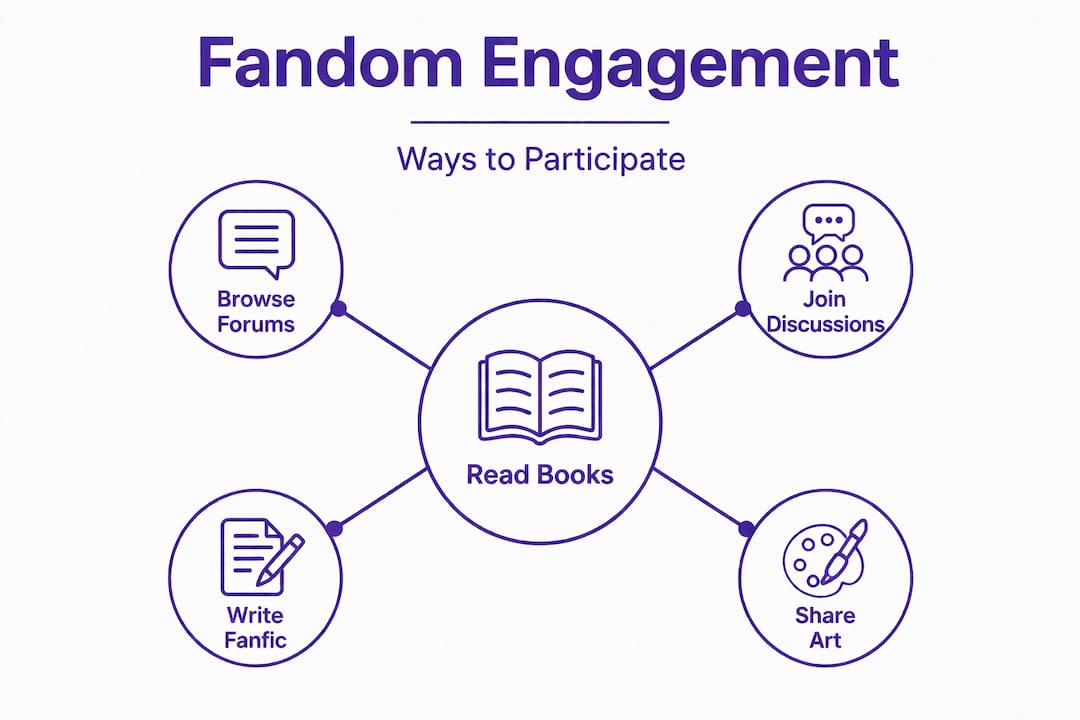
Jenkins's framework treats fandom as collective participation with rituals and practices, which means that if your expectation is only occasional consumption, some fandom norms may feel intense. That is completely fine. The key is choosing a community whose culture matches your comfort level.
Here is a breakdown of fandom spaces by engagement level:
- Low engagement: Reddit "r/books" threads, Goodreads shelves and reviews, author newsletters with comment sections
- Medium engagement: Discord servers with dedicated channels, Facebook reading groups, Twitter/X book communities using hashtags like #BookTok or #AmReading
- High engagement: Archive of Our Own (AO3) for fan fiction, fan wikis, convention communities, and author-moderated fan groups
- Creative engagement: Fan art communities on DeviantArt or Instagram, collaborative fan fiction projects, and themed zine publications
When evaluating a fandom space, ask yourself a few honest questions. How much time can you realistically give each week? Are you looking for intellectual discussion, emotional support, creative inspiration, or just a place to share excitement? Do you prefer text-based communities or do you enjoy video discussions and live chats?
Pro Tip: If you are building a sci-fi book collection and want to find fandom communities around those titles, start with the author's official website or social media pages. Most authors of popular sci-fi series actively cultivate fan communities and can point you toward trusted, well-moderated spaces. Fandom participation also connects to books and wellness benefits, since being part of a supportive reading community reduces isolation and boosts mood in measurable ways.
The most important thing is to start somewhere. Even reading one fan discussion thread after finishing a book chapter is a form of fandom participation, and it often sparks curiosity for deeper involvement over time.
Overcoming barriers: Making fandoms accessible for all ages
If you have never joined a book fandom, you are far from alone. As noted earlier, only 7% of U.S. adults report participating in book clubs, and formal fandom participation is even rarer. The reasons people hold back are understandable: social anxiety, unfamiliarity with online platforms, uncertainty about whether they belong, and sometimes just not knowing where to start.

Younger readers face different barriers. They may feel intimidated by older or more experienced fans, worry about saying something "wrong," or struggle to find communities focused on the specific genres they love. Older readers sometimes feel that fandoms are exclusively for younger generations, which is simply not true.
Here is a practical, step-by-step approach to overcoming the most common barriers:
- Acknowledge the hesitation without letting it stop you. Almost every fandom member felt uncertain at first. The community grew because people pushed past that feeling.
- Choose a low-stakes entry point. Liking a post, upvoting a comment, or adding a book to a public Goodreads shelf counts as participation. You do not have to write an essay on day one.
- Look for age-specific communities. Many fandoms have sub-groups organized by age, interest, or reading pace. Searching for "adult readers of [series name]" or "young adult fandom for [book title]" often surfaces the right fit.
- Use familiar platforms first. If you already use Facebook, start with a Facebook reading group. If you are comfortable on Instagram, follow book-focused accounts. There is no rule that says you must use a platform you find confusing.
- Give it thirty days. Fandom communities reward consistency. Showing up regularly, even just to read, builds familiarity and makes participation feel natural.
"The best time to join a book fandom was the day you finished your favorite novel. The second best time is today."
For younger readers, interactive books for kids can serve as a perfect gateway. Books that invite participation through puzzles, activities, or questions naturally prepare young readers for the collaborative mindset that fandoms reward. Parents and caregivers can use these books as conversation starters, modeling the kind of engaged, curious discussion that fandom communities celebrate.
It is also worth noting that fandoms are not monolithic. Some are intensely passionate and fast-moving. Others are quiet, thoughtful spaces where a single post might spark a week-long conversation. Finding the right pace matters as much as finding the right genre.
Our perspective: Why joining book fandoms transforms reading for you
Here is something that most articles about book fandoms will not tell you directly: the real value of fandom is not what you receive from the community. It is what you discover about yourself as a reader.
When you articulate why a character's decision moved you, or why a plot twist felt earned rather than cheap, you are doing something remarkable. You are developing your own critical voice. Most readers never do this because they never have to. They finish a book, feel something, and move on. Fandom participation forces you to put that feeling into words, and that process is genuinely transformative.
We have seen this pattern repeatedly in the book-loving communities we engage with through book publishing and e-commerce. Readers who participate in fandoms consistently report that they read more carefully, remember books more vividly, and feel more confident recommending titles to others. That is not coincidence. It is the direct result of having to think out loud about what they read.
There is also something worth saying about creative engagement specifically. Writing fan fiction, designing fan art, or even just crafting a detailed review is not a lesser form of creativity. It is a genuine creative practice that develops skills applicable far beyond the fandom itself. Many professional authors, editors, and designers point to their fandom years as the period when they first found their creative voice.
The uncomfortable truth is that staying a solitary reader, while comfortable, keeps a ceiling on how deeply you can engage with stories. Fandoms remove that ceiling. They challenge you, surprise you, and occasionally frustrate you, but they never let the story feel finished. And for anyone who has ever closed a book and wished the world inside it could keep going, that is a genuinely powerful thing.
Discover more and join the community
Exploring book fandoms is one of the most rewarding steps you can take as a reader, and having the right tools and resources makes that journey even richer.

At Munkter Products, we create and curate books, journals, activity books, and creative stationery designed to spark exactly the kind of engaged, imaginative reading that fandoms celebrate. Whether you are looking for a beautifully crafted journal to record your reading reactions, an activity book to share with a young fan in your life, or a novel like the Noah series to dive into with a new community, we have something that fits your fandom journey. Our activity book creation guide is a great place to start if you want to bring younger readers into the fold. Visit munkterproducts.com to explore the full collection and find your next favorite read.
Frequently asked questions
What is the difference between book fandom and a book club?
Book fandom is a wider social space built around shared rituals and creativity, where fans discuss, create, and celebrate collectively, while a book club is a smaller, more structured group focused on reading and discussing assigned titles on a set schedule.
How can I participate in book fandoms without being active all the time?
Many fandom spaces welcome passive members who simply read discussions or react occasionally. Since fandom norms can feel intense for occasional participants, the best approach is to choose a community whose pace and expectations match your preferred level of involvement.
Do book fandoms offer benefits for younger and older readers?
Yes, book fandoms can be tailored to any age group, with communities ranging from young adult series fandoms to literary fiction discussion spaces, making reading more engaging and socially rewarding for everyone involved.
Is joining a book fandom online safe and supportive?
Most established online fandoms maintain moderated, supportive environments, but you should always review a community's guidelines before joining and start with well-known platforms like Goodreads, Reddit, or official author-run groups for the most reliable experience.