

TL;DR:
- Self-publishing requires careful preparation, understanding costs, legal requirements, and trustworthy service providers before starting.
- Following a structured, risk-aware process from drafting to promotion increases the chances of success while avoiding scams and common pitfalls.
Self-publishing sounds liberating until you're three browser tabs deep into conflicting advice, wondering if that "publishing package" email you just received is a scam or a shortcut. The reality is that thousands of aspiring authors lose money, time, and confidence every year by skipping the foundational steps or trusting the wrong people. The good news is that self-publishing can absolutely work in your favor when you follow a clear, risk-aware process. This guide walks you through every stage, from preparation to promotion, with the expert-backed detail you need to move forward with confidence.
Table of Contents
- What you need before you start: Preparation and safeguards
- Step-by-step process for self-publishing your book
- Getting noticed: Promotion and support resources for self-published authors
- Common pitfalls and how to verify your process
- What most self-publishing guides miss: Efficiency, risk, and real-world outcomes
- Ready to publish? Get the tools and support you need
- Frequently asked questions
Key Takeaways
| Point | Details |
|---|---|
| Protect yourself from scams | Vet all service providers and never pay upfront fees for manuscript reviews. |
| Follow a clear step-by-step process | Move systematically from manuscript to marketing using trusted resources and automation when possible. |
| Use reliable support networks | Leverage directories and checklists from trusted organizations to maximize your book’s reach. |
| Automation boosts efficiency | Streamline repetitive tasks to save time and reduce errors with industry automation tools. |
What you need before you start: Preparation and safeguards
Now that you understand the need for a clear roadmap, let's talk about what you must have in place before diving into the self-publishing journey.
Before you upload a single file to any platform, you need a realistic picture of what self-publishing actually costs, what it legally requires, and which service providers are trustworthy. Skipping this stage is the single biggest reason new authors end up frustrated or scammed.
Start with your goals and budget. Are you publishing to build authority in your field, generate passive income, or simply share a story you care about? Your goal changes every decision that follows, including how much you should spend. A realistic self-publishing budget ranges from a few hundred dollars for a bare-bones ebook to several thousand for a professionally edited, beautifully designed print book.
Know the difference between publishing models. Not all "publishers" are equal, and the terminology is genuinely confusing.
| Publisher type | Who pays | Who controls rights | Typical cost |
|---|---|---|---|
| Traditional | Publisher pays advance | Publisher holds rights | $0 upfront |
| Self-publishing | You pay all costs | You keep all rights | $300 to $5,000+ |
| Hybrid | Shared costs | Negotiated rights | $1,000 to $15,000+ |
| Subsidy/vanity | You pay everything | Often murky | $2,000 to $20,000+ |
The critical distinction between self-publishing and subsidy publishing is rights and control. Subsidy publishers often charge high fees while retaining distribution control, which is rarely in your favor.
Legal and administrative basics. You need an ISBN (International Standard Book Number) for distribution to most retailers. In the United States, ISBNs are purchased through Bowker. You should also register your copyright with the U.S. Copyright Office, which costs around $65 and provides legal standing if someone infringes on your work. If you hire freelancers for editing or design, use written contracts that specify who owns the final work.
Essential materials checklist:
- Completed, polished manuscript
- Professional editing (developmental, copy, and proofreading)
- Cover design files (print-ready and digital versions)
- ISBN(s) for each format
- Author bio and back cover copy
- Metadata: keywords, categories, and description
Watch for scam signals. Legitimate publishers and agents do not charge upfront fees, so treat any self-publishing provider demanding large upfront payments without a clear, itemized service breakdown as a red flag. Other warning signs include vague contracts, guaranteed bestseller claims, pressure to decide quickly, and websites with no verifiable contact information or business history.
Pro Tip: Before hiring any service provider, verify their credentials through the Alliance of Independent Authors (ALLi) vetted directory or the Authors Guild resource pages. A five-minute check can save you thousands of dollars.
For a broader look at how the complete publishing process overview fits together, including traditional and independent paths, it helps to understand the full landscape before committing to any single approach.
Step-by-step process for self-publishing your book
With strong foundations set, it's time to walk through every key step of self-publishing.
Self-publishing is not one task. It is a sequence of interdependent steps, and a bottleneck at any stage can delay your entire launch. Here is the process broken down clearly.
1. Draft your manuscript. Write the complete first draft before worrying about anything else. Resist the urge to edit as you go. Get the story or content down first.
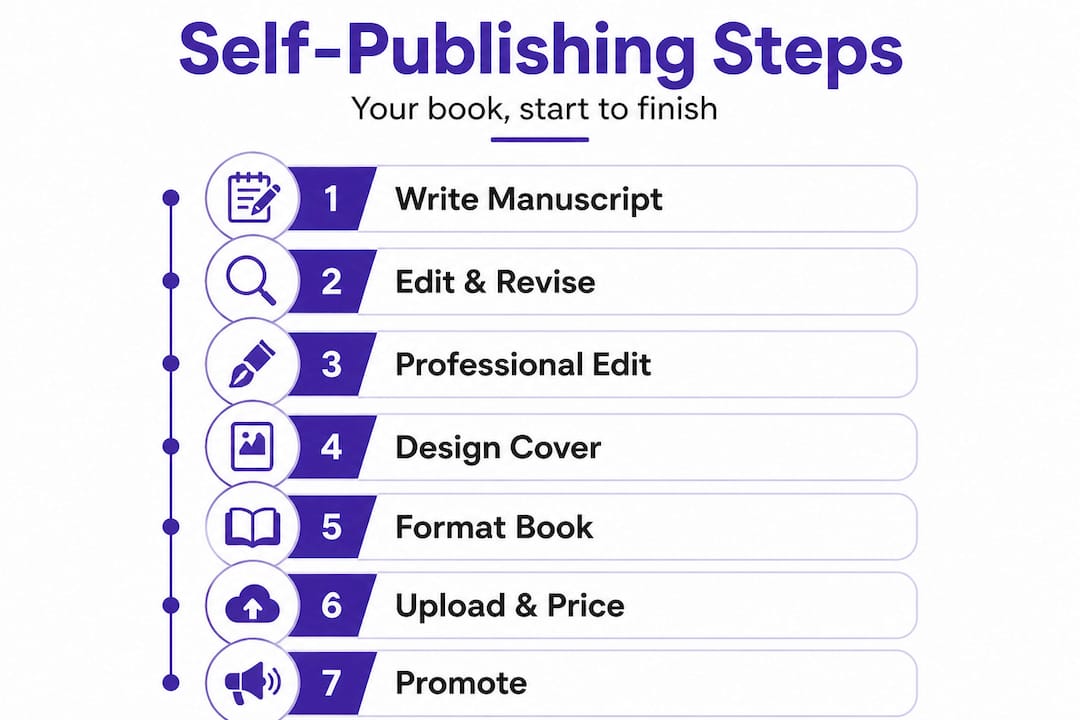
2. Self-edit and revise. Read your draft aloud, use tools like ProWritingAid or Hemingway Editor, and complete at least two full revision passes before sending it to a professional editor.
3. Hire a professional editor. This step is non-negotiable for a polished result. Developmental editing addresses structure and content. Copy editing handles grammar, style, and consistency. Proofreading catches final errors before publication.
4. Design your cover. Readers absolutely do judge books by their covers. Your cover must compete visually with traditionally published books in your genre. Hire a professional cover designer or use a platform like Reedsy to find vetted designers.

5. Format your interior. Print books and ebooks require different formatting. Tools like Vellum (Mac only), Atticus, or Adobe InDesign handle print-ready PDFs. Calibre and Sigil work for EPUB formatting. Formatting errors, such as inconsistent fonts, broken tables of contents, or incorrect margins, are one of the most common reasons platforms reject uploads.
6. Upload and set metadata. Platforms like Amazon KDP, IngramSpark, Draft2Digital, and Smashwords each have specific upload requirements. Your metadata, meaning your title, subtitle, keywords, categories, and description, directly affects how readers find your book.
7. Set your price and distribution. Research comparable titles in your genre to price competitively. Wide distribution (selling on multiple platforms) versus KDP Select exclusivity is a strategic decision worth researching based on your genre and goals.
| Task | Manual approach | Automated/streamlined approach |
|---|---|---|
| Formatting | InDesign manual layout | Vellum or Atticus templates |
| Metadata entry | Platform-by-platform input | Draft2Digital aggregator |
| PDF/EPUB generation | Manual export and check | API-based pipeline automation |
| Distribution | Upload to each store separately | Aggregator one-time upload |
Developers are increasingly automating self-publishing pipelines, generating print-ready PDFs and EPUBs programmatically for efficiency, which is especially useful if you plan to publish multiple books or editions.
Pro Tip: Explore book publishing automation tools that integrate formatting and distribution steps. Even partial automation, like using an aggregator for distribution, saves hours per title and reduces upload errors significantly.
Getting noticed: Promotion and support resources for self-published authors
You've launched your book, but visibility is the next mountain. Let's cover trustworthy tools and strategies for building your audience.
Publishing your book is only the halfway point. Without active promotion, even a brilliant book sits invisible in a catalog of millions. The good news is that effective promotion does not require a massive budget. It requires consistency and the right resources.
Core promotion tasks every self-published author should complete:
- Build an advance reader team (ARC readers) to generate early reviews before launch day
- Set up an author website with an email list opt-in, even a simple one-page site works
- Claim your Amazon Author Central and Goodreads author profiles
- Create a social media presence on platforms where your target readers spend time
- Pitch your book to book bloggers, podcasters, and local bookstores
- Submit to BookBub, Freebooksy, and genre-specific newsletters for promotional features
- Seek editorial reviews from credible sources in your genre or niche
"Authors Guild Launchpad provides structured promotion checklists, vetted provider directories, and webinars for self-published authors, giving independent authors access to the kind of organized support that was previously only available through traditional publishing deals."
The Authors Guild Annual Report 2024 highlights Launchpad as a structured resource offering exactly this kind of organized, vetted support. The Alliance of Independent Authors (ALLi) also runs regular webinars and publishes annual watchdog reports on service providers, which are invaluable for staying current.
Be cautious with paid promotion services. Any service promising guaranteed reviews, guaranteed bestseller status, or a specific number of sales in exchange for payment is almost certainly a scam or, at best, a waste of money. Paid reviews violate Amazon's terms of service and can result in your account being suspended.
Understanding how books influence growth in both cultural and commercial terms can also sharpen your promotional strategy, helping you position your book as more than just a product but as a meaningful contribution to your readers' lives.
Common pitfalls and how to verify your process
Finally, let's address the stumbling blocks and how you can avoid or correct them for a polished, successful launch.
Even authors who do their research make avoidable mistakes. Knowing the most common ones in advance puts you well ahead of the curve.
Frequent mistakes new self-published authors make:
- Paying for services without verifying the provider's track record or credentials
- Skipping professional editing to save money, then receiving poor reviews about quality
- Using a generic or DIY cover that signals "amateur" to potential buyers
- Publishing too quickly after writing, without adequate revision or feedback
- Under-investing in metadata and keywords, making the book nearly impossible to find
- Neglecting to build an email list before launch, leaving no direct line to readers
- Ignoring print formatting requirements and receiving platform rejection notices
Practical verification methods:
- Use a pre-publication checklist from ALLi or the Authors Guild before uploading
- Order a proof copy of your print book and read it cover to cover before approving
- Make a test purchase of your ebook on at least two different devices to check formatting
- Ask two or three beta readers who are not your friends or family to review the final draft
- Check your book's metadata on each platform after publishing to confirm accuracy
- Search your book title and author name to verify your listings appear correctly
The Authors Guild stresses vigilance against red flags like upfront fees and unverified offers, and they maintain ongoing access to support resources that are updated regularly as the industry evolves.
Pro Tip: Publishing practices change fast. Platforms update their requirements, new tools emerge, and scam tactics evolve. Set a calendar reminder to review your knowledge and tools every six months. Resources like ALLi's annual watchdog report and the Authors Guild's updated guides are worth bookmarking.
If you're considering publishing activity books, children's titles, or educational content specifically, the detailed walkthrough in step-by-step activity book publishing covers the unique formatting and content requirements for that niche.
What most self-publishing guides miss: Efficiency, risk, and real-world outcomes
Most self-publishing guides celebrate the romance of the solo author: one person, one vision, one book changing the world through sheer persistence. That story is appealing. It is also incomplete, and in some cases, it actively leads authors toward burnout and poor results.
Here is the honest truth we've observed: persistence alone does not make a book succeed. Process rigor does. The authors who consistently produce quality work and build real readerships are not necessarily the most talented or the most persistent. They are the ones who treat publishing as a repeatable, improvable system rather than a one-time creative event.
This means embracing automation where it makes sense. Formatting the same book for five platforms by hand is not a creative act. It is a technical task that tools can handle faster and more accurately than any human doing it manually. The same logic applies to distribution, metadata management, and even parts of promotion. Industrializing the mechanical steps of publishing frees your creative energy for the work that actually matters: writing better books and connecting with readers.
It also means being ruthless about who you trust. The self-publishing industry attracts predatory services precisely because authors are emotionally invested in their work and often unfamiliar with business norms. The best defense is not cynicism. It is a clear framework for vetting providers, which trusted organizations like the Authors Guild and ALLi have already built for you. Use those frameworks. They exist because experienced authors learned these lessons the hard way.
Finally, tap into author communities actively, not just passively. Reading a forum is useful. Participating in a webinar, asking a question in an author community, or joining a critique group creates the kind of accountability and feedback loop that actually changes your results. The e-commerce and publishing workflow has matured to the point where independent authors have access to professional-grade tools and networks that were unimaginable a decade ago. Use them.
Ready to publish? Get the tools and support you need
If you want to amplify your book's chances and avoid common snags, reliable support makes all the difference.
Navigating the self-publishing process is far easier when you have quality resources in your corner. At MunkterProducts.com, we understand the craft and business of independent publishing from the inside. Whether you're looking for inspiration from published authors who've walked this path, creative tools to support your writing life, or curated books and journals to keep your process organized and motivated, we've built a space for exactly that kind of author.

From handcrafted journals and planners to published fiction and activity books, self-publishing tools and support are available for authors at every stage. Explore what we offer and find the resources that fit where you are in your publishing journey right now. Your book deserves a professional launch, and you deserve a process that actually works.
Frequently asked questions
How much does it typically cost to self-publish a book?
Costs vary widely but generally range from a few hundred to several thousand dollars, depending on your editing, cover design, formatting, and distribution choices. A professional ebook launch can cost as little as $300 to $500, while a full print and digital release with professional editing often runs $2,000 or more.
How can I avoid publishing scams when self-publishing?
Never pay upfront fees for manuscript review, and always verify providers through trusted directories like ALLi or the Authors Guild. The Authors Guild lists red flags including upfront review fees and publishers charging fees without clear hybrid or verified status.
What does the self-publishing workflow look like?
The typical workflow moves from drafting and editing through cover design, interior formatting, platform uploading, metadata setup, and active promotion. Developers automate parts of self-publishing pipelines for efficiency, making it possible to streamline repetitive technical steps significantly.
Where can I find trusted providers and promotion resources?
Use the vetted directories, structured checklists, and webinars available through the Authors Guild Launchpad and ALLi. The Authors Guild Annual Report 2024 confirms that Launchpad provides exactly these structured promotion and provider resources for independent authors.
Recommended
- What is book publishing? Complete guide to the process
- Create engaging activity books for kids: a step-by-step guide
- How to write a sci-fi novel: essential steps for success
- How to build a sci-fi book collection: 5 expert steps
- Writing Tips: Boost Creativity and Master Your Craft Today | Hive creatives