

TL;DR:
- Literary escapism involves a mental shift to imaginative activity through literature, which can improve empathy and creativity. It is distinct from avoidance, offering stress relief and emotional growth when approached intentionally as leisure. Engaging with fiction, regardless of mental imagery ability, fosters cognitive empathy and enhances problem-solving skills through narrative transportation.
Literary escapism gets a bad reputation. Critics frame it as avoidance, a way to dodge real problems by hiding in fictional worlds. But this view misses something important. Reading deeply doesn't just help you escape reality. It reshapes how you understand it. When you lose yourself in a well-written novel, something real happens inside your mind: empathy grows, imagination stretches, and creativity finds new pathways. This article unpacks what literary escapism actually is, what science reveals about its effects, who benefits from it, and how you can use it intentionally to enrich both your reading life and your creative work.
Table of Contents
- Defining literary escapism: More than escape
- The science behind escapism: Mood, empathy, and imagination
- Who benefits—and how: Key escapism profiles
- Enriching your reading and creativity: Practical steps
- Why literary escapism isn't just "running away": A fresh perspective
- Explore creative products to fuel your escapism
- Frequently asked questions
Key Takeaways
| Point | Details |
|---|---|
| Escapism defined | Literary escapism is intentionally immersing in imaginative literature to break from routine and enrich experience. |
| Empathy and mood | Fictional stories help regulate mood and can foster empathy, though effects vary. |
| Profiles and risks | Different readers benefit uniquely; excessive escapism can lead to avoidance and addiction. |
| Creative growth | Mindful escapism boosts creativity, personal insight, and stress relief. |
| Practical application | Applying escapism in reading, journaling, and genre exploration enhances both enjoyment and self-development. |
Defining literary escapism: More than escape
Let's clarify exactly what literary escapism is, because the word "escapism" carries a lot of baggage.
"Literary escapism is the habitual diversion of the mind to imaginative activity or entertainment through literature as an escape from reality or routine." — Merriam-Webster
Notice what that definition doesn't say. It doesn't say escapism is harmful, lazy, or irresponsible. It simply describes a mental shift, moving imagination toward literature and away from the everyday grind. That distinction matters enormously.
There's a meaningful difference between escapism as leisure and escapism as avoidance. Leisure-based escapism is what most readers experience. You pick up a book after a long day, slip into a story, and return to your life feeling refreshed. It's similar to taking a walk or listening to music. Your mind gets breathing room. Avoidance-based escapism is different. It's when fiction becomes a hiding place from responsibilities, relationships, or problems that genuinely need attention. The activity looks the same from the outside, but the motivation and outcome are worlds apart.
Here's what makes literary escapism genuinely valuable as a leisure tool:
- It gives the stressed mind a structured rest without total disengagement
- It exposes readers to emotions, dilemmas, and worldviews they've never personally encountered
- It builds the mental habit of sustained attention, something increasingly rare in a distraction-heavy world
- It creates what psychologists call "narrative transportation," a state where the reader is so absorbed that time seems to disappear
Exploring books and wellness benefits reveals how consistent reading connects directly to measurable mental health improvements, including reduced cortisol levels and better emotional regulation. That's not avoidance. That's recovery.
The science behind escapism: Mood, empathy, and imagination
With the basics defined, let's take a look at what science says about the effects of literary escapism, because the research is more nuanced than most people expect.
Studies from 2025 show genuinely mixed results: fantasy reading aids mood regulation and empathy through immersion, particularly when writing contains vivid imagery that helps readers mentally "inhabit" characters. However, an intensive four-week fiction reading study found no superior social outcomes compared to nonfiction. Popular fiction was sometimes rated higher for self-reflection than literary fiction. These findings challenge the idea that "serious" literature is inherently more enriching than genre fiction.
The central mechanism researchers focus on is called narrative transportation. This is the experience of being so absorbed in a story that the real world temporarily fades. When transportation happens fully, several effects follow:
- Emotional resonance deepens, making fictional characters feel as real as acquaintances
- The brain processes social situations in the story using the same circuits activated by real-life social experiences
- Stress hormones drop, similar to what happens during meditation
- Creative associations become more flexible because the mind has stepped outside its usual patterns
| Effect | Fiction | Nonfiction |
|---|---|---|
| Mood regulation | Strong, especially with vivid imagery | Moderate |
| Empathy via immersion | Higher when well-written | Lower |
| Self-reflection | Mixed (popular fiction performs well) | Consistent |
| Creative thinking | Strong via narrative transportation | Moderate |
| Social cognition boost | Inconsistent in long-term studies | Comparable |
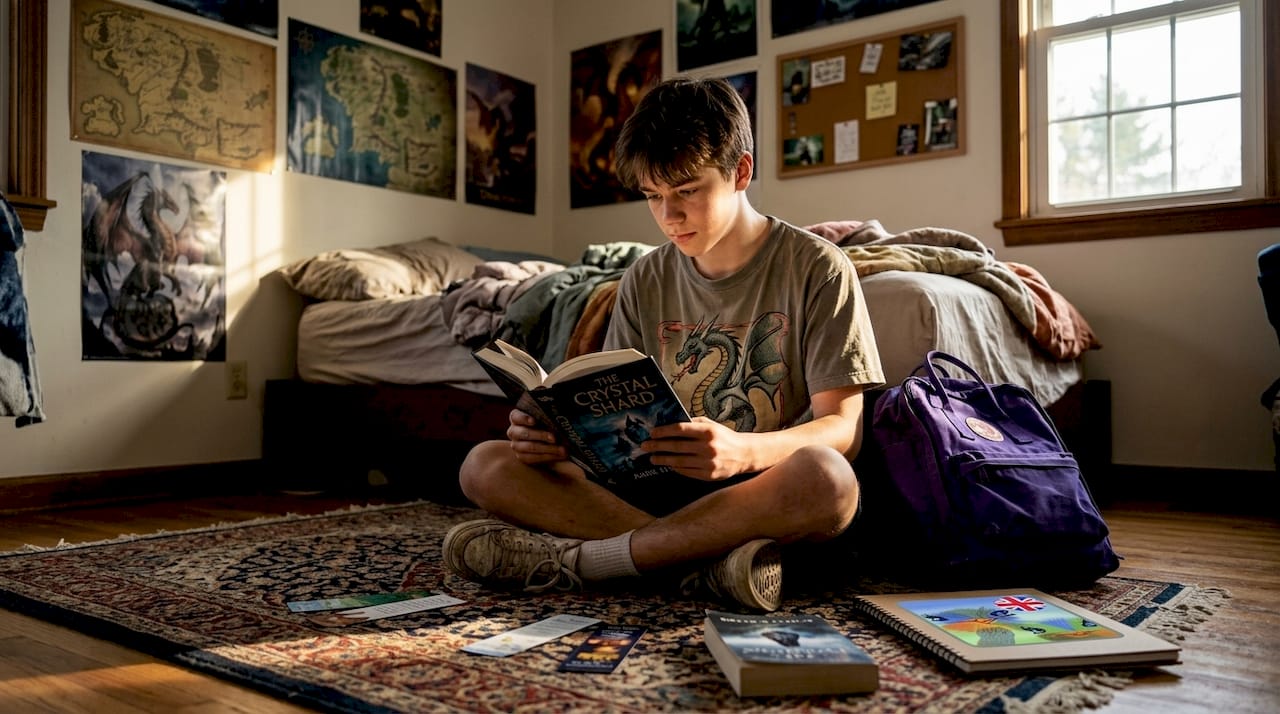
One particularly interesting data point: adolescents consistently report mood improvement after reading fantasy, even when controlled studies don't find a measurable cognitive gain. This suggests that the felt experience of escapism has real value, independent of whether it shows up cleanly in lab measurements.
Pro Tip: If you're reading specifically to support creativity, science fiction and creativity research suggests that speculative genres, those that ask "what if," are especially effective at loosening habitual thinking patterns and generating novel ideas.
The deeper point here is that reading fiction activates something in the brain that reading data or instructions simply doesn't. It puts you inside another person's experience, and that has value that's genuinely hard to measure but remarkably easy to feel.
Who benefits—and how: Key escapism profiles
Understanding who benefits from escapism can help you apply these ideas to your own reading, because not everyone experiences literary escapism the same way.
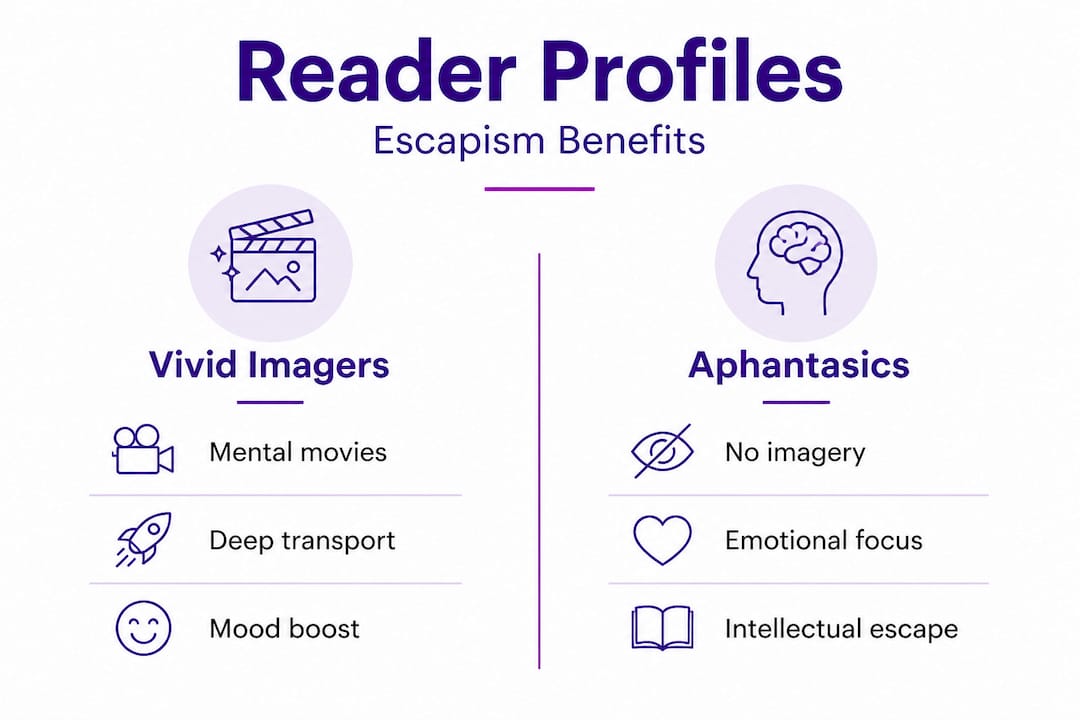
Vivid imagers are readers who mentally "see" stories like internal movies. For them, narrative transportation is almost automatic. A well-written scene triggers detailed mental pictures, sounds, and emotions that pull them deeply into the story. These readers often report the highest levels of stress relief and empathy following reading sessions.
Aphantasics experience something entirely different. Aphantasia is the inability to form mental images, and it affects a meaningful portion of the population. You might expect this would block literary escapism entirely. But it doesn't. Research on aphantasics and literature shows that aphantasic readers engage through intellectual and emotional immersion rather than visual imagery. They follow ideas, relationships, and emotional logic rather than mental pictures. Their escapism is real, just structurally different.
Fantasy-prone individuals are a third profile worth understanding. These readers have naturally high imaginative engagement and often find that escapist literature provides exceptional meaning, particularly when they're navigating depression or emotional difficulty. For this group, fiction becomes a genuine source of psychological scaffolding, stories that model resilience, hope, or alternative outcomes during hard times.
Here's a comparison of how these profiles experience escapism differently:
| Reader profile | Primary escape mechanism | Key benefit | Watch for |
|---|---|---|---|
| Vivid imager | Mental imagery and sensory immersion | Deep stress relief, empathy | Difficulty returning to real-world tasks |
| Aphantasic | Intellectual and emotional logic | Conceptual engagement, idea-building | May prefer structured fiction |
| Fantasy-prone | Rich imagination and personal meaning-making | Resilience and emotional modeling | Risk of over-identification with fiction |
The risks are real too. Excessive escapism can tip into avoidance when fiction consistently replaces real-world engagement rather than complementing it. Signs include using reading to avoid difficult conversations, skipping responsibilities to stay in a story, or feeling that fictional relationships are more satisfying than real ones.
Pro Tip: Set a "reentry ritual" after a long reading session. Write two or three sentences in a journal about what you just read and how it connects to your actual life. This keeps the escapism cycle healthy by bridging the fictional world back to reality in a productive way.
For younger readers, children's creative journals and activity books for kids are excellent tools for helping children process their reading experiences and stay connected to the real world while still enjoying the imaginative benefits of stories.
Enriching your reading and creativity: Practical steps
Now, let's turn theory into practice by exploring steps you can take to make escapism work for you.
Literary escapism enriches reading by providing stress relief, a creativity boost, empathy training, and aspirational models. But balance prevents maladaptive isolation, and the mechanics of transportation enhance the experience most when you're intentional about how you read.
Here are concrete steps to make escapism actively beneficial:
-
Choose genres with intention. Different genres do different things. Fantasy and science fiction expand imaginative boundaries. Historical fiction builds contextual empathy. Literary fiction sharpens emotional vocabulary. Pick genres that match your current creative or emotional needs, not just what's trending.
-
Practice slow reading. Speed-reading optimizes for information extraction, not transportation. Read at a pace that lets scenes develop in your mind. Give characters time to breathe. The more fully you inhabit a story, the more deeply its benefits register.
-
Journal your reading responses. After each session, write for five minutes without editing. What surprised you? What bothered you? What character felt uncomfortably familiar? This practice converts passive enjoyment into active self-knowledge, which is where the real creative fuel comes from.
-
Read across formats. Alternate between novels, short stories, and creative nonfiction. Each format trains different aspects of your imagination. Short stories are especially effective for writers because they show how much emotional work a small amount of space can accomplish.
-
Create a dedicated reading environment. Your brain learns from context. A specific chair, a specific time of day, even a specific cup of tea can signal to your nervous system that it's time to drop into deep reading mode. Consistency deepens the transportation effect over time.
-
Connect reading to making. Read a chapter, then sketch a scene, write a paragraph, or start a new page in a creative journal. The creative energy that reading generates has a short half-life. Use it immediately by making something, even something small and rough.
The books that spark creativity you choose matter, but how you read them matters more. Storytelling for creativity research shows that the act of retelling or responding to stories, even informally, dramatically increases the cognitive benefits. And if you're looking to pair escapism with structured personal development, educational books for growth can complement your fiction reading by giving you frameworks to process what the stories surface.
Why literary escapism isn't just "running away": A fresh perspective
Here's what years of engaging with literary escapism actually teaches you, and it's not what most productivity culture would have you believe.
The standard critique of escapism goes like this: real life is where growth happens. Stories are a distraction from the hard work of becoming who you need to be. Put the book down and do something real. This argument sounds sensible. It's also almost entirely wrong.
The readers and writers who develop the deepest creative intelligence are often the most committed escapists. Not because they avoid reality, but because they visit it more often, through more perspectives, than people who only inhabit their own experience. Every time you enter a well-built fictional world, you're practicing a form of cognitive empathy. You're exercising the mental muscle that lets you imagine what someone else's life feels like from the inside.
The creative benefits of fiction go beyond relaxation. Escapist literature, particularly speculative and genre fiction, trains you to hold multiple realities in mind simultaneously. That's a skill. It directly supports problem-solving, creative work, and interpersonal intelligence.
What changes when you approach literary escapism as a toolkit rather than a guilty pleasure is your entire relationship with the stories you read. You stop apologizing for loving fantasy or romance or space opera. You start noticing why certain books pull you in and what that pull is trying to tell you about your own needs, values, and imagination.
The uncomfortable truth is that "serious" culture has long devalued escapist literature precisely because it's so widely enjoyed. But education and creativity research consistently shows that intrinsic motivation, doing something because you genuinely love it, produces deeper learning and better creative outcomes than dutiful engagement. Reading what you love, even if it's considered "light," is not a lesser form of reading. It might actually be the most powerful kind.
Escapism is a catalyst. Not a crutch.
Explore creative products to fuel your escapism
If you're ready to take your escapism journey further, here's where to find the perfect tools.
Reading is just the beginning. The real transformation happens when you start creating alongside your reading life, journaling your responses, sketching characters, building your own worlds, or working through activity books that push your imagination in new directions.

At MunkterProducts.com, you'll find a thoughtfully curated collection of books, journals, coloring books, puzzles, and creative stationery designed to extend the imaginative experience beyond the page. Whether you're looking for a self-help journal to process your reading, an adult coloring book to engage your visual creativity, or the Noah science fiction series to fuel your love of speculative fiction, the collection is built for people who take their imagination seriously. Every product is chosen or crafted to turn your reading energy into something tangible and lasting.
Frequently asked questions
How does literary escapism enrich personal creativity?
Literary escapism activates imagination and fosters creative thinking by engaging readers in fictional worlds and diverse perspectives. It boosts creativity alongside empathy and stress relief, making it a genuine tool for creative development.
Can anyone experience literary escapism, even without vivid mental imagery?
Yes, even aphantasics, people who lack vivid mental imagery, can engage in escapism through emotional and intellectual immersion in stories. They escape via intellectual engagement rather than visual imagination, with equally meaningful results.
Is there a risk of escapism turning into avoidance or addiction?
Excessive escapism can lead to avoidance behaviors and even addiction, so finding balance is important. Watch for signs that fiction is replacing real-world engagement rather than refreshing you for it.
Does reading fiction improve empathy more than nonfiction?
Studies show mixed results on empathy: fiction can boost empathy through immersion and vivid imagery, but not all research finds a clear long-term advantage over nonfiction.
What are examples of healthy escapist activities in literature?
Reading diverse genres, journaling creative responses, and participating in book clubs are all effective ways to engage escapism positively. Pairing reading with a physical creative practice, like drawing or writing, helps keep the cycle productive and grounded.