

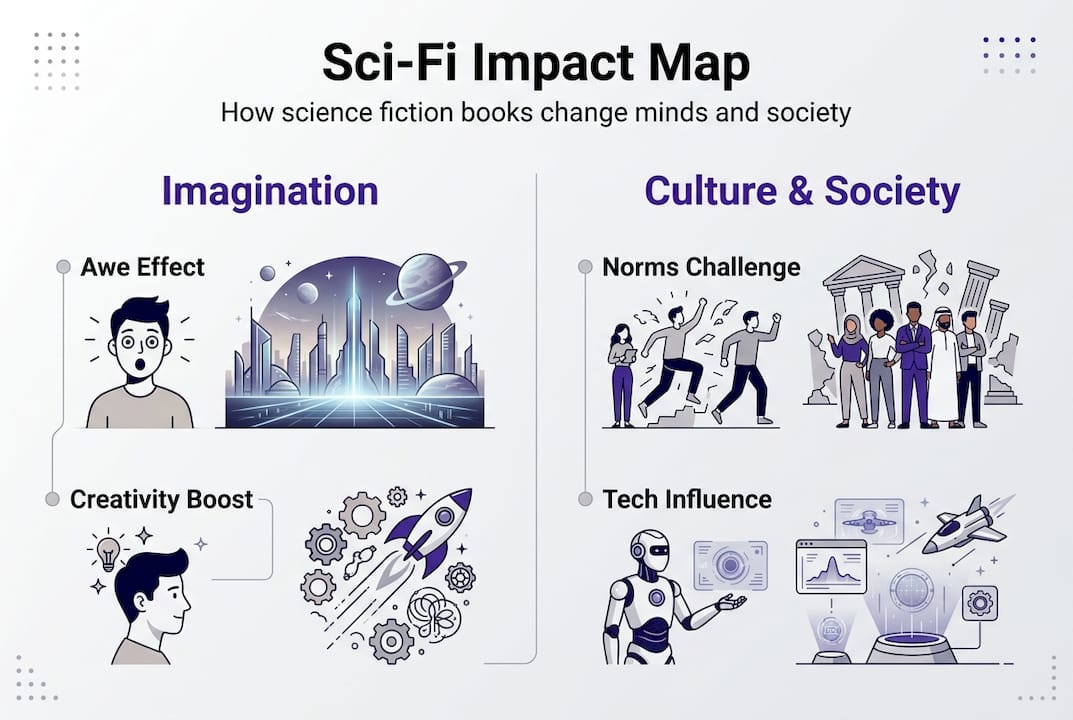
Science fiction gets dismissed as escapist fantasy more often than it deserves. But here's what that dismissal misses: SF is a proven creative sandbox that helps readers safely explore future scenarios, build empathy, and stress-test ideas before reality forces the question. From the robots in Isaac Asimov's stories to the surveillance states in dystopian classics, science fiction has shaped how we think, what we build, and how we challenge the world around us. This article unpacks the real, measurable influence SF has on imagination, culture, and societal norms, with a special nod to fans of character-driven series like Noah.
Table of Contents
- Why science fiction books spark imagination
- How science fiction shapes culture and technological innovation
- Challenging norms: Science fiction's role in societal critique
- Diverse perspectives and limits: Contrasting views on science fiction's role
- Applying science fiction's lessons: For readers and for society
- Explore more and spark your imagination
- Frequently asked questions
Key Takeaways
| Point | Details |
|---|---|
| Imagination catalyst | Science fiction books provide a proven boost to creativity and idea generation. |
| Cultural influencer | Fictional concepts often inspire real-world technology and societal change. |
| Social critique | SF challenges power structures, norms, and warns about possible negative futures. |
| Debate and diversity | Science fiction’s impact includes both positive inspiration and controversial influences. |
| Practical application | Readers can use strategies from SF to enhance their own creativity and critical thinking. |
Why science fiction books spark imagination
Science fiction does something no other genre does quite as well: it hands you a world that doesn't exist yet and asks you to take it seriously. That mental exercise is not just entertaining. It's cognitively demanding in the best possible way. When you follow a character through an alien civilization or a post-collapse society, your brain is forced to build new frameworks, question assumptions, and imagine cause-and-effect chains that have no real-world template.
The evidence backs this up. A 4-week SF intervention with middle school students produced significant gains in creativity scores, suggesting that even short-term exposure to science fiction literature reshapes how young minds approach problems. Adults aren't immune either. Imagination is a muscle, and SF gives it a serious workout at any age.
SF also has a unique ability to evoke a sense of awe, that feeling of being small in the face of something vast and meaningful. Awe is one of the most powerful triggers for creative and expansive thinking. It loosens rigid mental categories and makes room for new connections.
Here's a quick look at how SF stacks up against other reading types for creativity impact:
| Reading type | Creativity boost | Awe response | Critical thinking gain |
|---|---|---|---|
| Science fiction | High | Strong | High |
| General fiction | Moderate | Moderate | Moderate |
| Nonfiction | Low to moderate | Low | High |
| Fantasy | Moderate to high | Moderate | Moderate |
Some of the most powerful SF scenarios for unlocking creative thinking include:
- First contact stories that force you to imagine entirely different communication systems
- Post-scarcity economies that challenge assumptions about work and value
- Time travel narratives that demand you hold multiple timelines in your head at once
- AI consciousness plots that push you to define what makes a mind
If you want to unlock creativity and insight through reading, the genre's structure alone is doing half the work for you. The sci-fi series traits that make a story compelling, layered world-building, moral ambiguity, speculative stakes, are the same traits that push your imagination hardest.
Pro Tip: Pick one SF scenario per week and spend ten minutes writing your own version of how it plays out differently. This is lateral thinking practice disguised as fun.
How science fiction shapes culture and technological innovation
SF doesn't just inspire dreamers. It inspires engineers, entrepreneurs, and policymakers. The genre has a long track record of sketching concepts that later became real technologies. Submarines, satellites, video calls, credit cards, and even the atomic bomb all appeared in fiction before they appeared in labs.

This isn't coincidence. SF influences patents by shaping societal imaginaries, giving inventors a vocabulary and a vision before the tools exist to build them. Fiction functions as prior art, a conceptual blueprint that researchers and developers consciously or unconsciously draw from.
Here's how some famous SF concepts compare to the real technologies they inspired:
| SF concept | Source work | Real-world technology |
|---|---|---|
| Communicator device | Star Trek (1966) | Mobile phone |
| Tablet computer | 2001: A Space Odyssey (1968) | iPad and Android tablets |
| Earbuds | Fahrenheit 451 (1953) | Wireless earbuds |
| Self-driving vehicles | I, Robot (1950) | Autonomous vehicles |
| Video calling | Metropolis (1927) | FaceTime, Zoom |
The cultural impact goes well beyond gadgets. SF has driven innovation in how societies think about space exploration, environmental responsibility, and human rights. Movements for civil rights, feminism, and ecological awareness all found early expression in speculative fiction.
"I read science fiction as a kid and it shaped everything I thought was possible." This sentiment, echoed by figures like Elon Musk and Jeff Bezos, reflects how SF functions not just as entertainment but as a permission structure for ambition.
Here are the key ways SF enters tech and culture:
- Inspiration — Concepts in fiction give inventors a target to aim at
- Critique — SF warns of the dangers of unchecked technology, prompting regulation and ethical debate
- Myth-making — Stories create shared cultural narratives that shape collective values
- Talent pipeline — SF readers disproportionately enter STEM fields, carrying fictional visions into real research
- Policy framing — Dystopian scenarios inform legislative debates about surveillance, AI, and bioethics
The balance between utopian and dystopian visions matters enormously. Utopias give us something to build toward. Dystopias tell us what to avoid. The best SF holds both in tension, which is part of what makes publishing shapes innovation such a relevant conversation in 2026. If you're building your reading list, the essential sci-fi reads that shaped modern tech culture are a great place to start.
Challenging norms: Science fiction's role in societal critique
One of SF's most underrated tools is cognitive estrangement. This is the technique of making the familiar feel alien so you can see it clearly for the first time. When Ursula K. Le Guin describes a society with no fixed gender in The Left Hand of Darkness, she isn't writing about another planet. She's holding a mirror up to ours.
SF critiques power and gender through estrangement, using invented worlds to expose the assumptions baked into our own. Mary Shelley's Frankenstein interrogated scientific hubris two centuries before AI ethics became a boardroom agenda item. These works don't just entertain. They challenge.
Here are the major societal areas SF has consistently pushed back on:
- Race and colonialism — Stories like Octavia Butler's Kindred reframe historical trauma through speculative lenses
- Gender and identity — Le Guin, Joanna Russ, and others dismantled binary assumptions decades before mainstream culture caught up
- Environmental collapse — Climate fiction (cli-fi) has been warning of ecological tipping points since the 1960s
- Governance and surveillance — Orwell's 1984 and Huxley's Brave New World remain reference points in political debates today
- Economic inequality — Cyberpunk fiction mapped corporate dystopia before the gig economy existed
"Science fiction is not an instruction manual for the future. It's a warning label on the present."
This framing matters. Dystopian themes in sci-fi outnumber utopian ones for a reason. Warnings are more urgent than blueprints. And as future prediction limitations remind us, SF's power isn't in getting the future right. It's in making us ask better questions about the present.
Pro Tip: Step outside the Western SF canon. Writers like Nnedi Ofofor, Liu Cixin, and Nalo Hopkinson bring cultural frameworks that make the estrangement effect even sharper and more revealing.
Diverse perspectives and limits: Contrasting views on science fiction's role
SF is not a perfect lens. It has real limitations, and ignoring them leads to the kind of uncritical fandom that does more harm than good. The genre has historically centered white, Western, male perspectives, which skews both what futures get imagined and which problems get treated as urgent.
There's also the risk of treating SF as prophecy. SF as myth-making is powerful, but when tech billionaires treat their childhood reading as a literal roadmap, the results can be troubling. The influence on tech leaders has produced both genuine innovation and some deeply questionable priorities.
Here's a summary of what the research actually shows:
| Study type | Age group | Positive impact | Negative or null finding |
|---|---|---|---|
| Creativity intervention | Middle school | Significant gains | None reported |
| Awe and solidarity | Adults | Increased global ID | No causal empathy gain |
| Patent influence | Industry | SF as prior art | Gernsback-era bias noted |
| Dystopian bias | General | Warning function | Risk of fatalism |
The pitfalls of treating SF as social prophecy include:
- Mistaking fictional consensus for scientific consensus
- Allowing ideological bias in classic SF to shape real policy thinking
- Underrepresenting marginalized voices in both fiction and the futures it imagines
- Conflating inspiration with instruction, especially in AI and biotech
The impact of book publishing on which stories get told and amplified is part of this conversation. Diverse publishing pipelines produce more diverse imaginaries, and that diversity is what makes SF genuinely useful as a cultural tool rather than a mirror for existing power.
Applying science fiction's lessons: For readers and for society
Knowing SF's power is one thing. Using it intentionally is another. Here's how to get the most out of your reading in a way that actually changes how you think and act.
- Read with a question in mind — Before you start, pick one real-world problem you're wrestling with. Let the story run parallel to it.
- Diversify your reading list — Alternate between classic SF, contemporary voices, and international authors to avoid echo chambers.
- Discuss what you read — SF's ideas compound when shared. Book clubs, online forums, and even casual conversations multiply the insight.
- Separate the plausible from the dramatic — Not every SF scenario is equally likely. Practice identifying which elements are grounded in real science versus narrative convenience.
- Apply the scenario to your own life — Ask: if this fictional future arrived tomorrow, what would I do differently today?
The creativity boost in youth SF readers is significant and measurable, but the awe response that drives broader social identification works across age groups. You don't age out of the benefits. You just have to keep reading.
Pro Tip: Try science fiction prototyping. Take a personal challenge, say a career decision or a relationship dynamic, and write a one-page SF story where a character faces the same problem in a future world. The distance the fiction creates often reveals solutions you couldn't see head-on.
For personal growth with books, SF is one of the most underused tools available. And if you're not sure where to start, the sci-fi reading checklist is a practical guide to building a reading habit that actually stretches your thinking.
Explore more and spark your imagination
Science fiction isn't just a genre. It's a practice. The more intentionally you engage with it, the more it gives back in creativity, critical thinking, and a richer sense of what's possible. Whether you're a lifelong SF reader or just starting to explore what the genre can do, the right book at the right moment can genuinely shift how you see the world.

At Munkter Products, we curate books and creative materials that feed exactly that kind of curiosity. From the Noah series, a science fiction story built around character, consequence, and the kind of questions that stay with you, to journals and creative tools that help you process and apply what you read, everything in our collection is chosen to keep your imagination working. Browse our unique science fiction collections and find your next great read today.
Frequently asked questions
How do science fiction books boost creativity?
Science fiction forces readers to mentally simulate unfamiliar worlds and systems, which builds flexible, lateral thinking. A 4-week SF study with middle schoolers showed measurable creativity gains from this kind of structured imaginative exposure.
Can science fiction predict the future?
SF regularly inspires real technology and cultural shifts, but it doesn't predict specific events. As SF and future prediction analysis shows, its value is in asking better questions, not providing accurate forecasts.
What are some common themes science fiction explores?
SF consistently tackles technology, identity, environmental collapse, governance, and social inequality. These themes reflect SF's critique of power and its function as a warning system for present-day society.
How does science fiction influence society?
It shapes how societies imagine the future, challenges existing norms, and has directly inspired inventions and cultural movements. Research confirms SF shapes societal imaginaries and serves as prior art for real-world innovation.
Can reading science fiction improve empathy or social skills?
For youth, SF reliably boosts creativity and can increase a sense of global solidarity through awe. In adults, SF and social cognition research shows awe effects but limited causal evidence for direct empathy gains compared to literary fiction.