

Choosing a book as a holiday gift should feel exciting, but for most people it lands somewhere between stressful and paralyzing. You want something that gets read, loved, and remembered, not something that collects dust on a nightstand. The good news is that great book gifting is a skill, and like any skill, it comes down to a repeatable process. This guide walks you through preparation, key principles, step-by-step selection, and how to avoid the most common mistakes, whether you're shopping for a curious five-year-old, a teen who "doesn't read," or an adult who fills journals faster than they can buy them.
Table of Contents
- Understanding the essentials: What makes a book the perfect holiday gift?
- Preparation checklist: Getting ready to select the perfect book
- Step-by-step: How to match the right book to every recipient
- Troubleshooting and edge cases: Avoiding common book gifting pitfalls
- Why meaningful curation beats bestsellers every holiday
- Discover your next favorite book with MunkterProducts
- Frequently asked questions
Key Takeaways
| Point | Details |
|---|---|
| Personalization matters | The best holiday book gifts are matched to the recipient’s unique interests and reading habits. |
| Use expert-curated lists | Staff-picked and expert-reviewed recommendations are more reliable than bestseller charts. |
| Preparation is essential | Know your recipient’s age, interests, and preferred formats before shopping. |
| Avoid common pitfalls | Do not gift books that are too advanced, off-interest, or chosen for your own tastes rather than the recipient’s. |
| Think beyond books | For non-readers, journals, creative kits, or activity books make thoughtful alternatives. |
Understanding the essentials: What makes a book the perfect holiday gift?
Before you open a single browser tab or walk into a bookstore, you need to understand what separates a forgettable gift from one that genuinely lands. The answer almost always comes down to one word: intention.
A book chosen with real thought behind it communicates something powerful. It says, "I paid attention to who you are." That's the emotional core of great book gifting, and it's what makes the difference between a gift that gets read cover to cover and one that gets quietly donated.
Here are the foundational elements to keep in mind:
- Personalization first. Always start with the recipient's current hobbies, recent interests, reading level, and preferred format. A commuter might love an audiobook. A hands-on kid might prefer an activity book over a novel.
- Use curated lists, not sales charts. NPR curation methods rely on expert validation and genre tagging rather than raw sales data. That distinction matters enormously when you're trying to match a specific person.
- Balance safe picks with a thoughtful surprise. A "safe" pick is something squarely in the recipient's wheelhouse. A thoughtful surprise nudges them slightly outside their comfort zone while staying relevant. The key is keeping it relevant, not random.
- Know your recipient type. Non-readers often respond better to journals, novelty bookmarks, or creative activity books than to traditional novels. Avid readers, on the other hand, usually appreciate niche or literary picks that they wouldn't discover on their own.
As The Art of Giving Books puts it, the core methodology is simple: tailor to the recipient's current interests, reading habits, and lifestyle; match genre, age-appropriateness, and format; and add surprise within safe bounds.
"The best book gifts are chosen with the recipient's world in mind, not the giver's bookshelf."
For parents specifically, a solid parent's book selection guide can help narrow down options by developmental stage and learning goals. Adults looking for growth-oriented reads will find that educational book selection follows many of the same personalization principles.
Preparation checklist: Getting ready to select the perfect book
With an understanding of what matters most when giving a book, let's break your intended recipient's needs into actionable steps. Preparation is where most people skip ahead too fast, and it's exactly where the process breaks down.
Start by gathering the right information. You don't need to interrogate anyone. A few casual observations or a quick conversation with someone close to the recipient usually does the trick.
Information to collect before you shop:
- Age and reading level (or approximate grade for children)
- Recent favorites: books, shows, podcasts, or topics they've been excited about
- Lifestyle cues: Do they commute? Travel? Prefer short reads or long ones?
- Format preference: hardcover, paperback, e-book, audio, or activity kit
- Any known dislikes or sensitivities (certain themes, genres, or reading challenges)
Once you have that information, set a realistic budget. Format matters here too. A hardcover gift set costs more than a paperback, and a curated activity kit for a child sits in a different price range than a single picture book.
| Recipient type | Recommended format | Budget range |
|---|---|---|
| Child (ages 0-5) | Board book or picture book | $10-$20 |
| Child (ages 6-12) | Early reader or activity book | $15-$30 |
| Teen | Paperback novel or journal | $15-$25 |
| Adult | Hardcover, journal, or activity kit | $20-$50+ |
Pro Tip: Use tag and filter systems on curated sites to narrow your search fast. NPR Books We Love lets you filter by age, genre, and mood, which cuts browsing time dramatically and keeps your results relevant.
For children, check whether they're reading above or below grade level. A child who reads two grades ahead will be bored by an age-matched pick. A child who struggles with reading may feel embarrassed by something too advanced. Educational book picks and a solid activity book checklist can both help you calibrate. For adults, note whether they tend toward reflective formats like journals or prefer something more active like puzzles and coloring books. AP recommendations for age-appropriate books are also worth checking for children's picks vetted by journalists.

Step-by-step: How to match the right book to every recipient
Now that you're prepared and have the information you need, let's move into the actionable selection steps. This process works for every age group and every budget.
Step 1: Identify life stage and reading history. A retired teacher has different reading needs than a new parent or a twelve-year-old obsessed with space. Life stage shapes what feels relevant and what gets read.
Step 2: Use tag-based curated lists for precision. Don't just Google "best books 2026." Go to a trusted curated source, apply genre and age filters, and compare two or three top options side by side. This narrows the field without overwhelming you.
Step 3: Match book type to recipient. For children, select by age stage: board books for ages 0 to 3, picture books for ages 3 to 5, early readers for ages 5 to 7, and chapter books or activity books for ages 8 and up. Prioritize vivid language, diverse characters, and re-read value. For adults, consider interest-driven genres, self-help journals, or creative activity books. Holiday activity books work especially well for kids who prefer doing over reading.
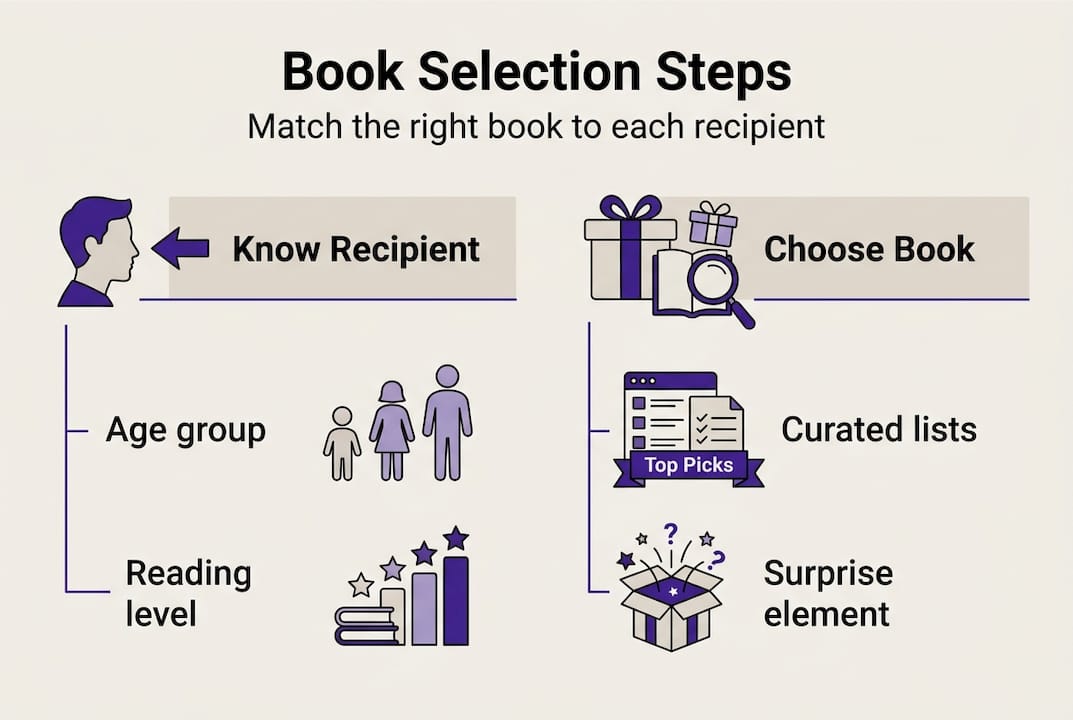
Step 4: Apply the "safe surprise" rule. This is the most underused technique in book gifting. Pick something squarely within their known interests (the safe part), then add one element that's slightly new: a different format, a debut author, or an unexpected angle on a familiar topic. For example, a child who loves animals might get a science-based nature book like Science Friday's Papilio instead of the usual fiction. An adult who enjoys thrillers might appreciate a family-friendly science fiction novel that stretches their reading range.
Step 5: Double-check against curated recommendations. Before you finalize, run your pick through at least one trusted curated list. Does it appear? Is it well-reviewed? This final check catches mismatches before they become awkward gift moments. Book gifting advice consistently reinforces this verification step as essential.
| Recipient | Safe pick | Surprise element |
|---|---|---|
| Child age 6 | Favorite animal theme | Science-based nonfiction |
| Teen | Dystopian fiction | Debut author, diverse cast |
| Adult reader | Literary fiction | Award-winning debut novel |
| Non-reader adult | Journal or planner | Illustrated or themed design |
Pro Tip: If you're stuck between two options, choose the one with higher re-read or reuse value. A book that gets picked up again and again is always the better gift.
Troubleshooting and edge cases: Avoiding common book gifting pitfalls
Even with careful steps, mistakes happen, or you hit unusual situations. Here's how to handle them skillfully.
The most common mistake is pushing a book that's too advanced. For young children, emotionally complex themes can confuse or even upset them, even if the reading level technically matches. Always consider emotional readiness alongside reading level.
The second most common mistake is gifting based on your own tastes. You loved that memoir. You found that self-help book life-changing. That doesn't mean the recipient will. Avoid projecting your tastes and stay focused on their interests, not yours.
Here's a quick troubleshooting list for tricky situations:
- Recipient isn't a reader: Choose journals, novelty bookmarks, coloring books, or creative activity kits. These are book-adjacent gifts that feel thoughtful without demanding sustained reading.
- You don't know the recipient well: Stick to a universally appealing activity format or a gift card to a curated bookstore.
- Child is significantly above or below grade level: Use reading level tags, not age tags, when filtering curated lists.
- Adult has "everything": A handcrafted journal or a niche interest book they'd never buy themselves usually hits the mark.
- Last-minute shopping: Commercial guides work fine for casual gifting. For something more meaningful, expert lists from trusted sources are worth the extra ten minutes.
"The goal isn't to improve someone's taste. It's to meet them where they are and give them something they'll actually enjoy."
For context on how commercial vs. curated guides differ in quality and intent, it's worth understanding how publishing trends shape what gets promoted. And if you're looking beyond mainstream retailers, alternative book sources can surface hidden gems that feel far more personal.
Why meaningful curation beats bestsellers every holiday
With pitfalls and troubleshooting covered, let's step back and examine why this curated approach matters more now than ever.
Bestseller lists are built on sales data, not on fit. They tell you what a lot of people bought, not what your person will love. There's a real difference, and it shows up every January when well-intentioned gifts sit unread on shelves.
The most memorable book gifts we've ever heard about share one trait: they were chosen because the giver paid attention. A grandmother who noticed her granddaughter's obsession with bugs and found a stunning illustrated insect encyclopedia. A friend who remembered an offhand comment about wanting to journal more and gifted a beautifully designed planner. These stories stick because the gift said, "I see you."
Prioritizing personalization over taste-improvement is the single biggest shift you can make as a gift-giver. You're not trying to expand anyone's horizons without their permission. You're trying to delight them. That's a fundamentally different goal, and it leads to fundamentally better outcomes.
If you want to go deeper on genre-specific gifting, an essential sci-fi reading checklist is a great starting point for fans of speculative fiction. The same curation logic applies across every genre.
Discover your next favorite book with MunkterProducts
Ready to put your next-level gifting skills to use? Here's where to find handpicked options that make holiday book shopping easy and joyful.

At MunkterProducts, the entire catalog is built around the idea that books and creative materials should feel personal, not generic. You'll find curated activity books for kids, illustrated holiday collections, adult coloring books, self-help journals, planners, and even science fiction novels, all in one place with postage included. Whether you're shopping for a curious child or a creative adult, the selection takes the guesswork out of gifting. Explore activity books for holiday gifting to find something that genuinely fits the person you're shopping for.
Frequently asked questions
How do I choose an age-appropriate book for a child?
Match the book type to the child's age stage: board books for ages 0 to 3, picture books for ages 3 to 5, and early readers for ages 5 to 7, always prioritizing vivid, diverse content that advances language and holds re-read value.
What are the best sources for book gift recommendations?
Expert-curated lists from NPR Books We Love, the WSJ, and trusted staff-picked sites offer recommendations filtered by age, genre, and interest, which makes them far more reliable than commercial sales charts.
What if my gift recipient isn't much of a reader?
Skip traditional books and consider journals, creative activity kits, or illustrated coloring books instead. Non-readers respond better to book-adjacent gifts that feel engaging without demanding sustained reading.
Is it better to pick a bestseller or a curated recommendation?
Curated picks are almost always more personally resonant because they're matched to the recipient's actual interests rather than broad market trends. Bestsellers work fine for casual gifting but rarely create the memorable connection a curated pick delivers.