

TL;DR:
- Creative writing emphasizes artistic expression and explores emotions beyond factual reporting. It includes poetry, prose, and various sub-genres, focusing on craft techniques like structure, voice, and revision. Engaging in creative writing develops empathy, communication, and emotional resilience through imaginative practice.
Creative writing is defined as imaginative, original composition that goes beyond standard journalistic, academic, or technical writing forms, emphasizing craft elements like narrative structure, character development, and the author's unique voice. Unlike a news report or a research paper, creative writing explores emotions and imagination to convey perspectives that facts alone cannot capture. It covers a wide range of forms, from novels and poetry to screenplays and personal essays. Writers like Toni Morrison, Raymond Carver, and Sylvia Plath built entire careers by mastering these craft elements. Whether you are a student, an educator, or someone picking up a pen for the first time, understanding what creative writing is gives you the foundation to practice it with purpose.
What is creative writing and how is it defined?
Creative writing is writing produced for its own sake, driven by artistic creation rather than the transfer of factual information. The goal is not to report what happened but to evoke what it felt like. This distinction matters because it changes every decision a writer makes, from word choice to sentence rhythm to structure.
The term "creative writing" is the widely accepted label in academic and professional settings. Universities like Southern New Hampshire University (SNHU) and City Lit in London offer dedicated programs under this exact name. The craft sits at the intersection of imagination and discipline, and that combination is what separates a polished short story from a raw journal entry.
A useful way to think about it: journalism answers the question "What happened?" Creative writing answers the question "What does it mean to be human?" That shift in purpose is the definition of creative writing in practice.
How does creative writing differ from other writing types?
Creative writing has a different reader contract than journalism or academic writing. Readers pick up a novel expecting invention, emotion, and voice. They pick up a news article expecting verified facts and neutral tone. Violating those expectations in either direction breaks trust.
The table below shows the core differences across four common writing forms.
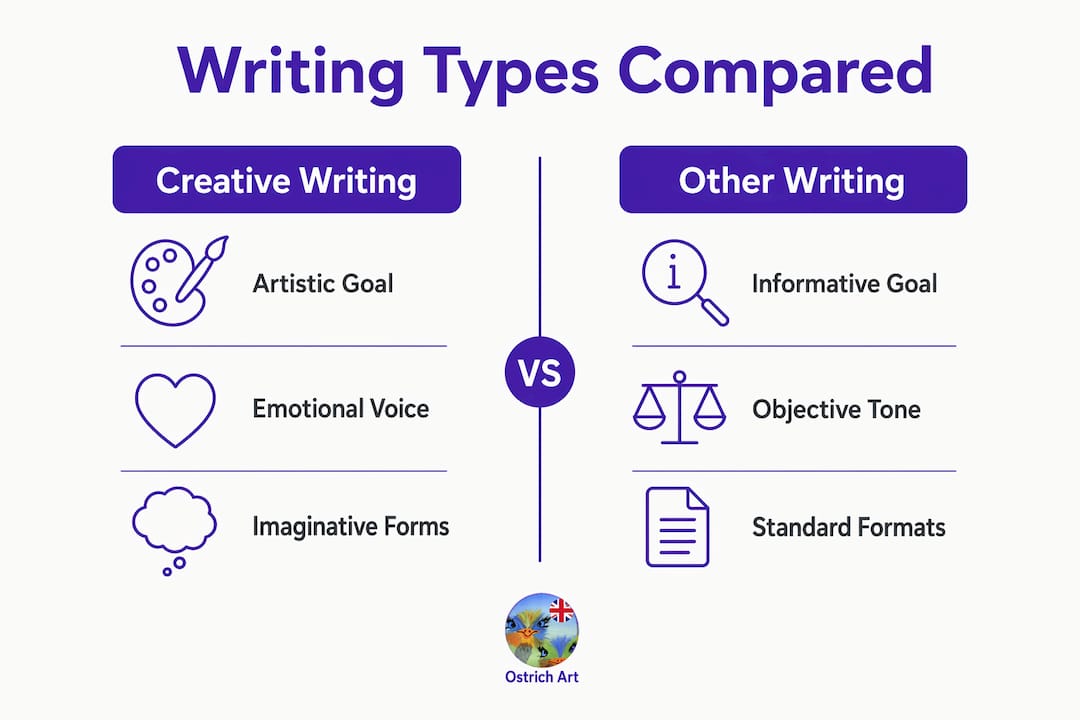
| Writing type | Primary goal | Key features | Example forms |
|---|---|---|---|
| Creative writing | Artistic expression | Voice, imagination, narrative craft | Novels, poetry, screenplays |
| Academic writing | Argument and analysis | Citations, formal structure, objectivity | Essays, research papers |
| Technical writing | Instruction and clarity | Precision, step-by-step format | Manuals, guides, reports |
| Journalism | Factual reporting | Accuracy, neutrality, timeliness | News articles, features |
Creative writing deals with ineffable qualities communicated through language manipulation. That phrase sounds abstract, but it means something concrete: a skilled writer can make you feel grief, joy, or dread without stating those words once. Academic and technical writing cannot do that, and they are not trying to.
Pro Tip: When you sit down to write, ask yourself which contract you are honoring. If you are writing to inform, stay factual. If you are writing to evoke, give yourself permission to invent.
What are the main types of creative writing?
The two broad categories of creative writing are poetry and prose. Each uses language differently to evoke emotion and imagery, and each contains multiple sub-genres with their own conventions.

Poetry uses line breaks, rhythm, sound, and compression to create meaning. It includes formal verse (sonnets, villanelles), free verse, spoken word, and prose poetry. Poets like Emily Dickinson and Langston Hughes show how radically different two poets can be while both working within the same broad category.
Prose covers everything written in continuous sentences and paragraphs. The main types of creative writing within prose include:
- Fiction: Novels, novellas, and short stories. Examples range from Ernest Hemingway's short fiction to Ursula K. Le Guin's science fiction novels.
- Creative nonfiction: Personal essays, memoirs, and literary journalism. Joan Didion's The Year of Magical Thinking is a defining example.
- Screenwriting: Scripts written for film or television, following strict formatting conventions. Screenwriters like Aaron Sorkin borrow heavily from prose fiction techniques.
- Playwriting: Scripts written for the stage. Screenwriting and playwriting share craft elements with prose fiction, particularly in dialogue and scene structure.
- Flash fiction: Very short stories, typically under 1,000 words, that demand extreme economy of language.
Each genre has its own rules, but the underlying craft principles, voice, structure, and emotional truth, apply across all of them.
What techniques define strong creative writing craft?
Strong creative writing craft rests on a set of repeatable techniques that writers learn, practice, and refine over time. These are not rules that limit creativity. They are tools that make creativity legible to a reader.
The core techniques, in the order most writers encounter them, are:
- Narrative structure: Every story needs a shape. The classic arc includes an inciting incident, rising tension, a climax, and a resolution. Even experimental writers like David Foster Wallace understood structure well enough to break it intentionally.
- Character development: Characters drive reader investment. A character needs a clear desire, a flaw, and a change (or a deliberate refusal to change). Flat characters are the most common reason readers stop reading.
- Dialogue: Good dialogue reveals character and advances plot simultaneously. It does not sound like real speech. It sounds like a crafted version of real speech, tighter and more purposeful.
- Literary devices: Metaphor, simile, imagery, irony, and foreshadowing are the tools that make prose memorable. Toni Morrison's use of imagery in Beloved is a masterclass in how a single well-chosen image can carry an entire theme.
- Voice: Voice is the personality of the writing. It comes from sentence rhythm, word choice, and point of view. It is the hardest element to teach and the most recognizable when it works.
Creative writing education emphasizes revision guided by craft goals to transform raw ideas into coherent works that respect grammar and style norms. Revision is not fixing mistakes. It is reshaping the work until the experience it creates matches the experience you intended.
Pro Tip: Start every revision session by asking one question: what experience does this piece evoke? If the answer does not match your intention, that is where to focus your edits.
Teaching these techniques typically starts with material generation. Prompts, journaling, and freewriting generate raw material without the pressure of producing a finished draft. From there, writers shape drafts through focused revisions that address theme, coherence, and voice. Educators at institutions like the Iowa Writers' Workshop and City Lit use this exact sequence.
What are the real-world benefits of creative writing?
Creative writing builds self-expression, therapeutic value, artistic development, and lifelong skills. These are not soft benefits. They translate into measurable outcomes in education, mental health, and professional communication.
The practical benefits include:
- Emotional processing: Writing about difficult experiences creates distance and clarity. Therapists use structured writing exercises to help patients process trauma, grief, and anxiety.
- Communication skills: Writers who practice creative writing consistently become better communicators in every context, including professional emails, presentations, and interviews.
- Empathy development: Reading and writing fiction builds the capacity to inhabit other perspectives. Research in cognitive psychology links regular fiction reading to higher scores on empathy measures.
- Critical thinking: Constructing a narrative requires evaluating what information matters, what order events should appear in, and what to leave out. These are the same skills used in analysis and problem-solving.
- Creative confidence: Regular practice lowers the fear of the blank page. Writers who use handmade journals for mindful creativity report that the physical act of writing by hand reduces self-censorship and increases output.
For educators, creative writing exercises like storytelling workflows for children build narrative structure skills early and make abstract concepts concrete. For adults, personal essay writing and memoir work serve as both creative practice and a record of lived experience.
Key Takeaways
Creative writing is defined by artistic intent, imaginative invention, and craft, not by genre, length, or whether the content is fictional.
| Point | Details |
|---|---|
| Core definition | Creative writing prioritizes artistic expression and emotional truth over factual accuracy. |
| Two main categories | Poetry and prose are the two broad forms, each containing multiple sub-genres. |
| Craft over rules | Techniques like narrative structure, voice, and revision are tools, not restrictions. |
| Real benefits | Creative writing builds empathy, communication skills, and emotional resilience. |
| How to start | Use prompts, freewriting, and journaling to generate raw material before drafting. |
The misconception that holds most writers back
The biggest misconception about creative writing is that it is "just making things up." That framing makes it sound easy and inconsequential. The reality is that creative writing approximates emotional experience through crafted language, and that is genuinely difficult work.
I have seen this play out repeatedly with beginners. They sit down, generate a flood of ideas, and then feel stuck when the draft does not match the vision in their head. The gap between imagination and execution is not a sign of failure. It is the normal condition of writing. Every working writer lives in that gap.
The other misconception is that creative writing requires natural talent. Craft is learnable. Voice develops through volume. The writers who improve fastest are not the most naturally gifted. They are the ones who revise most honestly and read most widely. Flannery O'Connor, who is widely studied in MFA programs across the United States, once said that anyone who survived childhood has enough material to write for the rest of their life. The material is not the problem. The craft is the work.
For educators, the implication is clear: teach revision as a creative act, not a corrective one. Evaluating creative writing focuses on emotional and reflective impact rather than factual accuracy. When students understand that, they stop trying to be correct and start trying to be true. That shift produces better writing every time.
— Mark
Creative writing resources worth exploring
Writers at every level benefit from having the right tools and prompts within reach. A blank page is easier to fill when you have a starting point.

Munkterproducts carries a range of handcrafted journals, notebooks, and activity books designed to support both new and experienced writers. Whether you need a dedicated writing journal or a structured prompt book to break through creative blocks, the catalog covers both. For writers looking for immediate inspiration, the 60+ creative writing prompts list is a practical starting point. Browse the full collection at Munkterproducts and find the tools that fit your practice.
FAQ
What is the simplest definition of creative writing?
Creative writing is original, imaginative writing that prioritizes artistic expression and emotional truth over factual reporting. It includes forms like fiction, poetry, screenplays, and personal essays.
How does creative writing differ from academic writing?
Academic writing argues a position using evidence and formal structure. Creative writing uses invention, voice, and narrative craft to evoke an emotional or imaginative experience in the reader.
What are the main types of creative writing?
The two broad categories are poetry and prose. Prose includes fiction, creative nonfiction, screenwriting, and playwriting, each with its own conventions and craft requirements.
How do you start creative writing as a beginner?
Start with freewriting or structured prompts to generate raw material without pressure. Revision and craft development come after you have something on the page to work with.
Why is creative writing taught in schools?
Creative writing instruction builds communication skills, empathy, and critical thinking. It also teaches students to revise purposefully, a skill that transfers directly to academic and professional writing.