

Literary content curation is the deliberate, human-led practice of selecting, organizing, and contextualizing existing literary works to create collections that carry meaning beyond any single title. Unlike simply gathering books or articles into a list, true curation adds an editorial layer: the curator's judgment about what belongs together, why it matters, and who it serves. The result is a collection that communicates something a random pile of books never could.
Here is what separates genuine literary curation from looser forms of content gathering:
- Selection with intent: Every included work earns its place through a defined theme, audience need, or cultural purpose.
- Contextualization: Curators add annotations, introductions, or framing that help readers understand why each piece belongs.
- Audience awareness: The collection is shaped around a specific reader, whether a student, a grief counselor's patient, or a marketing team's customer.
- Editorial voice: The curator's perspective is present throughout, not just in the titles chosen but in how they are sequenced and presented.
- Ongoing stewardship: Curation is not a one-time act. Collections evolve as new works appear and audience needs shift.
What is literary content curation, and how does it differ from content creation?
Content curation and literary content creation solve different problems. Creation produces something new: a novel, an essay, a poem that did not exist before. Curation works with what already exists, applying editorial judgment to organize and reframe it for a particular purpose.
The distinction matters because the skills involved are genuinely different. A creator's job is originality. A curator's job is selection and context, which requires a deep familiarity with existing material and a clear sense of what an audience actually needs from it. Both require craft; neither is a shortcut to the other.

Curation also differs from aggregation. An algorithm can collect every article tagged "climate fiction" and serve them in reverse chronological order. That is aggregation. A curator reads those articles, identifies the three that challenge conventional assumptions, pairs them with a 1970s short story that predicted the current crisis, and writes a brief note explaining the thread. That editorial commentary is what adds value that no automated process can replicate.
Why literary content curation matters for readers and publishers
The core problem curation solves is noise. Publishing output has grown to a scale where no individual reader can track what is worth their time, and no marketer can expect a raw catalog to guide a customer toward the right book. Curation filters that noise by applying human judgment at the point of selection.
The benefits extend well beyond convenience:
- Cultural preservation: Curated collections keep overlooked or underrepresented works in circulation long after their initial release.
- Thematic coherence: A well-built collection teaches readers to see connections they would have missed reading in isolation.
- Emotional resonance: Grouping works by mood or theme creates an experience that a single title rarely delivers on its own.
- Reduced decision fatigue: Readers who trust a curator's taste spend less time searching and more time reading.
- Marketing depth: For publishers and retailers, curated collections give customers a reason to engage beyond a single purchase.
Bibliotherapy, the practice of using books for emotional well-being, illustrates how far these benefits can reach. Therapists and librarians who build reading lists for clients dealing with grief, anxiety, or major life transitions are practicing literary curation in one of its most purposeful forms. The selection criteria go beyond quality: a book must meet a reader at exactly the right emotional moment.
Pro Tip: When building a curated collection for wellness or bibliotherapy purposes, sequence matters as much as selection. Start with works that validate the reader's current experience before moving toward those that challenge or expand it.
How to curate literature effectively: a practical framework
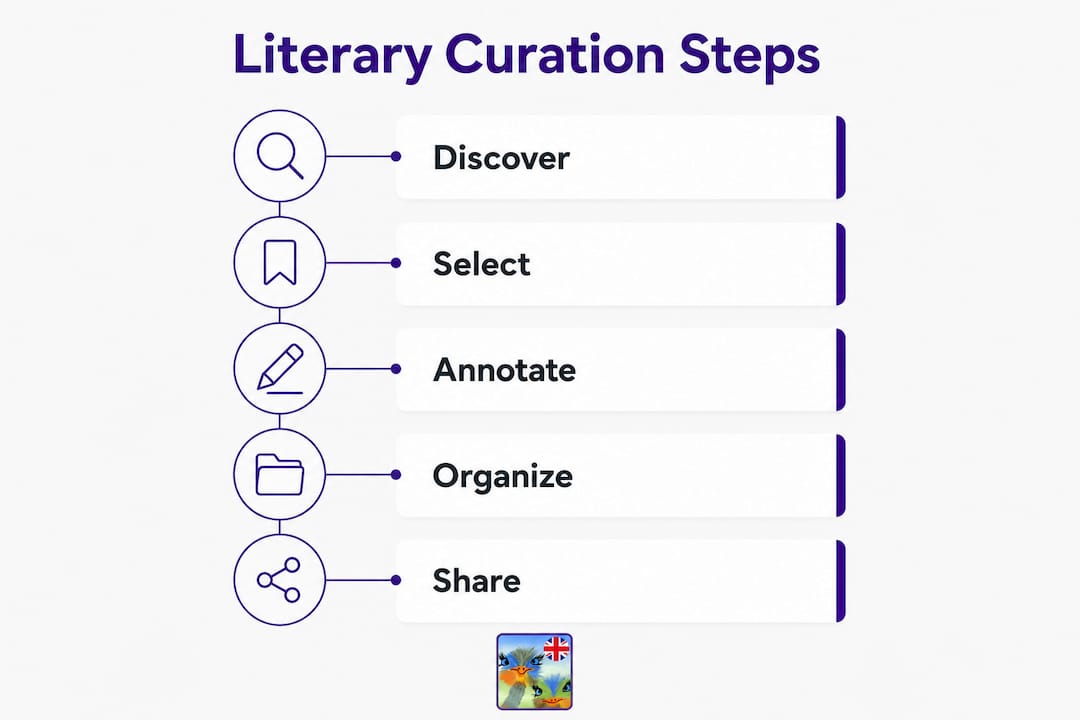
Good curation follows a repeatable process, even when the specific collection changes completely from one project to the next.
- Define your audience and purpose. A collection for middle-school readers exploring identity looks nothing like one built for marketing professionals studying narrative persuasion. Nail this before you touch a single title.
- Source widely before you narrow. Read beyond your usual channels. Academic journals, independent presses, translated works, and backlist titles often contain the most distinctive material.
- Apply a consistent selection criterion. Whether your filter is thematic, geographic, stylistic, or emotional, apply it the same way to every candidate. Inconsistency is what makes a collection feel arbitrary.
- Group works into thematic clusters. Sequence and grouping create the connective tissue that turns a list into a curated literary series. Think about how one work sets up the next.
- Write contextual annotations. Even a two-sentence note explaining why a work is included transforms a reader's experience of it. This is where the curator's voice becomes audible.
- Choose your platform and format. A curated reading list for a retail site, a bibliotherapy handout, and a literary newsletter all require different presentation. Match the format to where your audience will encounter the collection.
- Revisit and update. A static collection ages. Schedule periodic reviews to add new titles, retire ones that no longer fit, and refresh annotations as the cultural context shifts.
Tools that support this process include Goodreads for tracking and organizing candidates, Notion or Airtable for building annotated databases, and newsletter platforms like Substack for distributing curated collections directly to readers. For retail contexts, open shelving display strategies can translate a digital curation logic into a physical browsing experience that guides customers toward thematic groupings rather than alphabetical rows.
Real-world examples of literary curation in action
Literary curation shows up across publishing, retail, education, and wellness in ways that are easy to recognize once you know what to look for.
- Thematic reading series: Publishers that group backlist titles under a seasonal or cultural theme, such as "books for uncertain times" or a summer reading collection, are practicing curation. The editorial framing does the selling.
- Bibliotherapy collections: Hospitals, hospices, and mental health organizations build reading lists matched to specific emotional states. A list for patients managing chronic illness is curated around empathy and practical hope, not literary prestige.
- Content marketing campaigns: Brands that publish "what we're reading" roundups or annotated book lists for their audiences are using content curation strategies to build trust and demonstrate expertise without creating original content from scratch.
- Independent bookstore shelving: A shelf labeled "books that changed how we see cities" is a curated collection. The bookseller's annotation card is the contextual layer that makes it curation rather than merchandising.
- Literary festivals: Events like the Jaipur Literature Festival, shaped in part by Namita Gokhale's curatorial vision, function as live curated collections. The programming choices reflect a deliberate effort to bring interdisciplinary voices and underrepresented languages into the same conversation.
- Educational reading circles: Teachers who build multimodal literature circles around a theme are curating for learning outcomes, selecting texts that build on each other across genres and formats.
Munkterproducts applies this logic directly in its catalog, grouping handcrafted books, journals, and activity titles around themes of creativity, wellness, and personal growth rather than presenting them as an undifferentiated product list.
What recent research and thought leaders say about literary curation
The most useful thinking on literary curation comes from people who practice it at scale, not just theorize about it.
"In a new world of informational abundance, content curation is a new kind of authorship. The curator is not merely a collector but the author of the conversation itself." — Maria Popova, as cited by the Nieman Journalism Lab
Popova's framing reframes what curation actually is. The curator does not just point at existing work; the curator constructs a new intellectual object by deciding what goes next to what and why. That act of construction carries authorial responsibility.
Namita Gokhale describes effective literary curation as "literary architecture": weaving connections across genres, ideologies, and geographies to create thematic continuity that resists commercial homogenization. Her work at the Jaipur Literature Festival demonstrates that curation at its best is a form of cultural intervention, not just programming.
Research published in 2025 adds a technical dimension to the human-versus-algorithm debate. A study comparing human and AI-generated literature found that human authors produce higher idea density (higher idea density observed in human-authored texts compared to AI) and use figurative language more extensively. If human-authored texts are richer in the qualities that make curation meaningful, then human curators are also better positioned to recognize and select for those qualities. An algorithm optimizing for engagement metrics will miss what a skilled curator catches.
Books also function as cultural signals that carry meaning beyond their content. A curated collection encodes coherence and interpretive weight that no unfiltered catalog can match, which is why the curator's choices communicate something about values, not just taste.
Key Takeaways
Literary content curation is a human-led editorial practice that adds cultural and thematic value to existing works through deliberate selection, sequencing, and contextualization.
| Point | Details |
|---|---|
| Curation vs. creation | Curation organizes existing works with editorial context; creation produces original material from scratch. |
| Human judgment is irreplaceable | Human authors show higher idea density, and curators draw on that same depth to select meaningfully. |
| Bibliotherapy as applied curation | Curated reading lists built for emotional well-being are one of the most purposeful forms of literary curation. |
| Literary architecture | Effective curation weaves thematic connections across genres and geographies, not just compiles titles. |
| Curation as authorship | Maria Popova frames the curator as the author of the conversation, not merely a pointer to existing content. |