

TL;DR:
- Curated literary series influence the canon by shaping classroom preferences, cultural perception, and access to diverse voices.
- They are carefully constructed collections that combine literary merit, historical significance, and marketing strategies to legitimize their selections.
Most readers assume the literary canon formed naturally, that the books we call "essential" simply proved their worth across generations through merit alone. That assumption feels comforting. It also leaves out the editors, marketers, and institutional forces that quietly determined which titles got the elegant bindings, the classroom adoptions, and the cultural visibility. Curated literary series are the machinery behind much of what we call "the canon," and understanding how they work gives educators and literature lovers a far sharper lens for both choosing and questioning their reading lives.
Table of Contents
- What are curated literary series and why do they matter?
- Behind the scenes: How series are curated
- How curated series advance cultural enrichment and inclusion
- Controversies and challenges: Whose voices get heard?
- A fresh look: Rethinking curation in the digital era
- Explore curated literary collections with MunkterProducts
- Frequently asked questions
Key Takeaways
| Point | Details |
|---|---|
| Series shape the canon | Curated literary series play a central role in determining which works gain cultural and educational prominence. |
| Curation process matters | Editors weigh literary merit, diversity, and market factors when selecting works, impacting what readers and students encounter. |
| Promote inclusion | Many curated series now prioritize underrepresented voices, enriching reading lists and fostering intercultural understanding. |
| Critical engagement | It's important to question curatorial choices and seek diverse perspectives to avoid literary echo chambers. |
| Empathy and growth | Reading curated literary fiction can boost empathy and social-cognitive skills, enhancing personal and communal development. |
What are curated literary series and why do they matter?
A curated literary series is a branded, editorially selected collection of books published under a unified identity, typically with shared design aesthetics, stated criteria, and an implicit claim to cultural authority. Think of the Modern Library's iconic Borzoi colophon or the Library of America's distinctive cloth-bound volumes. These aren't random backlist collections. They're deliberate arguments about what literature matters and why.
Their influence runs deeper than most readers recognize. Book publishing's cultural impact reaches directly into classrooms, library acquisition budgets, and personal reading choices. When a series packages Toni Morrison, Edith Wharton, and Philip Roth under the same banner, it signals equivalence and authority. It tells educators, "This is the shortlist." That framing has enormous power.
Here's what makes these series matter most:
- Canon formation: Series selections define which works get taught, reprinted, and reviewed in major publications.
- Affordability and access: Affordable reprint editions often determine whether a reader in a smaller market ever encounters a particular author.
- Educator adoption: Series that target teachers through catalogs and supplementary materials gain classroom traction quickly.
- Cultural perception: Being included in a prestigious series often revives interest in authors who had faded from public attention.
- Marketing as legitimacy: Clever positioning treats institutional endorsement as proof of quality, even when the selection process is opaque.
Curated series like Modern Library and Library of America play a measurable role in canon formation through marketing, selection criteria, and affordable reprints that directly influence classroom adoption and the cultural perception of authors. A 2019 survey by the American Association of School Librarians found that over 60% of school librarians cited publisher series branding as a factor in acquisition decisions, which shows just how institutional this influence has become.
Behind the scenes: How series are curated
Understanding how these series actually work removes a lot of the mystique and replaces it with something more useful: informed skepticism paired with genuine appreciation.
The typical curation process moves through several distinct stages:
- Series identity definition: Publishers and founding editors establish the core mandate. Is this series focused on American literature? Global fiction? Marginalized voices? This identity shapes every subsequent decision.
- Candidate identification: Editors, advisory boards, and sometimes guest curators generate long lists based on nomination, scholarly recommendation, or market research.
- Evaluation against criteria: Works are assessed for literary quality, historical significance, thematic coherence with the series, and sometimes commercial viability.
- Packaging and design: Visual identity, introductory essays, and editorial apparatus are created to reinforce the series' authority and appeal.
- Educator and institutional targeting: Advance reading copies, curriculum guides, and direct outreach to teachers and librarians amplify uptake.
- Marketing and positioning: The series brand itself becomes the selling point, often through what critics call "Democratic Highbrow" positioning.
That last phrase deserves explanation. The selection mechanics of influential series involve expert curation based on literary merit, historical significance, and diversity, combined with marketing strategies including targeted educator promotions and "Democratic Highbrow" positioning. This means presenting serious, challenging literature as accessible and democratic while simultaneously signaling prestige. It's a careful balancing act between elitism and populism that makes these series appealing to both academics and general readers.
Here's a look at how major series compare on key curation factors:
| Series | Primary focus | Guest curators | EDI emphasis | Classroom materials |
|---|---|---|---|---|
| Modern Library | American/global classics | Occasional | Moderate | Yes |
| Library of America | American literature | Rarely | Growing | Yes |
| Penguin Classics | World literature | Frequent | Strong | Yes |
| Everyman's Library | International canon | Infrequent | Moderate | Limited |
| Restless Books | Global voices | Core model | Very strong | Emerging |
Pro Tip: When evaluating a curated series for classroom or personal use, read the series' editorial statement carefully. Watch for phrases like "timeless," "essential," or "definitive." These signal a particular ideological position about canon. A series that acknowledges its own limits is almost always more trustworthy than one that presents its selections as objectively correct.
For educators building curated book programs, understanding these mechanics is practical knowledge, not just academic theory. The more you know about how a list was assembled, the better you can use it, supplement it, or push back against it. And for creative educational books designed to spark curiosity, the principles are the same: curation that is transparent and intentional serves readers better than curation that hides its reasoning behind brand authority.
How curated series advance cultural enrichment and inclusion
Beyond the mechanics, there's a genuinely hopeful dimension to curated literary series. When done well, they serve as bridges, connecting readers to experiences, histories, and perspectives they would never otherwise encounter.

Consider what a well-designed series actually does for a reader's interior life. A student in rural Ohio who picks up a Library of America volume of Zora Neale Hurston is not just reading a novel. She's encountering the Harlem Renaissance, the African American oral tradition, the specific textures of Southern Black life in the early 20th century. That's cultural enrichment in the most concrete sense.
Cultural enrichment through curated series happens directly through the promotion of diversity, underrepresented voices, and intercultural understanding, especially when series align their selections with EDI calendars and integrate global literature systematically. Forward-thinking series now explicitly build around equity, diversity, and inclusion frameworks, treating representation not as a marketing gesture but as a curatorial responsibility.
The cognitive benefits are real too. Literary fiction reading links to improved social-cognitive skills, including Theory of Mind (the ability to understand that others hold beliefs different from your own), though the strength of short-term effects varies across studies. What's consistently true is that exposure to richly varied literary voices expands emotional vocabulary and sharpens empathy.
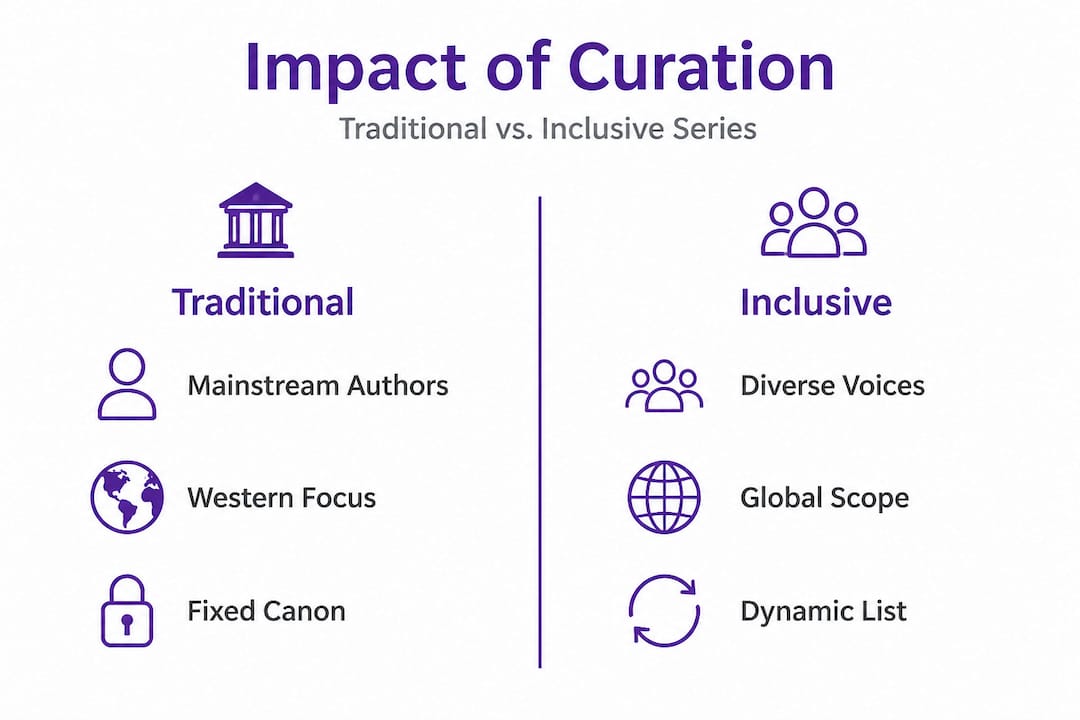
Compare how traditional and EDI-aligned series approach their selections:
| Feature | Traditional series | EDI-aligned series |
|---|---|---|
| Author demographics | Predominantly Western/white | Actively diverse |
| Language origins | Mostly English-language | Multilingual and translated |
| Historical scope | Often focused on the past | Includes contemporary voices |
| Selection transparency | Limited public criteria | Published guidelines |
| Community input | Rare | Often built in |
The differences are substantive, not cosmetic. An educator who chooses between these series for a curriculum unit isn't just picking books. They're choosing what kind of cultural imagination they want to cultivate in their students.
For readers focused on personal growth through curated reading, the cultural enrichment dimension is equally relevant. Building a personal canon that draws from multiple curated series (rather than just one authoritative list) creates a richer, more honest picture of what literature can do.
"The goal of reading should never be to confirm what you already know. The best literary series challenge you to encounter a mind completely unlike your own and come away changed by it."
Controversies and challenges: Whose voices get heard?
No curation system is neutral, and the history of literary series is full of instructive failures and uncomfortable choices. Engaging with these critiques makes you a more thoughtful reader and a more effective educator.
Here are the most significant challenges curated series face:
-
Popularization backlash: A work championed by a major series often becomes so associated with institutional approval that younger critics reject it. Virginia Woolf built her reputation partly on the idea of the "common reader," an ordinary person engaging honestly with literature. When popularization conflicts with prestige, that original spirit can get dropped, leaving the author's work trapped in a frame she would have resisted.
-
Authorial resistance: Some writers refuse to allow their work to appear in certain series because of disagreements over editorial framing, companion selections, or commercial associations. This resistance isn't petty. An author's work placed alongside writers they consider ideologically opposed can distort how readers interpret their output.
-
Echo chambers in selection committees: If the same scholars, critics, and editors rotate through advisory boards, the same biases circulate. A committee that skews toward a particular definition of literary quality will consistently overlook work that operates by different aesthetic rules, even when that work is genuinely important.
-
Marketing versus merit: When series selections are driven partly by what will sell to educators, commercially legible authors get prioritized over experimentally significant ones. The result is a canon that is slightly more conservative than it should be.
-
The permanence problem: Once a work enters a prestigious series, it tends to stay there and stay assigned. This creates inertia that makes it hard for newly recognized voices to displace older, less diverse selections.
Pro Tip: If you're building a reading curriculum or a personal literary education, treat any single curated series as a starting point, never an endpoint. Cross-reference at least two or three series with different editorial philosophies to identify both the overlaps (probably genuinely important works) and the gaps (where your particular series' blind spots live).
The shifts reshaping publishing in 2026 are pushing these conversations forward. Digital publishing, community-driven lists, and global distribution are all creating pressure on traditional gatekeeping structures. The question is whether established series will adapt or calcify.
"A canon is never a neutral description of what's good. It's a record of what particular people, in particular positions of power, decided to value and preserve."
A fresh look: Rethinking curation in the digital era
Here's a position that makes some literary traditionalists uncomfortable: curation, even well-intentioned curation, can harm reading culture when it becomes self-referential and stops refreshing its own assumptions.
We've been taught to think of curated literary series as correctives, as the thoughtful alternative to purely commercial publishing. And sometimes they are. But the same institutional prestige that makes a series influential also makes it resistant to change. Series built around rotating guest curators, community nominations, and explicit transparency about selection criteria consistently produce more interesting, more contested, and ultimately more valuable lists than those run by permanent editorial boards with fixed ideas about what literature means.
The digital era offers tools that didn't exist when the Modern Library was assembling its famous "100 Best Novels" list in 1998. Online reading communities, multilingual platforms, and independent literary podcasts are generating canons from below, based on actual reader engagement rather than top-down expert decree. These participatory models aren't perfect. They have their own biases toward the contemporary and the easily discussable. But they inject energy and genuine disagreement into a system that can otherwise become very comfortable with its own authority.
The most honest version of publishing's impact on the canon acknowledges that the series which shaped literary culture weren't just identifying greatness. They were constructing it, making certain works feel inevitable and others feel marginal through choices that could have gone differently. That's not a reason to dismiss curated series. It's a reason to engage with them critically, demand transparency from their editors, and actively seek out the series that are doing the harder, messier work of genuinely expanding what counts as literature.
As a reader or educator, the most powerful move you can make is to maintain your own curatorial practice. Build your reading life from multiple sources. Note which voices are absent from the lists you trust most. That absence is almost always more instructive than the presence.
Explore curated literary collections with MunkterProducts
After thinking carefully about how curated literary series shape reading engagement, you might be ready to explore collections that reflect those same values of intention, quality, and genuine diversity.

At MunkterProducts, we believe that the books and materials you choose should work as hard as you do, whether you're building a classroom library, deepening a personal reading practice, or looking for creative resources that spark authentic engagement. Our curated collections include educational books, creative activity books, self-development journals, and fiction titles designed to support real literary growth. From children's educational series to adult fiction, every selection reflects a commitment to meaningful content over empty prestige. Explore what we've gathered for readers who take their literary lives seriously.
Frequently asked questions
How do curated literary series influence classroom reading lists?
Curated series guide classroom selections by packaging canonized works with educator outreach, including curriculum guides and affordable reprints, making adoption easier for teachers and school librarians.
What criteria do editors use to select works for these series?
Editors typically prioritize literary merit and historical significance, alongside diversity and, in some cases, commercial appeal, often using a combination of expert panels and established advisory boards to evaluate candidates.
Can curated literary series help promote underrepresented voices?
Yes, particularly series built around EDI frameworks and diversity goals that actively seek authors from marginalized backgrounds and non-English-speaking traditions to broaden the literary landscape.
Are there any drawbacks to canon formation through these series?
Curatorial control can create popularization backlash and author exclusion, and series dominated by a fixed editorial board risk reinforcing the same cultural biases they were meant to correct.
Do curated literary series really affect readers' social or cognitive skills?
Research connects literary fiction to Theory of Mind improvements and stronger empathy, though direct studies on series-level effects are limited, with most evidence coming from broader literary reading research.