
TL;DR:
- Curated books involve deliberate selection, organization, and purpose, unlike random collections or sales-driven lists. Genuine curation requires transparency, expertise, and meaningful sequencing to offer true educational or creative value. Consumers should evaluate the curator's credentials and goals to ensure the collection meets their specific needs and interests.
Walk into any bookstore or browse any online catalog and you'll see the word "curated" slapped on everything from gift sets to reading lists. But here's the thing most people miss: curated does not automatically mean better. It signals intent — that someone made deliberate choices about what to include, how to organize it, and who it's for. This article breaks down what a curated book actually is, how the curation process works, where curated collections shine brightest, and exactly what to look for when choosing one for yourself, your kids, or a creative project.
Table of Contents
- What does "curated" mean in the context of books?
- How curated books are created: The process and what sets them apart
- Common uses: Curated books in education, creative discovery, and family reading
- Curation is not always perfection: Limits, subjectivity, and what to look for
- Why critical thinking matters more than the curated label
- Find your next curated book experience
- Frequently asked questions
Key Takeaways
| Point | Details |
|---|---|
| Curated means intentional | A curated book is chosen and organized for a focused purpose, unlike random collections. |
| Curation supports learning | Curated books often guide learning or creativity by theme, sequence, and audience fit. |
| Not always better | The curated label signals a process, not guaranteed quality or universal appeal. |
| Check for curator transparency | True curation should identify who chose the books, their criteria, and intended benefits. |
What does "curated" mean in the context of books?
Now that basic misconceptions about curation are addressed, it's important to unpack exactly what qualifies as curation — and what doesn't — in modern book collections.
A "curated" book is intentionally selected, organized, and presented for a specific purpose or audience. Think of it like a museum exhibit. A curator doesn't just pile objects in a room. They choose each piece deliberately, arrange them in an order that tells a story, and provide context that helps the visitor understand what they're looking at. The same logic applies to books.
In the reading world, curation can show up in several forms. A themed reading list compiled by a literacy specialist is curated. A journal with sequenced creative writing prompts that build on each other is curated. A holiday gift set assembled around a specific age group and developmental stage is curated. What connects all of these is editorial intent — a human (or team of humans) making purposeful decisions.
What is not curated? A bulk bundle thrown together because the titles were on sale. A generic "bestseller" list generated purely by sales data with no thematic or educational logic. A product page that slaps the word "curated" on a collection because it sounds appealing. These are aggregations, not curation.
"A curated collection is the difference between a librarian building a summer reading program and a warehouse palletizing whatever books are in stock. Both involve books. Only one involves thought."
The value for readers seeking educational or creative growth is real, but only when the curation is genuine. For families exploring literary series curation, understanding this distinction protects you from paying a premium for something assembled without real editorial care.
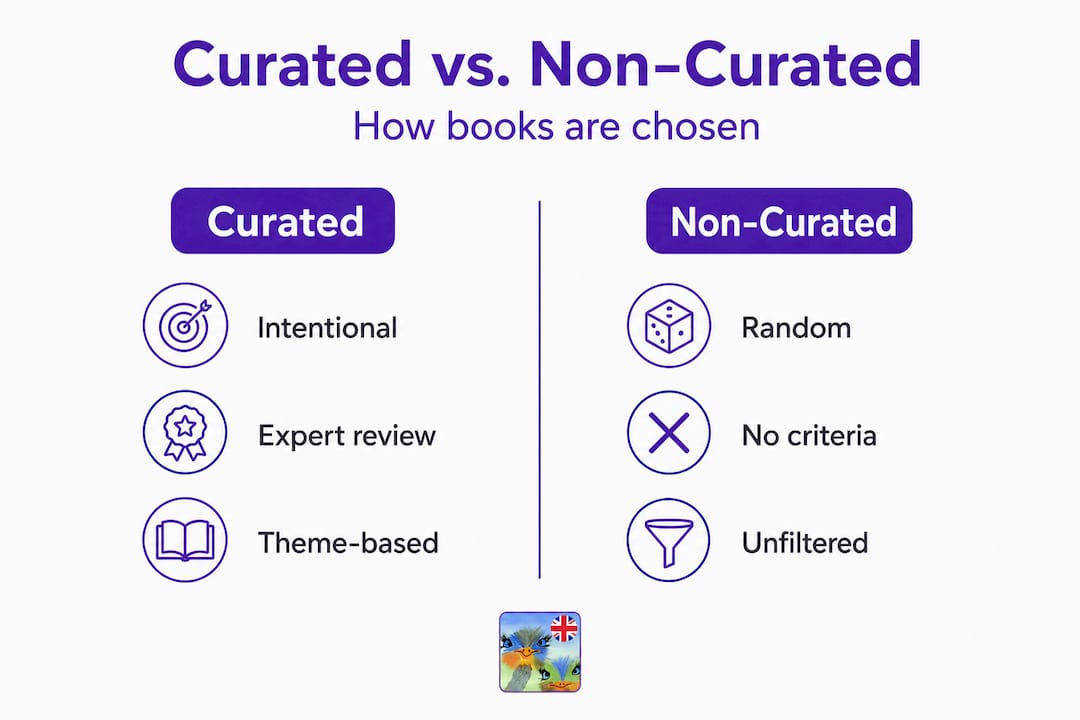
| Feature | Curated book collection | Non-curated collection |
|---|---|---|
| Selection method | Intentional, theme or audience-based | Random or sales-driven |
| Organization | Sequenced for purpose or learning | No deliberate ordering |
| Editorial guidance | Named curator or editor with criteria | No clear editorial voice |
| Reader benefit | Guided journey, clear purpose | Hit or miss usefulness |
| Transparency | Rationale is explained or implied | Little to no explanation |
How curated books are created: The process and what sets them apart
Understanding what curation is raises another question: how is intentional book curation actually done, and what makes it different from just building a list?
Curated book lists are compiled with specialized knowledge, organized around theme, audience need, and sequencing for learning. That last word — sequencing — is where most non-curated collections fall flat. A truly curated collection guides you through material in an order that makes sense. Earlier items build the foundation. Later items expand on it. The reader ends up somewhere meaningfully different from where they started.
Here's how a thoughtful curation process typically unfolds:
- Define the goal. What should the reader experience, learn, or feel by the end? A curated set of children's holiday books might aim to build seasonal vocabulary and family values. An adult creative journal might aim to unlock personal expression over 30 days.
- Define the audience. Age, reading level, prior knowledge, and emotional needs all shape which books belong and which don't. A collection for a 6-year-old is fundamentally different from one for a 60-year-old, even if they share a theme.
- Select the titles or content. This is where expert knowledge matters most. A curator draws on experience, research, and often community feedback to shortlist candidates. Not every great book makes the cut because fit with the collection matters as much as individual quality.
- Organize the sequence. Simple-to-complex, chronological, emotional arc, or thematic grouping — the order tells its own story. This step separates curators from list makers.
- Justify the selections. Great curation is transparent. The curator explains why each piece is included, what it contributes, and how it connects to the larger purpose.
Pro Tip: Before you buy any "curated" book collection, look for a clearly named editor, curator, or expert, plus at least a brief explanation of the selection criteria. If neither exists, you're probably looking at marketing language rather than genuine curation.
The difference between simple aggregation and real curation comes down to accountability. A curator puts their expertise on the line with every selection. That accountability is what makes the experience valuable — and what separates a thoughtfully curated holiday book selection from a generic seasonal bundle.
Common uses: Curated books in education, creative discovery, and family reading
Curation comes alive in real-world scenarios that matter to parents, educators, and creative adults, so let's look at specific uses and real benefits.
"Curated" in educational contexts means lists or collections built to support a learning journey, often with themed progression and a balance between depth and breadth. That's a mouthful, but in practice it means something simple and powerful: the right book, at the right time, for the right reader.
For education: A curated reading bundle for early readers might start with short phonics-based stories, then gradually introduce longer sentences, richer vocabulary, and more complex plot structures. Each book prepares the child for the next. Compare this to a random grab-bag of "educational" books where there's no progression — the child gets bored with books too easy and frustrated by books too hard. Curated collections solve this problem by design.

For creative exploration: Adults looking for creative outlets benefit enormously from curated journals, themed coloring books, and guided activity books. A coloring book organized around a theme of personal confidence, for example, isn't just a collection of pretty images. Each page builds on the last, subtly reinforcing a mindset shift as the reader works through it. Guided writing journals with sequenced prompts work the same way. Checking out books for creativity can help you find collections designed with this kind of depth.
For family reading: Curated story sets around holidays, values, or developmental milestones make it easier for parents to choose books without spending hours researching. A curated holiday collection might balance humor, emotion, and gentle life lessons in a way that keeps kids engaged and gives families something to talk about together. These aren't random titles; they're selected to work together.
| Book type | Audience | Curation purpose |
|---|---|---|
| Phonics reading bundle | Ages 4 to 7 | Progressive skill building |
| Holiday story set | Children, families | Seasonal engagement and values |
| Guided adult coloring book | Adults 18 and up | Creative expression, mindset themes |
| Themed writing journal | Adults, teens | Sequential self-exploration |
| Age-specific activity books | Children by grade | Curriculum-aligned learning |
| Science fiction novel series | Adults, YA readers | Narrative continuity and world-building |
Here's a quick breakdown of what to look for across each use case:
- Education: Clear age or grade targeting, progression from simpler to more complex, alignment with known learning goals
- Creative discovery: A unifying theme or creative philosophy, prompts or images that build rather than repeat, space for the reader to grow
- Family reading: Shared values or seasonal relevance, varied tone to hold different ages' attention, selections that reward re-reading
You'll also find that children's educational book picks from trusted sources tend to share these qualities. The curation is visible in the choices, not just claimed in the marketing.
Curation is not always perfection: Limits, subjectivity, and what to look for
Seeing the benefits doesn't mean ignoring the limits: not all curated books are equal, and it's important to know what could go wrong and what to question.
The honest truth is that "curated" does not mean automatically better — selections and descriptions always involve assumptions and subjectivity. A curator brings their own worldview, cultural context, and personal preferences to every decision. Sometimes that enriches the collection. Sometimes it narrows it in ways that don't serve your specific needs.
Common pitfalls to watch for include:
- Overly narrow selection. A curated reading list built around one cultural tradition or academic viewpoint may feel authoritative but actually excludes perspectives that would be valuable to your reader.
- Lack of transparency. If no one explains why the titles were chosen or who did the choosing, the word "curated" is doing a lot of heavy lifting with nothing behind it.
- Bias without acknowledgment. Every curator has biases. Trustworthy curators name them. A curated children's book collection built by a literacy specialist who specializes in early phonics will reflect that emphasis — which is great if that's what you need, and limiting if you're looking for imaginative fiction.
- Outdated criteria. A collection "curated" five or ten years ago for a specific educational standard may no longer match current approaches, especially in fast-moving fields.
Pro Tip: Before buying a curated collection, ask three questions. Who did the curating, and what's their relevant expertise? What was their stated goal for this collection? Does the sequence or organization reflect that goal visibly? If you can't answer all three, dig deeper before spending your money.
Understanding the publishing impact of thoughtful selection versus generic compilation helps you recognize the difference in real products. Publishers and brands who take curation seriously make their criteria visible. Those using it as a buzzword don't.
Why critical thinking matters more than the curated label
Here's a perspective worth sitting with: the book industry has done a great job borrowing the language of curation without always delivering the substance. "Curated" now appears on everything from subscription boxes to random book club picks, and buyers often assume the label guarantees a quality experience. It doesn't.
What matters far more than the label is evidence of the process. Did someone with real expertise make deliberate choices? Is the sequence meaningful? Does the collection serve a specific reader's actual needs, or does it serve the widest possible market? These are the questions that cut through the marketing noise.
Conventional wisdom says curated equals superior. Real experience says curated equals someone tried to be intentional. Whether they succeeded depends on who they are, what they were trying to achieve, and whether that matches what you're looking for. A collection curated by a children's librarian for reluctant readers aged 8 to 10 is genuinely valuable — but only if you have a reluctant reader aged 8 to 10.
This is why personal fit is the ultimate test of any curated book. Ask yourself: does the curator's goal align with mine? Does the audience match my reader (or me)? Is the progression visible and logical? When those three things line up, curated books deliver real, lasting value.
Handcrafted creative books offer a useful parallel here. The value of a handcrafted object isn't just in its material quality — it's in the intention and skill that shaped it. The same is true of genuinely curated books. The label is the starting point. The evidence is what counts.
Find your next curated book experience
If you've made it this far, you now know exactly what to look for in a genuinely curated book: a visible process, a named curator or editor, a clear audience, and meaningful organization. That knowledge is worth more than any marketing claim.

At Munkter Products, every book, journal, coloring book, and activity set in the catalog is selected and presented with a specific reader in mind — whether that's a parent looking for engaging holiday stories, an adult seeking a creative outlet through themed coloring, or a family building a reading habit together. You won't find random bundles dressed up as collections. You'll find books chosen because they serve a real purpose for a real reader. Browse the full range and apply everything you've just learned.
Frequently asked questions
What is the difference between a curated book and a regular book collection?
A curated book collection is intentionally selected and presented for a specific audience or theme, whereas a regular collection may be randomly compiled without expert intent or editorial logic.
How can I tell if a book or book collection is truly curated?
Look for a clearly named curator or editor with stated criteria or theme, plus content organized in a sequence that serves a specific purpose or audience rather than assembled at random.
Are curated books always higher quality?
No — curated selections always involve assumptions and subjectivity, so quality and real value depend heavily on the curator's expertise, their criteria, and how well those match your specific needs.
What are some common types of curated book collections for children?
Common examples include themed reading bundles, holiday story sets, and age-specific educational packs built around a theme or audience to guide learning, often compiled by librarians or literacy experts with a clear progression in mind.