
TL;DR:
- Fostering creativity in children enhances critical thinking, emotional resilience, and motivation, especially during ages 3 to 7. Engaging in imaginative play, guided reflection, and open-ended digital activities supports developmental growth, while high-quality adult guidance optimizes creative outcomes. Building creative skills reinforces emotional regulation and resilience, making it essential to prioritize playful, reflective, and interest-based activities in childhood development.
Creativity in childhood is defined as the capacity to generate original ideas, make unexpected connections, and express thought through play, art, and storytelling. Inspiring creativity in kids directly strengthens problem-solving ability, emotional resilience, and intrinsic motivation to learn. ASCD research confirms that creativity increases engagement and higher-order cognitive skills, particularly for children who struggle with traditional academic formats. A 2026 meta-analysis published in F1000Research found an effect size of g=0.74 for creativity development in early childhood, one of the strongest findings in recent developmental science. This article combines that 2026 research with practical, age-specific strategies for parents and educators who want to act on it.
Why inspire creativity in kids, according to research
The science behind nurturing imagination in children is more specific than most parents realize. Creativity does not develop passively. It requires the right conditions, and the research now tells us exactly what those conditions look like.
ASCD's 2026 analysis identifies three psychological needs that creative learning must meet: interest, autonomy, and competence. When all three are present, children move from passive participation to intrinsic motivation and genuine cognitive engagement. That shift matters because intrinsically motivated children persist longer, tolerate frustration better, and retain what they learn.
A separate body of work from Frontiers in Psychology links aesthetic education, which includes visual art, music, and dramatic expression, to measurable gains in psychological resilience. The mechanism is emotion regulation. Children who engage regularly in creative activities develop stronger cognitive reappraisal skills, meaning they learn to reframe difficult experiences rather than suppress them. That is a skill most adults spend years trying to build.
"Creativity is not a talent. It is a way of operating." — John Cleese
The importance of creativity for children also shows up in how they handle academic difficulty. ASCD notes that creative learning normalizes mistakes by framing them as part of the process rather than evidence of failure. Children who experience this framing early develop a fundamentally different relationship with challenge.
Key findings from the 2026 research base include:
- Effect size g=0.74 for creativity development in early childhood (ages 3 to 7), the strongest window for creative growth
- Dramatic play produces an effect size of g=0.71, making it one of the most powerful single activities for creative development
- Cognitive reappraisal is the primary mediator between aesthetic education and psychological resilience, with a total indirect effect of β=0.193
- Digital games used over a 16-week period significantly improved drawing innovation and storytelling richness in preschoolers
How do different types of play shape creative development?
Not all play produces the same creative outcomes. The type of play, the age of the child, and the level of adult involvement each change the result significantly.
A three-level meta-analysis from F1000Research examined creative play across age groups and found that early childhood (ages 3 to 7) is the most sensitive period for creativity development. The effect is not just stronger at this age. It is qualitatively different. Younger children are still building the cognitive flexibility that creativity depends on, which means the window for maximum impact is real and time-limited.
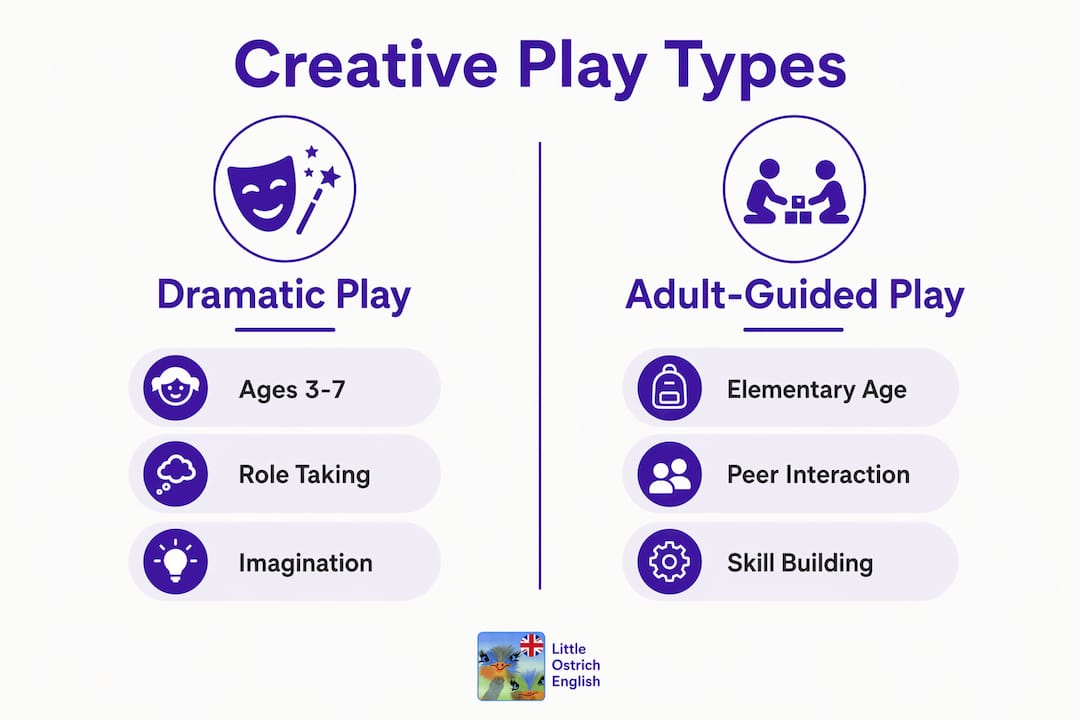
The type of play also matters. Dramatic play, where children take on roles and construct imaginary scenarios, produces the strongest effect. Psychology Today's review of pretend play research explains why: the "as-if" stance required in pretend play forces children to shift perspectives and generate alternative possibilities, two cognitive operations that sit at the core of creative thinking.
| Play type | Best age range | Adult role | Creative benefit |
|---|---|---|---|
| Dramatic/pretend play | Ages 3 to 7 | Light facilitation | Perspective-taking, idea generation |
| Constructive play (building, making) | Ages 4 to 10 | Minimal guidance | Spatial reasoning, problem-solving |
| Digital open-ended games | Ages 4 to 8 | Co-play and discussion | Storytelling, visual expression |
| Adult-guided peer play | Ages 6 to 12 | Active scaffolding | Collaborative creativity, social skills |
| Unstructured free play | All ages | Absent or observational | Autonomy, self-directed thinking |
A ScienceDirect meta-analysis adds an important nuance: adult-guided peer play benefits elementary-age children's creativity more than unstructured play alone. More play is not automatically better. The quality of adult involvement, specifically calibrated scaffolding rather than full control or full absence, determines whether play translates into creative growth.
Pro Tip: Avoid hovering or directing every move during play. Instead, ask open questions like "What could happen next?" or "Is there another way to do that?" These prompts activate the perspective-shifting that makes dramatic play so effective.
Why creative development builds emotional resilience in kids
The emotional benefits of creative engagement go beyond self-expression. They reach into how children regulate stress, recover from setbacks, and relate to other people.
Research from Frontiers in Psychology shows that aesthetic education strengthens resilience through two emotion regulation pathways. Cognitive reappraisal, the ability to reinterpret a situation, is the primary mechanism. Expressive suppression, which involves holding back emotional responses, plays a smaller role. Children who learn to reappraise rather than suppress are better equipped to handle social conflict, academic pressure, and personal disappointment.
ASCD's research adds a behavioral layer to this picture. When children work through repeated cycles of creative attempt and reflection, they build what researchers call productive struggle tolerance. The key is the reflection step. Reflective prompts from adults after a creative effort, questions like "What was hard about that?" or "What would you change?", normalize difficulty and build confidence over time.
The social dimension of creativity also deserves attention. Children who engage in collaborative creative activities, group storytelling, shared building projects, or dramatic play with peers, practice perspective-taking and negotiation in low-stakes environments. These are the same skills that predict positive peer relationships and conflict resolution ability in later childhood. Encouraging artistic expression in group settings is not just about art. It is social skills training with a creative wrapper.
What practical strategies help parents and educators inspire creativity?
Knowing why creativity matters is one thing. Knowing how to build it into daily life is another. The following strategies are grounded in the 2026 research and designed for both home and classroom settings.
-
Align creative activities with the child's existing interests. ASCD's framework identifies interest as the first psychological need for creative engagement. A child obsessed with dinosaurs will engage more deeply with a creative writing prompt about prehistoric worlds than a generic story starter. Interest is not a shortcut. It is the mechanism.
-
Integrate open-ended digital games for younger children. A BMC longitudinal study found that a 16-week digital game intervention significantly improved drawing innovation and storytelling richness in preschoolers. The key word is open-ended. Games with fixed outcomes do not produce the same effect. Look for tools that allow children to build, narrate, or design freely.
-
Balance guided and free play deliberately. The ScienceDirect meta-analysis is clear that calibrating adult guidance produces better creative outcomes than defaulting to either extreme. For children under 7, light facilitation during dramatic play works well. For children aged 6 to 12, structured peer collaboration with adult scaffolding produces stronger results.
-
Use reflective prompts after creative work. ASCD recommends mirroring productive struggles with specific questions rather than generic praise. "I noticed you tried three different endings. Which one felt most true to the character?" builds more creative confidence than "Great job."
-
Protect pretend play time against academic pressure. Psychology Today's review warns that the push toward early academic skills is crowding out dramatic play, precisely when its developmental effect is strongest. A child who spends ages 4 to 6 in structured academic prep misses the peak window for the creative cognitive skills that will serve them in every subject later.
Pro Tip: Children's journals and activity books designed around open prompts, like those available through creative activity guides, give kids a structured starting point without closing off where the idea can go. That balance of scaffold and freedom is exactly what the research recommends.
Key takeaways
Inspiring creativity in children requires intentional, age-calibrated play, adult scaffolding at the right moments, and consistent reflection to build both cognitive skills and emotional resilience.
| Point | Details |
|---|---|
| Early childhood is the peak window | Ages 3 to 7 show the strongest effect size (g=0.74) for creativity development through play. |
| Dramatic play is the most powerful single activity | Effect size g=0.71 makes pretend play the top evidence-backed tool for building creative thinking. |
| Adult guidance quality matters more than quantity | Calibrated scaffolding outperforms both full control and complete absence in developing creativity. |
| Creativity builds emotional resilience | Aesthetic education improves psychological resilience via cognitive reappraisal (β=0.193 indirect effect). |
| Reflection amplifies creative growth | Asking specific reflective questions after creative work normalizes struggle and builds lasting confidence. |
What I've learned from watching creativity get squeezed out of childhood
I have spent years watching parents and educators make the same well-intentioned mistake: they treat creativity as a reward for finishing the real work. Art on Friday afternoon. Free play after the worksheet is done. The implicit message to children is that creativity is optional, decorative, and lower priority than structured learning.
The 2026 research dismantles that hierarchy completely. Creativity is not the dessert. It is the nutrition. The cognitive skills built through dramatic play, reflective creative projects, and open-ended digital tools are the same skills that predict academic persistence, emotional regulation, and social competence. Treating them as extras is a developmental miscalculation.
What I find most underappreciated is the role of productive struggle in creative work. Most adults, parents and teachers alike, intervene too quickly when a child gets stuck. The instinct to help is genuine, but it short-circuits the exact process that builds resilience. Sitting with a child who is frustrated by a creative problem and asking "What have you tried so far?" instead of offering a solution is one of the hardest and most valuable things an adult can do.
The other pattern I keep seeing is the over-scheduling of structured activities at the expense of pretend play, particularly for children between ages 4 and 7. Swim lessons, coding classes, and reading programs all have value. But none of them replicate what happens cognitively when a child decides that the couch is a spaceship and spends 45 minutes building a world around that premise. That kind of play is not wasted time. It is the foundation.
— Mark
Creative tools from Munkterproducts to spark your child's imagination

Munkterproducts carries a curated range of printed resources designed to put the research into practice at home or in the classroom. The educational coloring books combine visual creativity with learning prompts that align with children's interests, hitting two of ASCD's three psychological needs in a single activity. The children's journals use open-ended prompts that mirror the reflective questioning the research recommends. For parents looking to build a home creativity practice, the full range of educational books and activity resources at Munkterproducts offers a practical starting point without the guesswork.
FAQ
Why is creativity so important for children's development?
Creativity builds higher-order cognitive skills, emotional resilience, and intrinsic motivation. ASCD research shows it increases engagement and problem-solving ability, particularly for children who struggle with traditional academic formats.
What age is best for developing creativity in kids?
Ages 3 to 7 represent the strongest developmental window, with a meta-analysis effect size of g=0.74 for creativity development in early childhood. Dramatic and pretend play during this period produce the most significant gains.
Does screen time help or hurt creativity in children?
Open-ended digital games support creativity when used intentionally. A 16-week BMC study found significant improvements in drawing innovation and storytelling richness in preschoolers who used open digital tools, distinguishing them from passive or fixed-outcome screen time.
How much should parents guide creative play?
Calibrated adult guidance outperforms both full control and complete absence. For children under 7, light facilitation works best. For ages 6 to 12, structured peer play with active adult scaffolding produces stronger creative outcomes.
What is the link between creativity and emotional resilience?
Aesthetic education and creative engagement strengthen psychological resilience primarily through cognitive reappraisal, the ability to reframe difficult experiences. A Frontiers in Psychology study recorded a total indirect effect of β=0.193 between aesthetic education participation and resilience.