
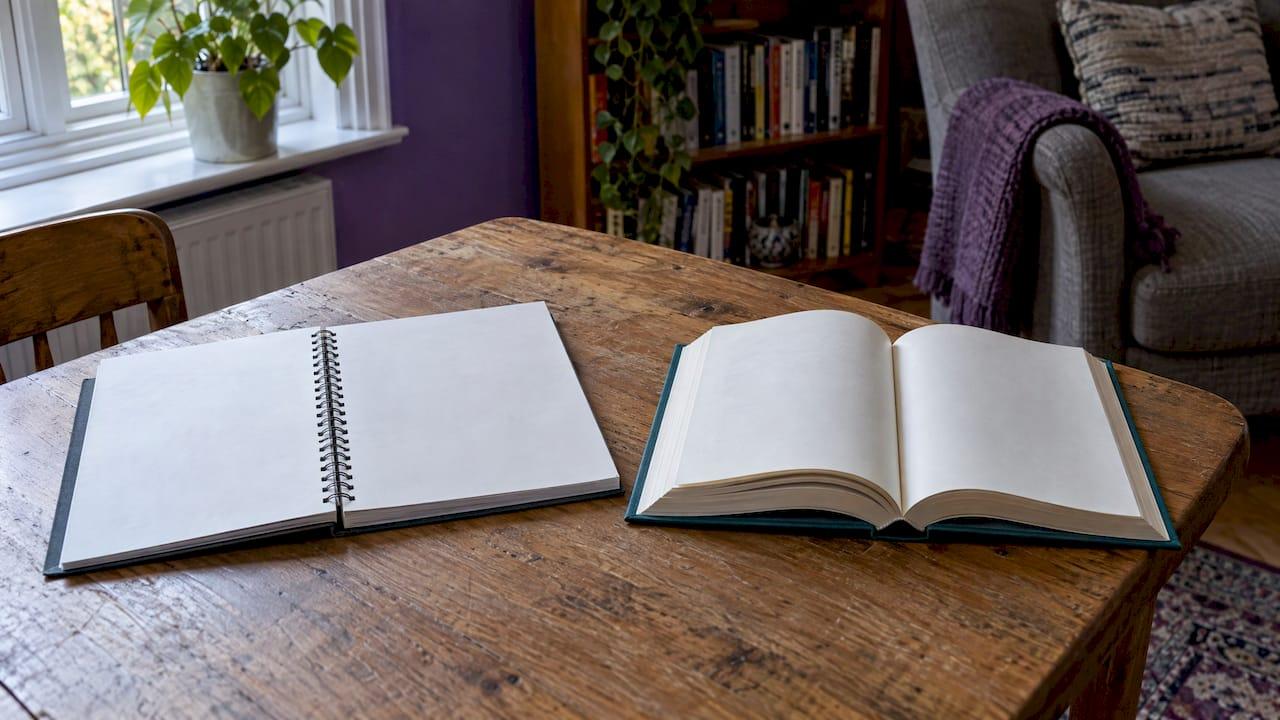
Choose wirebound if you will write, color or solve in the book and need it to open completely flat. Choose casebound if you want a hardback that protects its pages, looks substantial on a shelf and is built to be handled for years. The two bindings solve different problems, so the right one depends on what you will do with the book, not on which is "better".
This guide explains what each term means, how each book is made, where each one wins and which suits coloring books, puzzle books, journals and novels. It is written for parents choosing activity books for children, for coloring and puzzle fans, for journal keepers and for readers who simply want a book that lasts.
TL;DR
- Wirebound (also called Wire-O or wiro) opens a full 360 degrees and lies flat, which suits books you work in: coloring, puzzles, planners, journals.
- Casebound is the hardback: a rigid cover of board wrapped in paper, cloth or leather, glued to a sewn or glued stack of pages. It suits books you keep and read.
- Wire has no printed spine and can bend if squashed. Casebound is heavier, bulkier and costs more to make.
- For children under 6, exposed wire loops are a cut and entanglement risk, so a closed-spine book is the safer pick.
- Match the binding to the job: flat for work, hardback for keeping.
Table of Contents
- What casebound means
- What wirebound means
- Wirebound vs casebound side by side
- Opening and lay-flat: the biggest practical difference
- Durability: what really makes a book last
- A safety note for young children
- Which binding suits which kind of book
- Weight, bulk and cost
- Where to find books built for how you use them
- Our view on choosing a binding
- FAQ
- Sources
What casebound means
Casebound is the technical name for a hardback. The cover, called the case, is made separately from the pages and attached afterward. The Language of Bindings project at the University of Edinburgh describes it as a hard cover made wholly apart from the book and joined by gluing the endpapers (the sheets at the front and back) to the inside of the case boards. It dates to Britain in the 1820s, so it is a very old and well-proven method.
The case itself is simple. A UK printer explains that the case is made from three pieces of greyboard: front, spine and back. These are covered in anything from a printed paper sheet to book cloth or leather, often with the title foil-blocked onto the spine and front.
Inside, the pages are folded into groups called sections. One UK bookbinder describes folding printed sheets into 16-page sections, collating them into a block, sewing them down the spine, strengthening the sewing with a linen lining, trimming three edges and then casing the block into its board cover. Another UK printer lists the full sequence, from cutting and folding to forming the joint groove, the small hinge that lets the cover open cleanly.

Many casebound books also wear a dust jacket. That gives space for full-color artwork while the cloth or paper case underneath does the protecting.
What wirebound means
Wirebound, Wire-O, twin-loop and wiro are all names for the same idea. A row of small holes is punched along the left edge of the pages and covers, and a double-loop metal wire is threaded through them. A UK machinery supplier explains the wire starts open in a U shape, the leaves are threaded over the loops and the wire is then compressed closed. It can only be closed once, so the book is permanently bound.
Production is largely automated. Instant Print describes pages being printed and trimmed, the cover sometimes laminated, then punched and bound on machines that cut the wire to size and close its loops. A UK printer adds that the wire seam is hidden inside the back cover, so pages cannot fall out.
The result is a book whose pages turn all the way around the wire. That one feature explains almost everything people like about wirebound books.
Wirebound vs casebound side by side
The table pulls together the points that matter when you are choosing a book to use, rather than to print.
| Wirebound | Casebound | |
|---|---|---|
| How it opens | Flat, pages rotate 360 degrees | Conventional opening; flat only if sewn well |
| Spine | No printed spine | Printable spine and full cover surface |
| Protection | Pages held firmly; loops can bend under pressure | Rigid boards protect pages and corners |
| Weight | Light to medium | Heavier and bulkier |
| Typical cost to make | Low to medium | Highest |
| Best for | Coloring, puzzles, planners, workbooks, journals | Novels, gift books, keepsakes, reference |
The comparison draws on Yuen Printing's binding guide, which says wire opens a full 360 degrees and lies completely flat but has no printable spine, while case binding is the most durable and visually substantial option at the highest production cost. A UK binder's own pros-and-cons list agrees: Wire-O lies flat and folds back, case binding gives a strong, long-lasting premium feel, and the trade-offs are bendable loops on one side and weight and cost on the other.
Opening and lay-flat: the biggest practical difference
If you have ever fought a book that keeps closing while you color, you already know why lay-flat matters. A wirebound book sits open on the desk by itself. You can also fold the cover back behind the pages so that only one page takes up your space. For a coloring page, a word search or a planner spread, that is exactly what you want.

Casebound books open the way most novels do: comfortably, but with a curve toward the spine. Printing guides note that a casebound book does not lie flat unless it is Smyth sewn. Smyth sewing means the pages are stitched in sections with thread, which gives a flexible spine. One UK printer explains that such a spine can be forced flat without losing strength, which is why high-end books use it.
One more detail: wire needs room. The holes are punched near the edge, so they take some of the inner margin. A UK printer recommends keeping about 15mm of the binding edge clear of important content. For a coloring book that means artwork is designed to sit comfortably away from the holes. If you want to read more on opening behavior across bindings, our guide to lay-flat binding and who actually needs it goes deeper.
Durability: what really makes a book last
People assume a hardback always outlasts everything else. It is a little more complicated. A UK printer argues that what makes a book last is the binding beneath the cover, not the cover itself, and ranks a sewn hardback at the top. A hardback whose pages are only glued in is not the same thing.
The same sources point to the weak spot. Yuen Printing identifies the endpaper as the structural core of a casebound book: the sheet that joins the pages to the case. Poor endpapers or poor pasting are the most common reason these books fail.
Wirebound books wear differently. The metal loops hold pages firmly through frequent handling, and one UK finishing house describes wiro as keeping documents secure through frequent handling and prolonged use. The risk is physical: the same Yuen guide notes wire can deform if stored badly or packed tightly. In practice, that means a wirebound book is happiest on a desk or shelf, not crushed at the bottom of a heavy bag.
A simple rule: casebound protects pages from outside knocks; wirebound keeps pages secure while you use them hard.
A safety note for young children
If you are buying for a small child, bear this in mind. One guide says wire binding is not recommended for children under 6 because the exposed wire loops carry a cut and entanglement risk. A UK printer adds that where safety is a concern, a plastic coil is preferred because wire can be pulled out and straightened.
For toddlers and early primary children, choose a book with a closed spine and no exposed metal, and supervise coloring sessions as you would with any crayons and small items. For older children and teens, wire is a practical choice for activity pages that need to lie flat.
Which binding suits which kind of book
Here is the choice by what you will actually do. Binding guides give a consistent pattern: spiral or Wire-O for workbooks and manuals where lay-flat improves usability, and hardcover or perfect binding for standard novels.
Coloring books
You press down, shade, flip and sometimes tear out or display pages. Lay-flat opening helps because both the page and your hand stay comfortable. Wire is the natural fit for adult and teen coloring, where you work for an hour at a time. For young children, think about the safety note above.
Activity and puzzle books
Word searches, mazes and logic puzzles are worked with a pen, often on a table, often with a pencil case beside you. A book that stays open at the right page is a real convenience. The same guides list workbooks as a classic wire use.
Journals, notebooks and planners
UK printers list notebooks, calendars and planners as typical uses for wire binding, anywhere you want pages to lie flat. A journal that folds back on itself is easy to write in on a lap or a small desk. If you want a keepsake journal that will sit on a shelf for decades, a casebound book gives you a spine you can read and a cover that protects.
Page count matters too. We explain why in our guide to why 192 pages is the sweet spot for journals.
Novels
Novels are read, not worked in, and they live on shelves. Casebound suits premium editions and gift books, and a printable spine makes the title visible when the book is lined up with others. Wire has no printable spine, so wirebound books cannot be identified on a shelf.
A quick decision test
A UK printer suggests asking whether the book must lie completely flat, fold back on itself, or simply turn pages smoothly. Turn that into three questions:
- Will I write, color or solve in it? If yes, lean wirebound.
- Will it be kept, gifted or shelved for years? If yes, lean casebound.
- Will it travel in a bag every day? Weigh the bulk of a hardback against the bendable loops of wire.
If you are also comparing wire with other everyday bindings, our piece on spiral vs perfect binding covers the paperback side.
Weight, bulk and cost
Casebound is the heaviest and most expensive of the common options because of what goes into it. UK printing guidance notes that the extra cost comes from the boards, the covering material, case-making labor and the sewn book block, and hardbacks also take longer to produce. Wire sits in the middle: more than a basic coil, less than a hardback.
For you as a buyer, this usually shows up in the shelf price. A hardback typically costs more than a paperback of the same length, and a hardback is more to carry. If you will use a book daily, the extra comfort of a flat-opening wire book often counts for more than a hard cover. If you will treasure it, the hard cover earns its premium.
Where to find books built for how you use them
We publish original books by author Mark Terry across several kinds of use: children's coloring books, seasonal holiday activity books, creative coloring books for teens and adults, activity and puzzle books, word search books, journals, notebooks, planners and the science fiction Noah saga. Postage is included in the price worldwide, so the price you see at checkout is what you pay for delivery as well.
Start with what you plan to do. For hands-on pages, browse our activity and puzzle books, word search books or coloring books for children, teens and adults. For everyday writing and planning, look at our journals, notebooks and planners. For reading, the Noah science fiction series is the place to begin.

Our view on choosing a binding
We think a book should be chosen for the way it will be used, and then designed around that use. Every title in our catalog is an original work by Mark Terry, and we put thought into how each one is meant to be held, opened and enjoyed.
A coloring page, a word search or a planner spread asks for a book that stays open and out of your way. A novel asks for something you can keep and return to. Those are different jobs, and a good binding decision starts from the job, not from a list of features.
That is why we would encourage you to ask one question before any purchase: what will I do with this book most days? Answer that honestly and the binding more or less chooses itself. Then choose the subject you love, whether that is calming coloring, a clever puzzle, a journal for your own thoughts or a story set among the stars.
Mark
FAQ
What does casebound mean?
Casebound means hardback. The pages are sewn or glued into a block, and that block is fixed inside a rigid cover made of board wrapped in paper, cloth or leather. The cover is made separately and attached by gluing the endpapers to its inside.
What is wiro bound?
Wiro, Wire-O and twin-loop are names for the same binding: a double row of metal loops threaded through holes punched along the page edge and then closed. Pages lie flat and can rotate a full 360 degrees. It is popular for planners, workbooks, manuals and coloring or puzzle books.
Is wirebound or casebound more durable?
It depends on what wears the book. Casebound protects the pages and corners from knocks, particularly when the pages are sewn. Wirebound holds pages securely through heavy daily use, though the loops can bend if crushed. Choose casebound for keeping, wirebound for working in.
Can a casebound book lie flat?
Sometimes. A casebound book with a glued spine generally does not lie flat, while a Smyth-sewn one opens much more easily because its sewn spine is flexible. If lay-flat opening is essential for what you are doing, wire is the most reliable choice.
Is wire binding safe for young children?
For children under 6, a closed-spine book is the better option, because exposed wire loops can cut or snag. For older children, wire-bound activity and coloring books are a practical choice, and a closed-spine option remains good for rougher play.
Sources
- Case Binding: The Complete Guide
- Case binding (bookbinding process), Language of Bindings
- Book Binding Guide Part 2
- How do we make a case bound book?
- Wire Binding
- How a Wire Bound Book Is Made
- Wire-O Bound Book Printing UK
- Book Binding Options Compared
- Types of Book Binding: Which Option Is Best for Your Book?
- Binding Guide
- Sewn Binding
- Wiro Bound Books
- Hardcover vs Paperback: Which is Better for Your Book?
- Binding Methods Explained
- Book Binding Options Guide