
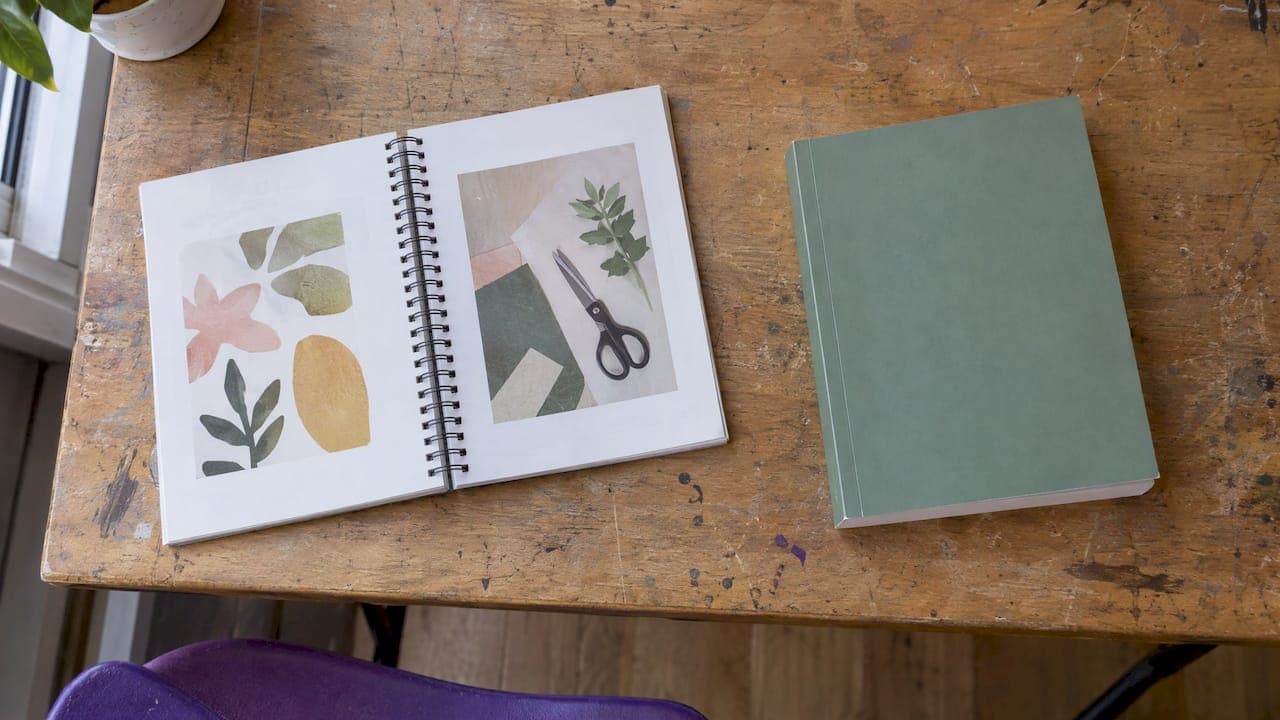
Choose spiral binding when the book has to lie flat and stay open while you work: coloring, writing, puzzles, recipes, manuals. Choose perfect binding when the book should look like a bookshop paperback, with a square, printable spine that sits neatly on a shelf: novels, reports, catalogues. This guide explains how each binding is made, where each one wins and loses, what spiral binding costs in the UK, and how to match the binding to what the book will actually be used for.
TL;DR
- Spiral binding threads a coil through punched holes. The book opens a full 360 degrees and lies flat, which suits hands-on use.
- Perfect binding glues the pages and cover at the spine. It gives a polished, printable spine, but it does not naturally lie flat.
- Think about use first, then looks: workbooks, journals and coloring books lean spiral, while novels and catalogues lean perfect bound.
- Page count matters. Perfect binding suits medium to high page counts, and very thin documents do not suit it.
- In the UK, one online printer lists spiral binding from £0.85, so the cost is often small next to the cost of printing.
Table of Contents
- What spiral and perfect binding actually are
- Spiral vs perfect binding side by side
- Where spiral binding works best
- Where perfect binding works best
- Page count, durability and how you will use the book
- What spiral binding costs in the UK
- Matching binding to the kind of book
- Perspective
- Find a book that suits how you use it
- Quick checklist before you decide
- FAQ
- Sources
What spiral and perfect binding actually are
The two methods hold pages together in completely different ways, and nearly every difference you notice in the hand comes from that.
How perfect binding is made
Perfect binding uses glue to attach a cover to a stack of pages, which creates a squared spine that can carry printing. In production, single leaves or folded sections are gathered and clamped into a book block. The spine edge is milled, then coated with hot-melt EVA glue. A creased cover is pressed on and the edges are trimmed for a square-back finish.
The result is what most people picture when they think of a paperback. It is the format of the typical novel, and the reason it looks "finished" is the flat spine you can read from across a room.

How spiral binding is made
Spiral binding uses a continuous spiral of wire or plastic wound through the pages. A row of small holes is punched along the binding edge, and the coil is threaded through them. Because nothing is glued, the pages pivot freely around the coil.

That is why a spiral-bound book can be folded right back on itself. It is also why it has no real spine: the edge is a row of holes with a coil running through, so there is nowhere to print a title.
Spiral vs perfect binding side by side
| Feature | Spiral binding | Perfect binding |
|---|---|---|
| How it holds | Coil threaded through punched holes | Glued spine with wrap-around cover |
| Lies flat | Yes, opens 360 degrees and folds back | Not naturally |
| Spine | None to print on | Square and printable |
| Look | Practical, workbook feel | Polished, bookshop style |
| Best page counts | Works across a wide range | Medium to high page counts |
| Typical uses | Workbooks, manuals, cookbooks, journals, coloring and puzzle books | Novels, reports, catalogues |
| Main weak point | Coil can snag or deform | Glue can fail under frequent stress |
The table summarizes the comparison from a UK binding guide. Everything below expands on the rows that matter most.
Where spiral binding works best
Spiral binding is chosen for function. A print production guide notes that spiral-bound books open a full 360 degrees and can fold back on themselves while remaining flat. That sounds like a small detail until you try to color, write or solve a puzzle on a page that keeps trying to close.
The advantages
- Hands-free reference. The book stays open on the page you left it, which is ideal for recipes, manuals and workbooks.
- Both sides usable. Fold one half back and you have a compact, single-page surface to work on. That is handy at a desk, on a lap or at a kitchen table.
- No stress on the spine. Because there is no glued spine to crack, repeated opening is simply what the binding is built for.
The trade-offs, and how to handle them
The same guide lists three drawbacks: no printable spine, a coil that can snag or deform, and a less bookshop-style appearance. None of them is a deal breaker if you plan for it.
- No spine text. Put the title on the front cover and, if you keep many books, add a small label or stack them cover up.
- Coil care. Slide the book into a bag sleeve or a flat pocket rather than loose among keys and chargers, so the coil keeps its shape.
- Look. Spiral books read as tools rather than keepsakes. For a journal, planner or activity book, that is exactly the right message.
Spiral binding also turns up in diaries and calendars, which are used open on a desk all year. A spiral-bound business calendar is a good example of a product where lying flat matters more than a spine.
Where perfect binding works best
Perfect binding gives a professional, bookshop-style appearance and a spine you can print on, so the book is easy to identify on a shelf. Another printer describes the clean, flat spine as the reason these books look polished and professional.
The advantages
- Shelf presence. Title and author run down the spine, so a row of books stays readable.
- Suits longer books. It works well for medium-to-high page counts, which is why novels and thick catalogues use it.
- Clean reading experience. Pages are uninterrupted by holes or coils, so text and artwork run right to the gutter margin.
The trade-offs
Perfect-bound books do not naturally lie flat, the glue can fail under frequent stress, and the method is not suited to very thin documents. In practice that means:
- Reading books are fine. You open a novel, read, and close it. The stress is gentle.
- Keep important content out of the gutter. Planning the layout and keeping content within margins helps avoid binding problems, and on a glued spine it means nothing essential is lost in the fold.
- Glue quality counts. PUR perfect binding costs more than hot-melt, but it is more durable, which is worth knowing if the book will be opened often.
Page count, durability and how you will use the book
Printers point to four criteria when choosing a binding: production cost, durability, page count and application. Here is how to apply them in a sensible order.
- Application first. Ask whether the book will be held open while you do something else. If yes, spiral. If it will be read through, perfect binding is a natural fit.
- Page count second. A very thin book has too little spine edge for glue to work well, while a thick book gains from a proper spine. A very thick spiral book can become bulky because the coil must be large enough to carry all the pages.
- Durability third. Frequent hard use stresses a glued spine more than it stresses a coil. A coil, in turn, can be crushed by careless storage.
- Cost last. The binding is rarely the biggest part of the price, as the next section shows.
If you are choosing a journal specifically, page count shapes how a notebook feels and lasts. Our guide to why 192 pages is the sweet spot for journals walks through that trade-off.
What spiral binding costs in the UK
Spiral binding is one of the cheaper finishing options. One UK online print-and-bind service lists A4 spiral binding from £0.85, and the price depends on what you order, so check the current figure on the provider's page before you budget.
A few things move the price:
- Coil type. Continuous coil binding is generally more cost-effective than wiro binding, especially for larger print runs.
- Quantity. Setup costs are spread across more copies in a bigger run.
- Size and thickness. Larger formats and thicker books need bigger coils and more material.
- Cover options. Heavier covers or extra clear sheets add to the cost.
For perfect binding, the main cost question is the glue. Hot-melt is the standard choice, while PUR costs more and lasts longer. If you are only buying finished books rather than making them, none of this changes the shelf price, but it explains why two similar-looking books can differ.
Matching binding to the kind of book
Here is a practical shortcut by book type.
Coloring books
Coloring is a flat-surface activity. A book that lies flat means a hand can rest on the page without bending the spine, and a finished page can be folded back for display or for working without the opposite page getting in the way. Spiral suits this well. A glued spine can still work, particularly if the artwork keeps clear of the gutter, but you will press it open more.
Journals, notebooks and planners
Writing happens at the edge of the page, close to the binding. A book that stays open is easier for left- and right-handed writers alike, and planners are used open all year. If you are deciding between formats, see our guides on lay-flat binding and who needs it and on artistic notebooks.
Puzzle and word search books
You work in the book with a pen, often on one page at a time. Lying flat helps, and so does being able to fold a page back and hold it in one hand. Spiral is the natural fit.
Novels
Perfect binding is the standard for novels, reports and catalogues because the book is read straight through and the printed spine matters on a shelf.
Children's activity books
Children open, bend and press books hard, and they like to color on whichever page they choose. A book that lies flat is easier for small hands. For a gift or a keepsake they might keep on a shelf, a squared spine has its own appeal.
Perspective
When we choose how a book should be made, we start from one question: what will the person be doing with it? A reader with a novel wants a clean spine and a book that feels like a book. Someone coloring, writing or working a puzzle wants the page to stay put and stay open.
Every product we offer is an original work by Mark Terry, and we think about the page as a place to do things, not only something to look at. That is why we pay attention to how a book opens, how the pages sit and how much room the artwork and writing space have near the gutter.
Our advice to anyone choosing between spiral and perfect binding is simple. Do not pick on looks alone. Imagine the book on a desk, a kitchen table or a bedside shelf, and picture the hand that will use it. Whatever you pick, a book that fits how it is used will be opened more, and that is what a book is for.
Mark
Find a book that suits how you use it
If you are choosing for a particular project, our catalog covers the main uses discussed above: children's and family coloring books, activity and puzzle books, word search books and journals, notebooks and planners. Postage is included in the price, and our original titles are authored by Mark Terry.

For fiction, you can also browse the Noah science fiction series, and the full shop has everything in one place.
Quick checklist before you decide
- Will it be held open? Choose spiral.
- Will it stand on a shelf with a title on the spine? Choose perfect binding.
- Is the book thin? Perfect binding is not suited to very thin documents, so lean spiral.
- Is it long and mostly read? Perfect binding suits medium-to-high page counts.
- Will it be used hard every day? Think about durability: coil care for spiral, stronger glue for perfect binding.
- Are you making your own? Our guides to step by step bookbinding and handcraft bookbinding for beginners cover the basics of making books by hand.
FAQ
What are the disadvantages of spiral binding?
Spiral binding has no printable spine, the coil can snag or deform, and the book looks less like a bookshop paperback. Store it flat or in a sleeve to protect the coil, and put the title on the front cover. For workbooks, journals and puzzle books, the benefit of lying flat usually outweighs these points.
Is perfect binding or spiral binding more durable?
It depends on how the book is used. A perfect-bound book can suffer glue failure under frequent stress, while a spiral book can have its coil bent or caught. PUR glue is more durable than hot-melt for perfect binding, and careful storage protects a coil.
Does a perfect-bound book lie flat?
Not naturally. The glued spine holds the pages firmly, so the book tends to close unless you press it open. If you need to keep a book open while you work, spiral binding is the better match.
How much does spiral binding cost in the UK?
One UK online service lists A4 spiral binding from £0.85. The final cost depends on size, thickness, quantity and the coil type, so check the provider's current page before you order.
Sources
- Types of Book Binding: Which Option Is Best for Your Book?
- Binding | Atlas MachinesDirect
- A Guide to Print Production, Part 2: Binding
- Which binding to choose for which product?
- Your Guide to Perfect Bound and Spiral Bound Books
- A4 Spiral Binding Services Online
- Binding A Booklet: A How-To Guide for Beginners
- Spiral-bound business calendar