

Gratitude journaling reliably improves mood, sleep, and social connection, with small to moderate effects confirmed across randomized controlled trials and meta-analyses. Most benefits show up within a few weeks and grow stronger with consistency. Here's what to expect:
- Mental and emotional: lower anxiety and depressive symptoms, higher life satisfaction
- Sleep: better rest quality within weeks of starting
- Social: stronger feelings of connectedness, especially with gratitude letters
- Physical: fewer self-reported health complaints and modest gains in activity levels
A 2023 systematic review and meta-analysis backs the mental health claims, and a 2026 longitudinal trial adds a new wrinkle: guided prompts beat free writing for benefits that last past two months. Aim for three to seven entries a week, and rotate in guided prompts if you want the effect to stick.
Key Takeaways
Gratitude journaling produces measurable, research-backed improvements in mood, sleep, and social connection, with guided prompts sustaining stress reduction longer than free writing alone.
| Point | Details |
|---|---|
| Mental health gains are real | Meta-analyses show reduced anxiety and depression symptoms alongside higher life satisfaction. |
| Depth beats breadth | Detailed entries about specific people or events outperform quick, surface-level lists. |
| Letters strengthen connection | Writing to a specific person boosts elevation and connectedness more than listing items. |
| Guided prompts sustain results | The 2026 trial found guided journaling held stress reductions longer than autonomous writing. |
| Journaling supports, not replaces, treatment | Worsening mood or suicidal thoughts require professional care, not just a journaling habit. |
Table of Contents
- Gratitude Journal Benefits for Mental and Emotional Health
- Physical and Behavioral Effects: Sleep, Health Complaints, and Activity
- Why Writing to People Beats Writing Lists
- How Gratitude Journaling Actually Changes Your Thinking
- How to Start a Gratitude Journal That Actually Sticks
- Guided or Free Writing: Which Gratitude Journal Format Wins?
- Where Gratitude Journaling Falls Short
- The Research Behind These Gratitude Journal Benefits
- Try This: A Journal Built for the Evidence Above
- An Editorial Take on What This Research Actually Tells You
- Sources
Gratitude Journal Benefits for Mental and Emotional Health
The clearest evidence for gratitude journaling sits in mental health outcomes, not physical ones. A systematic review and meta-analysis pooling multiple gratitude intervention studies found consistent improvements in life satisfaction alongside reductions in anxiety and depression symptoms. The effect sizes land in the small to moderate range, which in psychology research is a genuinely useful outcome, not a rounding error.
Timing matters. Most trials measure change over four to twelve weeks, not overnight. One randomized controlled trial conducted during the COVID-19 pandemic found that a brief online gratitude writing intervention decreased stress and negative affect at one-month follow-up, outperforming both expressive writing and no-intervention control groups. That's a meaningful signal: gratitude writing didn't just feel good in the moment, it held up against a real comparison condition during an unusually stressful period.
Who benefits most? Evidence spans college students, patients managing chronic illness, and general community samples, but effect sizes and durability shift depending on the group and the format used. People already prone to rumination or negative thought loops tend to show larger shifts, likely because the exercise interrupts a well-worn mental habit rather than adding to an already positive baseline.
A few caveats worth holding onto:
- Effects are group-level averages; individual results vary widely
- Most trials run a few weeks to a few months, so long-term data is still catching up
- Journaling appears to work best as a consistent practice, not a one-off exercise
None of this makes gratitude journaling a cure. It makes it a well-tested habit with real, replicated psychological upside.
Physical and Behavioral Effects: Sleep, Health Complaints, and Activity
Gratitude journaling's physical evidence is more preliminary than its mental health data, but it's not nothing. Foundational research from psychologist Robert Emmons found that participants who journaled about their blessings reported fewer physical complaints and spent more time exercising than those who journaled about daily hassles.

That single finding has held up as one of the most cited results in gratitude research because it hints at a behavioral pathway. Feeling more optimistic and less burdened seems to nudge people toward better self-care choices, not just better moods.
A few patterns show up repeatedly across studies:
- Improved subjective sleep quality, likely tied to reduced pre-sleep rumination
- Fewer self-reported aches, colds, and minor physical complaints
- Small increases in exercise frequency and healthier daily choices
The honest caveat: most of this physical evidence is correlational or based on self-report, not blood tests or wearables. Journaling probably doesn't lower blood pressure by itself. It more plausibly reduces the stress load that worsens sleep and immune function over time. If sleep is your main goal, pairing a wind-down journaling habit with solid sleep hygiene practices gives you a more complete approach than journaling alone.
Why Writing to People Beats Writing Lists
Gratitude journaling gets more powerful when you name a person instead of a category. A randomized experiment published in Affective Science found that writing gratitude letters to specific individuals produced stronger feelings of elevation and connectedness than simply listing things you're grateful for. Lists are easy and sustainable. Letters hit harder emotionally.
There's a trade-off, though. The same study found that social letters could also increase feelings of indebtedness, particularly when the letter implied an unspoken obligation to reciprocate.
Practical guidance for using this:
- Write letters occasionally (monthly, not daily) rather than as your default format
- Focus on specific moments and actions, not vague praise
- Decide upfront whether you'll send the letter or keep it private; both work, but they change the tone you write in
Pro Tip: Write the letter as if you're describing a scene to a friend who wasn't there. "You drove two hours in the rain to help me move" lands harder than "Thanks for everything."
How Gratitude Journaling Actually Changes Your Thinking
Three mechanisms explain most of what researchers observe. The first is cognitive reframing: journaling shifts attention from what a psychologist might call "hassle focus" toward "asset focus," retraining your brain to scan for what's working instead of what's broken. Do this often enough and the scanning habit starts running in the background, not just during journaling time.
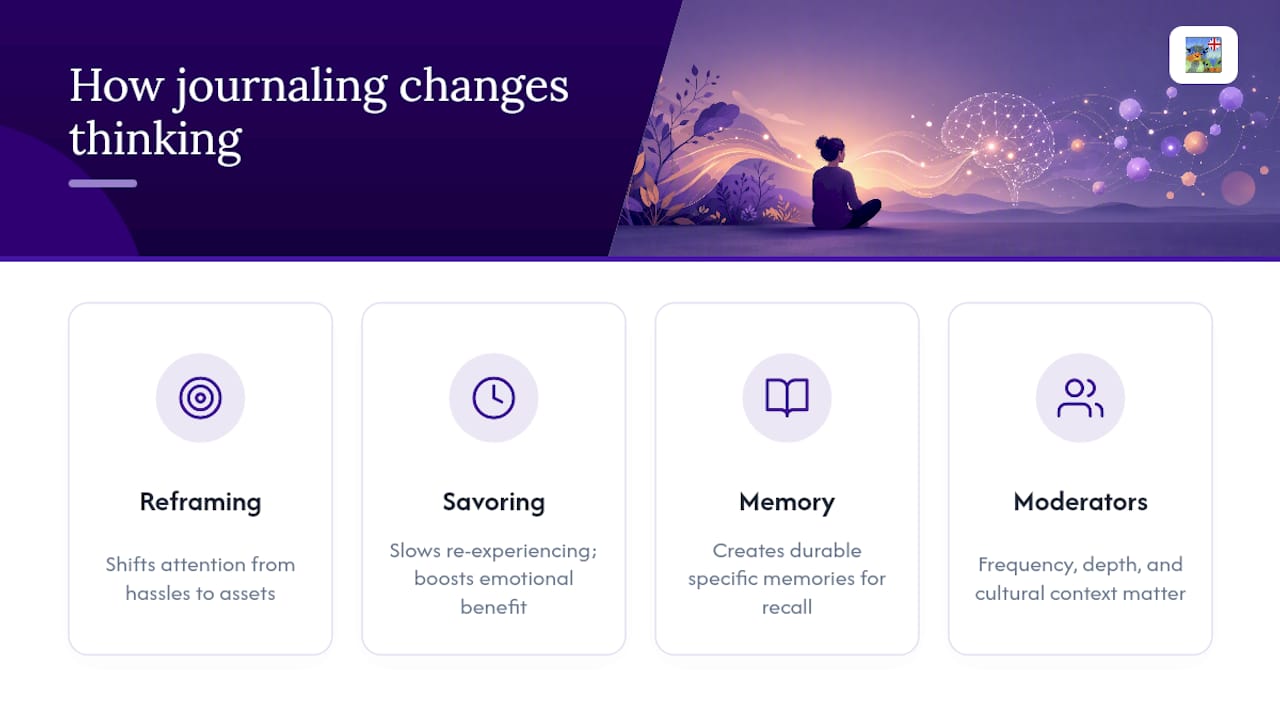
The second is savoring. Writing something down forces you to slow down and re-experience it, rather than letting a good moment evaporate the second it's over. That extra few seconds of attention appears to be where a chunk of the emotional benefit actually lives.
The third is memory concretization. A vague sense of "things are okay" is fragile and easy to forget under stress. A written, specific memory, "my neighbor fixed my fence without being asked," is a durable data point your brain can retrieve later, which is part of why depth outperforms breadth.
Research from Greater Good in Action at UC Berkeley suggests that detailed, narrative entries about a specific person or event generate stronger wellbeing gains than surface-level item lists, even though lists remain useful for daily maintenance.
Frequency and depth both act as moderators. Writing five detailed entries a week tends to outperform writing twenty rushed ones. Cultural context matters too. Gratitude expressed to a specific person carries different social weight depending on the relationship norms someone grew up with, which is part of why no single format works for everyone.
How to Start a Gratitude Journal That Actually Sticks
Getting the mechanism right on paper doesn't matter if the habit dies in a week. Here's a routine grounded in what the research above actually supports.
- Pick your medium first. A physical notebook removes the friction of app notifications and screen fatigue; a handmade journal adds a small ritual quality that makes people more likely to return to it.
- Set a fixed time. Morning entries tend to shape the day's attention; night entries tend to improve sleep-related rumination. Try each for two weeks and compare.
- Write three to five items, not ten. Depth beats breadth. One well-described moment outperforms a rushed list.
- Use a subtraction prompt occasionally. Ask "what would I miss if this were gone?" instead of "what am I grateful for?" It disrupts habituation to the good things already in your life.
- Rotate in guided weeks. Alternate free writing with structured prompts to avoid boredom and keep the exercise from becoming rote.
A few starter prompts to break the blank-page problem:
- Who made your week easier, and how, specifically?
- What's something ordinary you'd miss if it disappeared tomorrow?
- Describe a moment today when you felt physically comfortable or safe.
- What skill or ability are you glad you have?
- Who taught you something you still use?
For a deeper prompt bank, the Journaling Prompts List: 60+ Ideas for Growth gives you enough variety to avoid repeating yourself for months. Anchor the habit to something you already do, coffee, brushing your teeth, shutting your laptop, so it doesn't rely on willpower alone.
Guided or Free Writing: Which Gratitude Journal Format Wins?
A 2026 longitudinal randomized trial comparing autonomous journaling against guided and random-topic prompts found a genuine trade-off. Autonomous, self-directed writing produced stronger immediate benefits, people liked it more in the moment and felt a bigger initial mood lift. Guided and randomly suggested prompts, though, produced more sustained reductions in perceived stress at the two-month follow-up.
That's a useful finding for anyone choosing between formats:
- Free writing feels better right away and suits people who already know what they're grateful for
- Guided prompts perform better over the long haul, likely because they prevent the repetition and boredom that causes autonomous journaling to fade
- A hybrid schedule, several autonomous weeks followed by a guided week, may capture both effects
If structured prompts sound like a better fit for your personality, the guide on what a guided journal is and how to use one walks through the format in more depth.
Where Gratitude Journaling Falls Short
Gratitude journaling is a genuine mental health tool, not a substitute for treatment. It's an adjunct, something that supports therapy or medication, not something that replaces either when clinical depression or anxiety is in play. Effect sizes across the research are modest on average, and results vary by population, format, and consistency.
Watch for these signs that journaling alone isn't enough:
- Mood that keeps worsening despite regular practice
- Any thoughts of self-harm or suicide, which require immediate professional support
- Loss of interest in daily activities that persists for more than two weeks
If any of that applies, talk to your GP or contact NHS mental health services rather than relying on a journal to carry the weight alone.
The Research Behind These Gratitude Journal Benefits
The strongest evidence here comes from a 2023 systematic review and meta-analysis on gratitude interventions, Emmons' foundational work on gratitude and physical wellbeing, and the 2026 trial comparing guided and autonomous formats. Mark, who covers evidence-based journaling practices for the Munkter Products blog, draws on this research alongside deeper dives into journaling's role in mental health and self-help journal structure.
Not all gratitude research carries equal weight. A single small study hints at something worth testing further; a meta-analysis pooling dozens of trials tells you the effect is real across different populations and settings.
Weigh claims accordingly, and favor practices backed by reviews and randomized trials over single anecdotes.
Try This: A Journal Built for the Evidence Above
None of the mechanisms above require an expensive app or subscription. What they require is a format you'll actually return to. A well-made physical journal removes the friction of screens and notifications, and gives the ritual of writing a bit more weight than typing into a phone. Munkterproducts' curated self-help and gratitude journals are built with that in mind, structured enough to guide you on the days you're stuck, open enough to let depth and detail win out over rushed lists. If you're picking a gift for someone starting this habit, a guided journal with built-in prompts solves the blank-page problem before it becomes an excuse to quit.
An Editorial Take on What This Research Actually Tells You
Most gratitude journal advice treats the practice as one-size-fits-all: write three things you're grateful for, every day, forever. The research doesn't actually support that rigidity. The 2026 trial makes a strong case that format should change over time, autonomous writing when you want an immediate lift, guided prompts when you need the effect to last past two months. Treating journaling as a fixed ritual instead of a rotating toolkit is where most people quit.
The bigger miss in conventional advice is depth. Everyone tells you to journal daily; almost nobody tells you that one well-described moment beats ten rushed ones. If you only take one thing from the evidence here, it's this: write less often if that's what it takes to write with actual detail. The mechanism doing the heavy lifting isn't frequency. It's the act of slowing down long enough to actually notice something.
Start there before worrying about streaks or perfect consistency.
— Mark
Sources
- Systematic review and meta-analysis on gratitude interventions (PMC10393216)
- Robert Emmons — Gratitude and well-being
- Self-help or Guided? Comparing Interaction Strategies in Gratitude Journaling Interventions (2026 DOI)
- A Brief Gratitude Writing Intervention Decreased Stress and Negative Affect During the COVID-19 Pandemic (PMC8867461)