

TL;DR:
- AI is revolutionizing book publishing by reducing production timelines by up to 50% and enhancing editorial workflows. The global book market is projected to grow steadily to nearly $100.5 billion by 2026, with diverse formats like print, e-books, and audiobooks expanding their reach. Publishers emphasizing human authenticity and strategic multi-platform distribution will thrive amidst technological transformation.
Book publishing was never supposed to move fast. For most of its history, bringing a title from manuscript to shelf took 18 to 24 months, and nobody questioned it. That assumption is now obsolete. AI-driven publishing workflows are cutting production timelines by up to 50% and improving editorial processes by 35%, forcing every corner of the industry to reconsider its pace, model, and purpose. Whether you publish handcrafted journals, science fiction novels, or educational activity books, understanding what's driving this transformation in 2026 puts you in a far stronger position to serve readers and grow your business.
Table of Contents
- Market growth and format diversification in 2026
- AI-driven innovation transforms publishing workflows
- New publishing models: Hybrid, self-publishing, and multi-platform strategies
- Human authenticity and genre blending: Meeting demand in 2026
- Why strategic balance matters: Lessons for publishing leaders
- Explore publishing solutions for your next project
- Frequently asked questions
Key Takeaways
| Point | Details |
|---|---|
| Market growth continues | Book publishing revenue is projected to rise steadily through 2030, including print, digital, and audio formats. |
| AI accelerates workflows | AI integration cuts production times and boosts editorial efficiency, reshaping industry operations. |
| Self-publishing expands | Hybrid and self-publishing models now drive millions of annual titles and diversification beyond Amazon. |
| Authenticity vs. automation | Despite AI's efficiency, readers increasingly value human-authored, authentic content. |
| Strategic balance is key | Combining technology with creativity and multi-format strategies ensures real industry impact in 2026. |
Market growth and format diversification in 2026
With the publishing landscape rapidly evolving, understanding market performance is essential before examining the technologies reshaping the industry.
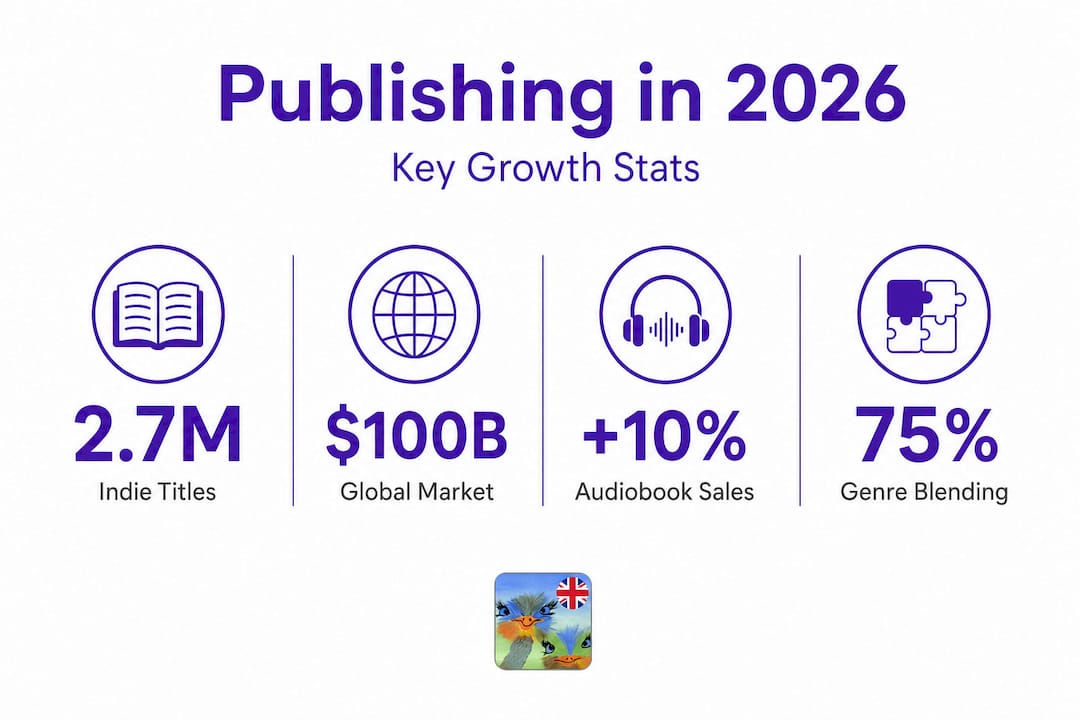
The headline number is compelling. The global book publishing market is projected to grow from $97.71 billion in 2025 to $100.47 billion in 2026, representing a CAGR (compound annual growth rate, meaning the average rate of year-over-year growth) of 2.8%. By 2030, that figure is expected to reach $113.63 billion at a 3.1% CAGR. These numbers signal a market that is not shrinking or stagnating, but steadily expanding even as its internal mechanics shift dramatically.
In the United States specifically, publishing revenues hit $14.6 billion for 2025, up 1.1% year over year. December 2025 was an especially strong month, climbing 9.4% to reach $1 billion for that month alone. The trade segment surged 14.2% in December, even though it finished the full year slightly down at 0.5%. That kind of seasonal spike tells a clear story: consumers still buy books in large numbers, and gifting culture around physical books remains powerful.
Format performance at a glance
| Format | 2026 trend | Key growth driver |
|---|---|---|
| Print books | Stable to growing | Gift market, collector editions, direct sales |
| E-books | Steady growth | Subscription platforms, indie publishing |
| Audiobooks | Fast growth | AI-assisted narration, commuter culture |
| Direct sales | Emerging surge | Author websites, community-first models |
What's worth noting here is that no single format is "winning" at the expense of others. Print has staged a genuine revival, particularly for niche, beautifully produced titles. Audiobooks are expanding into global markets through AI-assisted translation and narration. E-books continue serving readers who prioritize convenience and affordability.
Key format trends shaping 2026 include:
- Print revival driven by premium packaging, limited editions, and the tactile appeal that screens can't replicate
- Audiobook acceleration supported by AI narration tools that reduce production costs significantly
- Direct-to-reader channels gaining traction as authors bypass traditional retail gatekeepers
- Subscription models becoming a standard expectation for digital readers
The broader culture and growth impact of these format shifts reaches far beyond sales figures. Books shape communities, support literacy, and create the cultural conversations that define generations.
AI-driven innovation transforms publishing workflows
Now that we've reviewed the market, let's uncover how technology, especially AI, reshapes book publishing behind the scenes.
The changes AI is bringing to publishing are not superficial. According to a detailed 2026 industry analysis, AI integration in publishing workflows is reducing production timelines by up to 50% and improving editorial workflows by 35%. Those are not incremental gains. They are structural changes to how books are made.
How AI changes the process: step by step
-
Editing and proofreading. AI tools now assist human editors with grammar, consistency, and even pacing analysis. This does not replace editorial judgment, but it removes the most time-consuming mechanical tasks, letting editors focus on the creative work that actually matters.
-
Metadata generation. Accurate metadata, meaning the keywords, categories, and descriptions that help readers find books, has always been underestimated. AI can now generate optimized metadata in minutes, dramatically improving discoverability across retail platforms.
-
Marketing copy. From back-cover copy to social media posts and email sequences, AI drafts marketing materials at scale. Publishers using these tools report faster campaign launches and more consistent messaging.
-
Backlist revitalization. Publishers with deep catalogs are using AI to resurface older titles, update their positioning, and match them to new reader audiences. A book published in 2015 can find its first real audience in 2026 with the right AI-assisted marketing push.
-
Audiobook production. Audiobooks and direct sales growth are accelerating thanks to AI-assisted narration and translation tools that make multilingual production economically viable for independent publishers.
AI tools comparison: productivity vs. discoverability
| AI application | Productivity gain | Discoverability impact |
|---|---|---|
| Automated editing | High | Low |
| Metadata optimization | Medium | Very high |
| AI-assisted narration | High | High (new markets) |
| Translation automation | High | Very high (global reach) |
| Marketing copy generation | High | Medium |
Pro Tip: Prioritize AI tools that enhance discoverability over those that simply speed up production. A faster workflow means nothing if readers still can't find the book. Metadata and category optimization consistently deliver the highest return on investment for independent publishers.

The implications extend beyond big publishing houses. Independent creators producing interactive books for kids or niche adult content can now access the same AI-powered production efficiencies that were previously reserved for major publishers. Similarly, authors focused on educational books in 2026 are using AI to generate supplementary materials, study guides, and localized editions faster than ever before.
New publishing models: Hybrid, self-publishing, and multi-platform strategies
Technological innovation is just one side. New publishing models are also redefining how books reach readers.
The rise of hybrid and self-publishing models is one of the most significant structural shifts in the industry. The United States now sees over 1 million self-published titles released annually, and that number continues climbing. Hybrid publishing, which blends traditional editorial quality with the speed and flexibility of self-publishing, is attracting authors who want professional polish without giving up creative control or a large share of royalties.
What's also changing is where those books are sold. For years, Amazon dominated indie distribution so completely that "self-publishing" and "Amazon KDP" were practically synonymous. That's changing fast. Smart publishers and authors are diversifying beyond Amazon dependency, building audiences on their own platforms, selling directly to readers via author websites, and expanding into international markets through regional distributors.
Key strategies driving this shift include:
- Multi-platform distribution across multiple retail and library channels to reduce single-point-of-failure risk
- Direct sales via author websites that offer higher margins and deeper customer relationships
- Print-on-demand partnerships that make global distribution economically feasible for small publishers
- Community-building through newsletters, podcasts, and social content that creates loyal reader bases before a book even launches
- Series publishing that builds long-term catalog value and reader retention
"The authors who thrive in 2026 are not those who published the most books, but those who built the most loyal readership communities across multiple touchpoints." This reflects the shift from transactional publishing to relationship-driven publishing that industry analysts are consistently observing.
Pro Tip: Combine print and digital strategies deliberately. A beautifully produced physical book serves as its own marketing tool, especially in the gift and specialty retail space, while digital and audio editions capture the convenience market. You don't have to choose.
If you're considering entering or expanding in this space, our self-publishing guide covers the practical steps in detail. For publishers interested in the craft side of physical book production, our coverage of bookbinding techniques offers actionable guidance on producing premium print editions that stand apart.
With projections showing 2.7 to 2.9 million titles expected from independent publishers in the US market, the volume of content competing for reader attention is staggering. The publishers who win are those who pair high volume with strategic focus, not just output.
Human authenticity and genre blending: Meeting demand in 2026
While new models ensure accessibility, the quest for authentic storytelling remains central, especially in an AI-saturated ecosystem.
Here's the paradox of 2026: AI is making it easier to produce books, but it's also making readers hungrier for books that feel unmistakably human. Demand for authentic human-created content is rising in direct response to the flood of AI-generated material entering the market. Readers can often sense when something lacks a genuine personal voice, even if they can't always articulate why.
Traditional publishers have taken note. A striking 75% of debut publishing deals in 2026 involve genre blending, meaning publishers are actively seeking stories that cross conventional category lines. A mystery with strong literary fiction elements. A romance with speculative fiction undertones. A children's educational book that doubles as a family conversation starter. These crossover titles attract broader audiences and generate stronger word-of-mouth.
The backlist optimization trend ties directly into this. Publishers are revisiting their catalogs with fresh eyes, using both AI tools and human editorial judgment to identify titles with untapped audiences. A strong narrative voice from a debut novelist published five years ago might find its ideal readership today, especially with updated positioning and improved metadata.
Key signals of the authenticity demand in 2026:
- Memoir and personal essay sales holding strong as readers seek real human experience
- Author-led communities outperforming algorithmically distributed content in engagement metrics
- Handcrafted and specialty books commanding premium prices due to their obvious human effort and care
- Genre blending rewarded by both traditional publishers and independent retail buyers
"Responsible AI adoption in publishing means using technology to amplify human creativity, not substitute for it. The publishers who understand this distinction will define the next decade." This perspective, increasingly shared across the industry, reflects a human-first publishing approach that prioritizes connection over convenience.
The tension between speed and soul is real. The complete book publishing process has always required both craft and commerce, and 2026 is no different. What's changed is that the commercial pressure to produce quickly has intensified, making the deliberate choice to prioritize quality more meaningful and more visible to discerning readers. Understanding how publishing and e-commerce intersect in this environment is increasingly important for anyone selling books through retail channels.
Why strategic balance matters: Lessons for publishing leaders
Here's what most industry guides miss when covering publishing trends: the assumption that more technology automatically means better outcomes. It doesn't.
We've seen this pattern before in other creative industries. Music went through a similar moment when digital production tools became cheap and accessible. The result was more music, not necessarily better music. The artists who stood out were those who used technology to serve their vision rather than replace it. Publishing is at exactly that inflection point right now.
The practical lesson is this: AI adoption in publishing should be purposeful, not reflexive. Using AI to generate metadata for a backlist of 500 titles is brilliant. Using AI to write the actual narrative content of a book that's supposed to represent a human author's voice is a different proposition entirely, and readers are increasingly sophisticated enough to notice the difference.
For publishing leaders and industry professionals, the strategic imperatives in 2026 are clear. First, invest in discoverability infrastructure: metadata, categories, and positioning that help the right readers find your books. Second, protect and amplify human voice across every title, because that is your most durable competitive advantage. Third, diversify your distribution footprint so you're not dependent on any single platform's algorithm or policy decisions.
The culture and growth impact of books extends well beyond revenue figures. Every book published with care represents a contribution to public discourse, to education, to imagination. Publishers who stay connected to that purpose, while intelligently adopting the tools available to them, will find that their readers become not just customers but advocates.
Don't chase every trend. The publishing world will surface a new "must-have" innovation every quarter. The most successful publishers in 2026 are those with a clear editorial identity, a loyal reader community, and a willingness to adopt technology in service of their mission, not instead of it.
Explore publishing solutions for your next project
If reading about publishing innovation in 2026 has sparked ideas for your own projects, you're not alone. The combination of new tools, new models, and renewed reader appetite creates genuine opportunity for publishers and creators who are ready to act.

At Munkter Products, we work at the intersection of storytelling, creativity, and practical publishing, offering handcrafted books, journals, activity books, coloring books, and science fiction novels that reflect exactly the kind of human-first publishing that readers are hungry for in 2026. Whether you're an author figuring out your next step or a retailer looking to stock titles that stand out, our self-publishing guide offers grounded, practical direction to help you move forward with clarity and confidence. Explore what's possible when publishing is done with purpose.
Frequently asked questions
How is AI changing book publishing workflows in 2026?
AI tools applied to editing, metadata, and marketing are cutting production timelines by up to 50% and improving editorial workflows by 35%, making publishing faster and more scalable without sacrificing quality when applied thoughtfully.
Are self-publishing and hybrid models still growing?
Yes, the US market now sees over 1 million self-published titles annually, and hybrid models are gaining ground as authors seek professional quality with greater creative and financial control.
What formats are most popular with readers in 2026?
Print, e-books, and audiobooks are all growing, with direct sales channels gaining ground as authors build direct relationships with readers for higher margins and stronger community engagement.
Why is human authenticity important in publishing?
As AI-generated content floods the market, readers are actively seeking genuine human-created works, and publishers who deliver that authenticity consistently are earning the kind of loyalty that algorithms can't replicate.
What's the projected global market value for book publishing in 2026?
The global publishing market is expected to reach $100.47 billion in 2026, with continued growth toward $113.63 billion by 2030 driven by format diversification and expanding global readership.