
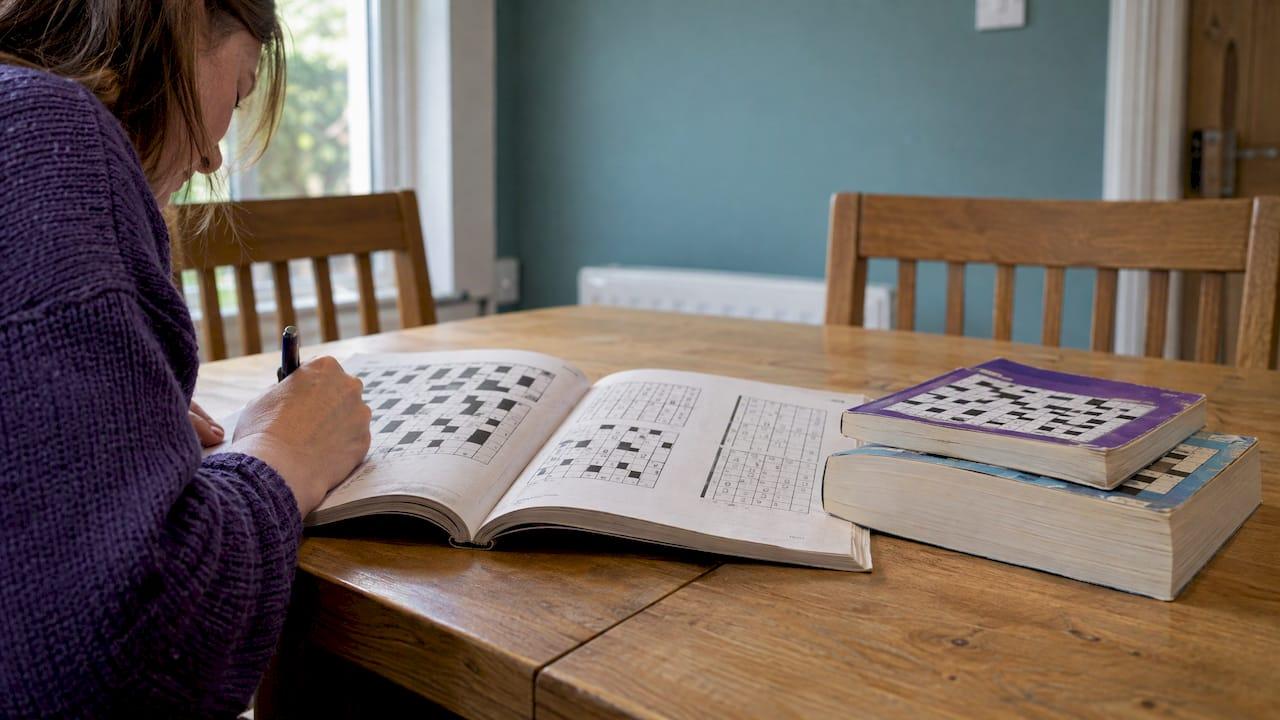
Most puzzle books run between about 80 and 150 pages, and the page count is not the same as the puzzle count. A book with 100 puzzles usually has well over 100 pages once the instructions, the answer section and any blank pages are added, so the number that tells you how much you will actually solve is the puzzle count, not the page count. Read both, plus the trim size, and you will know what you are getting.
This guide is for parents choosing activity books for children, adults who love word searches and colouring, and anyone buying a puzzle book as a gift. It explains what is normal, why the numbers differ from book to book, and what to check on a product page.
TL;DR
- A typical puzzle book has 80 to 120 interior pages including solutions, and printed activity books commonly sit in a 100 to 150 page band.
- A 100-puzzle book usually lands at around 110 to 135 pages, because front matter and answers sit on top of the puzzles.
- Children's books are usually shorter, with a mix of puzzle types. Adult books tend to focus on one type across a longer volume.
- Page size matters as much as page count: a book with larger pages gives bigger grids and more room to write.
- On a listing, look for the puzzle count, the page count, the dimensions and whether solutions are included.
Table of Contents
- The short answer: how many pages is a puzzle book?
- Why page count and puzzle count are different numbers
- How many puzzles are usually inside?
- Children's books versus adult books
- Page size changes how long a book feels
- How to read a listing before you buy
- Choosing a length for your reader
- Our view on length
- Browse puzzle and activity books
- FAQ
- Sources
The short answer: how many pages is a puzzle book?
There is no fixed length, but there is a clear centre of gravity. One 2026 guide to making puzzle books puts the typical interior at 80 to 120 pages, solutions included. Guidance from another source aimed at print-on-demand books targets 100 to 150 pages in total, adding that books under 100 pages can feel thin on a product listing, while books over 200 pages cost more to print.
Those are guides to how books are made, and shelf reality is wider. A 2026 roundup of adult puzzle books included a 384-page variety book of logic mysteries, a 336-page crossword collection, a 256-page sudoku book with more than 200 puzzles and a large-print word search at 114 pages. So a mass-market crossword collection can be three times the length of a standard activity book, and neither is wrong. They are built for different kinds of solver.
In practice, you can sort puzzle books into three rough bands:
| Band | Typical pages | Who it suits |
|---|---|---|
| Short | Under 80 | Young children, travel, a quick gift |
| Standard | 80 to 150 | Most children's and adult activity books |
| Bumper | 250 and above | Dedicated solvers who want months of puzzles |
The bands are a way of thinking about it, not a rule. What matters is whether the length matches how you or your child will use the book.
Why page count and puzzle count are different numbers
This is the point that confuses most buyers. A page count of 120 does not mean 120 puzzles. Several things share those pages.
Front matter. Title page, copyright page, introduction and contents typically take 4 to 8 pages.
Answers. The solutions section length depends on how compactly the answers are laid out. One guide recommends a single solutions section at the back, with about two word-search answers per page, four sudoku answers, one crossword answer or two to four maze answers.
Blank pages. Books are printed in sheets, so pages are sometimes added to reach an even count.
Layout. One puzzle per page gives the solver room and doubles the page count compared with two per page. The same page-count source describes one puzzle per page as the premium standard and two per page as the economy layout.
A worked example
Take a 100-puzzle word search with one puzzle per page. One source works the sum for a 100-puzzle book with one puzzle per page, four answer keys per page and four pages of front matter: around 130 pages. The same source reports a 120-puzzle large-print Christmas word search at 8.5 by 11 inches coming out at 173 pages, because large print means fewer answers per page.
Another set of studio page counts shows the same pattern. 150 sudoku at 6 by 9 inches, two per page, came to 109 to 110 pages; 100 sudoku at 8.5 by 11 inches, one per page, came to 118; 100 large-print sudoku to 132; and 100 word searches to 128 pages. Notice that the book with 150 puzzles is shorter than the one with 100. Layout decides.

So when you compare two books, divide. A 128-page book with 100 puzzles gives you a different experience from a 128-page book with 150 puzzles at two per page.
How many puzzles are usually inside?
Puzzle counts cluster tighter than page counts. One FAQ on puzzle book design gives these sweet spots:
- Word search and sudoku: around 100 puzzles
- Mazes: 60 to 80
- Crosswords: about 50
- KenKen and Kakuro style number puzzles: 40 to 60
- Children's books: 30 to 50 puzzles
The same source says 100 word searches fill roughly 100 to 120 pages including solutions. Another data point from builders of puzzle books is that the median book has exactly 100 puzzles, which matches what you see on shelves: 100 is the number people reach for.
Harder puzzles take longer to finish, so a 50-puzzle crossword book can last as long as a 100-puzzle word search. If you want to understand which puzzle types suit you, our guide to the best puzzle types for adults is a good place to start.
When a book is too short or too long
A book with under 50 puzzles tends to feel poor value to adult buyers, according to one design FAQ, while above 150 the spine becomes unwieldy and the page count starts to look like padding (source). That is a useful rule of thumb when you are looking at a listing: a very long book is not automatically better. If it is heavy to hold and awkward to open flat, you may solve fewer puzzles from it.
Children's books versus adult books
The two audiences get different lengths for good reasons. Adult books focus on one puzzle type per volume at 100 to 150 pages. Children's books mix several types into shorter books of about 60 to 80 pages, with larger grids and thicker lines.
That suits how children use them. A child who tires of mazes can move to a spot-the-difference or a colouring page, and a shorter book is something they can finish, which matters more for confidence than owning a giant volume. Instructions, illustrations and writing spaces also need room for the age group, which is why a UK book printer recommends A4 for generous grids and writing space, with smaller trims for compact collections.
If you are choosing for a child, our puzzle book checklist for parents walks through age, difficulty and layout. For word-based activities specifically, see problem-solving with word search books for kids.
Adult solvers have their own preferences. Readers who want bigger type will find that a large-print book is longer than its puzzle count suggests, because each puzzle and each answer takes more space. We cover that in large print puzzles and their benefits and in our guide to large print word search books for seniors in the UK.

Page size changes how long a book feels
Two books with 100 pages can feel nothing alike if one is a small paperback and the other is A4. Page size, called trim size, sets how big the grids are and how much room you have to write.
A UK printer lists the standard sizes for activity and puzzle books:
| Format | Size (mm) | Typical use |
|---|---|---|
| B-format | 198 x 129 | The usual UK fiction paperback |
| A5 | 210 x 148 | Compact puzzle collections |
| Royal | 234 x 156 | Mid-size activity books |
| B5 | 250 x 176 | Larger grids |
| A4 | 297 x 210 | Generous grids, children's activities |
The sizes come from that printer's activity book guide, which also advises counting puzzle pages, instructions, answer sections and blanks when you specify a page count.
There is a practical reason larger pages dominate. A 20 by 20 word-search grid fits on an 8.5 by 11 inch page with 0.4-inch cells, and a sudoku grid fits at 6.5 inches square, so smaller trims cramp the grid. For solvers with tired eyes or children with big handwriting, size matters more than the number of pages. A 8.5 by 11 inch page is close to US letter, and in the UK the nearest everyday equivalent is A4.
How to read a listing before you buy
This is where length is decided in practice. Product pages are inconsistent, so scan for these five things.
- Puzzle count. Look for "100 puzzles" or similar in the title or description. This is the real measure of content. If it is missing, estimate from the page count using the layout (one per page or two).
- Page count. This is often listed as "print length" or "pages". It tells you the bulk of the book and, with the puzzle count, how much is answers and front matter.
- Dimensions. Check the size in millimetres or centimetres. A book labelled A4 is roughly 297 by 210 mm. Smaller than A5 is a pocket-size book.
- Solutions. A back-of-book answer section is the norm. The same specification guide says leaving solutions out should be avoided, except in hard cryptic crosswords sold as no spoilers. If a listing does not mention answers, check.
- Print size. For anyone who wants easy reading, look for large print in the description rather than assuming it.
Some examples of how listings present this: one UK retailer's book lists 136 pages at slightly smaller than A4 with 68 sheets. A printed sheet carries two pages, one on each side, which is why 68 sheets equal 136 pages. A bumper quiz-show collection runs to 336 pages with over 750 puzzles. Both are clear because they give pages and dimensions.
If a listing gives only a title and a cover image, you are guessing. A good shop description tells you what is inside.
A note for jigsaw fans: those are measured differently, by piece count rather than pages, and 1000-piece jigsaw puzzles are a popular size for a longer evening project. A puzzle book is better for short sessions, which is why page and puzzle counts matter more.
Choosing a length for your reader
For a young child. Choose a shorter book with a mix of activities and large grids. It can be finished, which builds the habit.
For a teenager or adult who solves a little each day. A standard book of about 100 puzzles gives you over three months at one a day. A longer bumper book is best if you want one volume for a long trip or a long winter.
For an older reader. Large print lengthens the book, so a book with fewer puzzles can still be the better buy. Think about how it sits on a table or in a lap. Our guide to brain health and puzzle books explains why many readers like a daily routine.
For a gift. Pick the puzzle type the person already enjoys, and prefer a clear 100-puzzle book to a vast one. A pencil in the parcel is a nice touch.
For a challenge. Length is less important than difficulty. See hard word search books for adults and teens if you want something that takes longer per puzzle.
If you are still unsure what a puzzle book is or which types exist, our complete guide to puzzle books covers it, and what a word search book is covers the most popular type.
Our view on length
Length is a design decision, not a number to chase. Every book we publish is an original work, and we think about how it will be used: who is holding the pencil, how long they sit, and what they want to feel when they close the book.
A children's book should be something a child can finish and be proud of. An adult book should give you enough to settle into without feeling padded. That is why we care about the puzzle count, the layout and the page size together, rather than quoting one big number.
Our range covers colouring books, activity and puzzle books, word searches and journals, and we post worldwide with postage included in the price. When you choose a book, look for the one whose design fits the person using it.
Mark
Browse puzzle and activity books
If you know the length and type you want, you can look through our activity and puzzle books and our word search books, all original works by author Mark Terry. For younger solvers, there are children's colouring and activity books. Postage is included in the price, and we send worldwide.

Prices are shown on each product page.
FAQ
How many pages should a good puzzle book have?
Most have between 80 and 150 pages, which comfortably holds about 100 puzzles plus answers. Shorter books suit young children, and longer ones suit people who want a volume to last. A good book is one whose length matches how you will use it.
How many puzzles are in a typical puzzle book?
Around 100 for word search and sudoku, fewer for crosswords at about 50, and 30 to 50 for children's books. The design guidance gives these as common targets. Check the listing for the exact count.
Do the answers count towards the page total?
Yes. The answer section sits inside the page count, along with the introduction and any blank pages. That is why 100 puzzles often come to 110 to 135 pages in total.
Is a longer puzzle book better value?
Not always. Value depends on the puzzle count, the print size and whether you will finish it. A very thick book can be awkward to hold, and a mid-length book with clear, comfortable puzzles may be used more.
Sources
- How to Make a Puzzle Book for Amazon KDP
- The 8 Best Puzzle and Brain Teaser Books for Adults in 2026
- How to Create Puzzle Books for Amazon KDP
- KDP Puzzle Book FAQ: Word Search, Sudoku, Maze and More
- Puzzle Book Interior Formatting for KDP: 2026 Spec Sheet
- How Many Puzzles in a Puzzle Book? KDP Page Count Math
- How Many Puzzles in a Puzzle Book, and How to Mix
- How Many Puzzles Should a KDP Puzzle Book Have?
- Activity and Puzzle Book Printing UK