
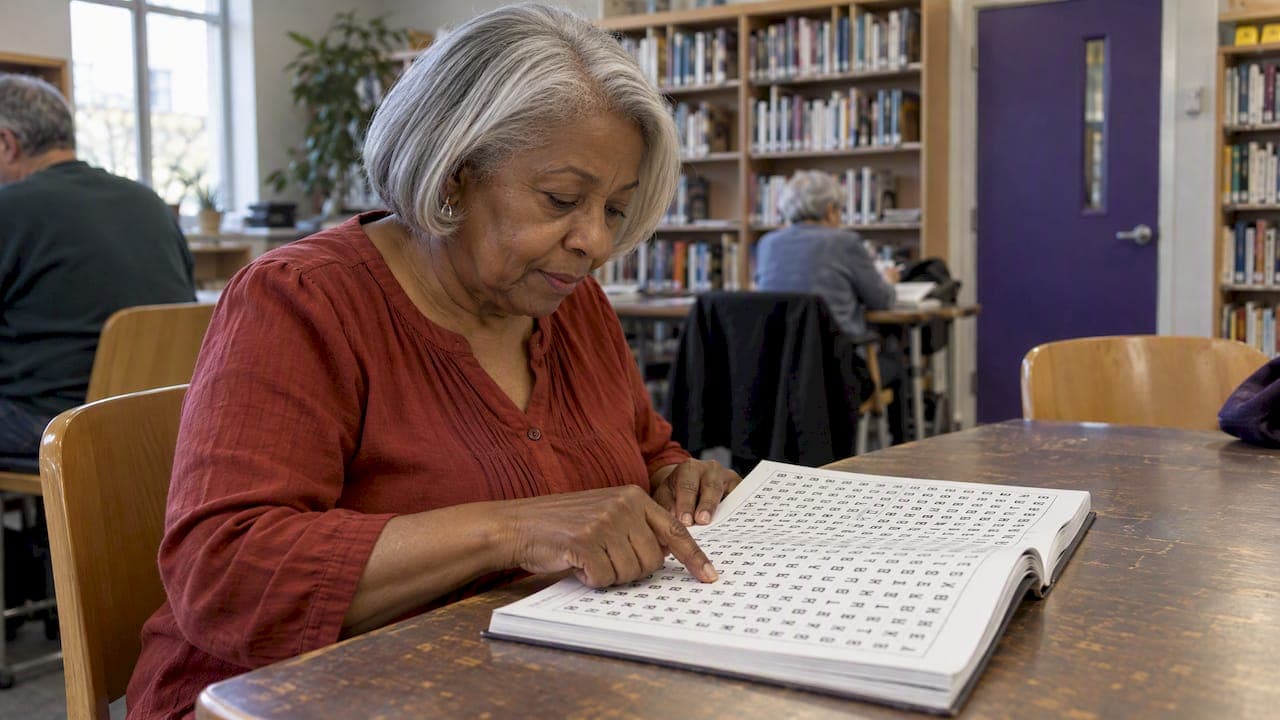
Large print puzzles make a pastime easier to see, and that is their clearest benefit: you spend your effort solving the puzzle, not squinting at it. Around that sit some well-studied extras. Regular word and number puzzles are linked with better scores on attention and memory tests, and the routine can be relaxing and sociable. What puzzles cannot do is guarantee protection against dementia, and we will be straight about that below.
TL;DR
- Larger type, bolder grids and clearer spacing cut eye strain, so you can puzzle for longer and enjoy it more.
- Large studies of adults aged 50 and over link regular word and number puzzles with better attention, reasoning and memory scores, though they show association, not proof of cause.
- Puzzles are a pleasant, engaging habit. UK health bodies say the evidence that they prevent dementia is incomplete, so keep up exercise and a healthy lifestyle too.
- Bigger is not always better: the right size depends on your vision, so choose size, contrast and pen to suit you.
Table of Contents
- What "large print" actually means in a puzzle book
- Benefit 1: Comfort for your eyes
- Benefit 2: A steady workout for attention, memory and reasoning
- Benefit 3: Relaxation, mood and a daily rhythm
- Do puzzles protect against dementia?
- How to choose a large print puzzle that suits you
- Starting a puzzle habit that sticks
- Puzzles as a gift
- Find a puzzle book to start with
- FAQ
- Sources
What "large print" actually means in a puzzle book
There is no single legal definition of large print, so the label on a cover tells you less than you might hope. Guidance from the UK Association for Accessible Formats explains that readability depends on more than text size: contrast, typeface, spacing and paper color all play a part, and longer reading sessions may call for larger text than a short note does.
For a puzzle book, that translates into a few things to look for:
- Letter and number size. Characters in the grid and in the clue list should both be big. A book with a large grid but tiny clues only solves half the problem.
- Grid size. Fewer, larger squares per page give each letter room, so your eye does not jump between neighbors.
- Contrast. Dark, solid print on plain, non-glossy paper is easier on tired eyes than gray ink or busy backgrounds.
- Spacing. Clean gaps between rows, words and clues stop lines from blurring together.
- Page format. A larger page lets the grid and the word list sit together without cramping.
Hadley, a low-vision education organization in the United States, points out that large-print puzzle books vary in print and grid size, so it is worth choosing the size and contrast that work for your own eyes rather than assuming any "large print" label will do.
Benefit 1: Comfort for your eyes
The most immediate benefit needs no study. When you can see the puzzle without effort, you relax into it. Eye strain and the small frustrations of misreading a letter drain the fun out of a word search or crossword long before the challenge does.
RNIB's guidance for people with sight loss says that making things bigger usually makes them easier to see, and that many people with central vision loss find this helpful. It also adds a caution worth taking seriously: people with a limited field of vision may not find very large text any easier. If you have a diagnosed eye condition, a low-vision assessment can identify which size and format suits you best.
That makes large print a good fit for several kinds of reader:
- Adults whose near vision has changed with age and who are tired of reaching for reading glasses mid-puzzle.
- People with age-related central vision loss who find enlargement helps.
- Anyone who solves in the evening, when eyes are tired and light is poor.
- Readers who simply prefer a more relaxed page, whatever their eyesight.
If you want a closer look at word searches in particular, we cover them in our guide to large print word search books for seniors in the UK.
Benefit 2: A steady workout for attention, memory and reasoning
This is the benefit most people search for, and the research is encouraging but needs reading carefully.
The PROTECT study analyzed data from 19,078 cognitively healthy adults aged 50 to 93 and found that more frequent word-puzzle use was associated with better performance on all 14 cognitive measures it examined, including attention, processing speed, executive function, working memory and episodic memory. The authors note that further research is needed to establish whether puzzles actually influence how thinking skills change over time.
The University of Exeter, which led the work, reported that people who did word puzzles performed at a level equivalent to brain function about 10 years younger on grammatical reasoning and about 8 years younger on short-term memory. The same report links more frequent word and number puzzles in adults aged 50 and over with better results on attention, reasoning and memory tests.
An earlier 2014 study of more than 65,000 participants found that how often people did Sudoku or similar puzzles was positively associated with grammatical reasoning, spatial working memory and episodic-memory scores, though its authors also called for further investigation.
What does this mean for you? Two honest points:
- These are association studies. People who enjoy puzzles may differ in other ways from people who do not, so the results do not prove that puzzles cause sharper thinking.
- None of these studies tested large print specifically. Large print matters because it removes a barrier: a puzzle you can see comfortably is a puzzle you are more likely to keep doing.
That last point is the practical heart of it. A habit only helps if it lasts, and comfortable print helps it last. For a wider look at how different puzzle types exercise different skills, see our guide to the best puzzle types for adults, and for memory in particular, our piece on whether puzzles improve memory.
Benefit 3: Relaxation, mood and a daily rhythm
Puzzles give the mind something absorbing and finite to do. A word search has an end. A crossword has a solution. That small sense of completion is part of why people find them calming.
The evidence here is broader than for puzzles alone, and it is worth being clear about what it covers. NHS England's evidence summary on Cognitive Stimulation Therapy, a structured group programme, describes sessions designed to be relaxed and fun, and participants with dementia reported that they were enjoyable, involved laughter and helped them feel more confident. That is organized therapy, not a puzzle book at the kitchen table, but it shows how much value enjoyable, mentally engaging activity can carry.
Age UK says its creative-activity pack links taking part in creative and cultural activity with increased wellbeing in later life, and offers accessible activities suitable for people living with dementia. Again, this is evidence about participation in general rather than a trial of large-print puzzles.
Deafblind UK puts it in plain terms: mentally stimulating games, reading and puzzles are a great way to keep the mind active, and large-print Sudoku and crossword books are available for people who need them.
In everyday life, readers tell us the same few things help most:
- A set time, such as after breakfast or with an evening cup of tea, turns puzzling into a routine.
- A single puzzle is a clear start and finish, which suits days when concentration is short.
- Solving together with a friend, partner or grandchild turns it into conversation.
Do puzzles protect against dementia?
This is the question behind many searches, so here is the careful answer. The University of Exeter team said they could not say that playing crosswords and Sudoku necessarily reduces the risk of dementia in later life. A systematic review summarized by the NHS Specialist Pharmacy Service found insufficient evidence that cognitive training prevents or delays cognitive decline or dementia.
Dorset HealthCare NHS Foundation Trust takes a sensible middle path in its brain-health guidance: people may continue with puzzles for enjoyment, while the evidence that brain exercises reduce dementia risk or improve thinking skills remains incomplete. It also notes that their possible value includes learning and connecting with other people. An NHS-linked dementia information resource likewise says mental and social activity can improve wellbeing and may help delay or avoid dementia, but warns that crosswords and Sudoku should not replace physical activity or a healthy lifestyle.
So treat puzzles as one good habit among several: enjoyable, engaging and sociable, alongside movement, good sleep and time with people. If you are worried about your memory or someone else's, speak to your GP rather than relying on puzzles.

How to choose a large print puzzle that suits you
The best book is the one you will pick up tomorrow. Use this checklist when you browse.
| What to check | What to look for | Why it matters |
|---|---|---|
| Print size | Large, clear characters in the grid and the word or clue list | Both parts need to be readable, not just one |
| Contrast | Solid dark ink on plain, matte, non-glossy paper | Glare and pale ink tire the eyes quickly |
| Grid size | Fewer, bigger cells per page | Gives each letter room and reduces misreads |
| Difficulty | Easy to medium to begin with | Early wins build the habit |
| Page count and format | A comfortable page size that lies flat | Easier to hold and write in |
| Solutions | Answers included at the back | Takes the stress out of getting stuck |
| Your vision | Match size to your own eyes | Enlargement helps some conditions more than others |
Puzzle type: which one first?
- Word searches are the gentlest entry point. There are no clues to decode, you can start anywhere, and large print makes the letters easy to scan. Our guide on what a word search book is and how to use one explains the basics.
- Crosswords reward vocabulary and general knowledge and suit people who like language.
- Sudoku and other number puzzles suit readers who enjoy logic and patterns.
- Themed puzzles built around a hobby, season or place add personal interest, which helps with motivation. We look at this in the role of themed word searches in learning.
Make the page easier still
Hadley recommends a dark, bold-tip marker so your entries are easier to see, and advises taking breaks to avoid eye strain and give your eyes and brain time to rest. RNIB's guidance adds that lighting, contrast, magnifiers and bold pens can all help, so it is worth trying a few combinations.
A few practical habits:
- Sit near a window or under a bright, even lamp, with light coming over your shoulder rather than shining on the page.
- Use a firm surface or a lap desk so the book does not slip.
- Take a short break every 20 to 30 minutes, or sooner if your eyes feel tired.
- Circle or highlight words with a bold marker instead of a fine pen.
- If you use reading glasses, keep them within reach, and mention any new difficulty to your optician.
Starting a puzzle habit that sticks
Once you have a book, the aim is to make it easy to return to. People who keep puzzling tend to do a few simple things.
- Start small. One page a day beats a marathon on Sunday.
- Keep the book visible. Leave it next to your chair with the pen on top.
- Pick your level honestly. If you finish every puzzle in five minutes, step up. If you abandon half of them, step down.
- Mix it up. Alternate word searches with crosswords or number puzzles so you use different skills.
- Share it. Do one puzzle with someone else each week and compare how you went about it.
If you are new to word searches, our guide on solving word searches faster walks through scanning methods that work at any age. Readers interested in how the whole category fits together can also read our overview of what a puzzle book is.
Puzzles as a gift
Large print puzzle books make an easy, thoughtful present for a parent, grandparent or friend who likes to keep busy. Because they work as a shared activity, they also suit a grandchild visiting for an afternoon. Choose a theme the person already enjoys, such as nature, travel or food, and add a bold pen and a bookmark. Younger relatives can join in too, and our piece on problem-solving with word search books for kids shows how the same activity grows with the reader.
Our perspective
Every book we make is an original work, and we design each page to be used, not just looked at. When we think about large print puzzles, we think about the moment someone sits down with a cup of tea and a pen. If the type is comfortable, the grid is clear and the theme is something they care about, they stay with it. That is the whole idea.
We do not promise that a puzzle book will change your brain. What we have seen, and what the research supports, is that regular, enjoyable mental activity is a good habit, and the habit lasts when the page is easy on the eyes. So we put thought into spacing, layout and theme, and we include postage in the price anywhere in the world, so a book reaches the right person without surprises.
Start with a puzzle type you already like, choose a size that suits your sight, and give it ten minutes a day. The rest follows.
Mark
Find a puzzle book to start with
If you are ready to try one, our word search books include the Artful Wordsearch range, and our wider activity and puzzle books give you more variety. Every title is an original work by author Mark Terry, and postage is included in the price. Browse the full range at Munkterproducts.

If you like to jot down your progress, a notebook or log book from our journals and planners range pairs well with a puzzle habit.
FAQ
Are large print puzzles only for older people?
No. Anyone who finds small type tiring can benefit, including adults who solve in dim light, people with a visual condition and readers who simply prefer an uncluttered page. Many of the studies on puzzles involve adults aged 50 and over, but comfort on the page matters at any age.
Do large print puzzles improve memory?
Large studies link regular word and number puzzles with better attention, reasoning and memory scores in adults aged 50 and over. The researchers stress that this shows an association, not proof that puzzles cause the difference. Large print helps by making the puzzle comfortable enough to keep doing.
Can puzzles prevent dementia?
The evidence does not show that. UK health sources say puzzles are worth enjoying, but evidence that brain exercises reduce dementia risk is incomplete, and they should not replace physical activity or a healthy lifestyle. If you have memory worries, talk to your GP.
What size print is best?
There is no single best size. Large-print puzzle books vary in print and grid size, so pick the size and contrast that suit your own vision. If you have an eye condition, a low-vision assessment can show which format works best for you.
Sources
- Creating clear print and large print documents (UK Association for Accessible Formats)
- Starting Out series: Making the most of your sight (RNIB, 2023)
- Pen and Paper Puzzles (Hadley)
- An online investigation of the relationship between the frequency of word puzzle use and cognitive function (PubMed, 2018)
- Regular crosswords and number puzzles linked to sharper brain function (University of Exeter, 2019)
- International Journal of Geriatric Psychiatry (Wiley, 2014)
- Cognitive Stimulation Therapy: summary of evidence (NHS England)
- 31 accessible and age friendly creative ideas for everyone (Age UK, 2023)
- Keeping your mind active (Deafblind UK)
- Does Cognitive Training Prevent Cognitive Decline? A Systematic Review (NHS Specialist Pharmacy Service)
- Brain health (Dorset HealthCare NHS Foundation Trust)
- Dementia (NHS Health Check information resource)