

TL;DR:
- Speculative fiction imagines realities beyond known existence, exploring "what if" scenarios across genres.
- It uses world-building, societal commentary, and moral ambiguity to challenge assumptions and predict future trends.
- The genre plays a vital role in understanding and navigating rapid societal and technological changes.
Speculative fiction is one of the most misunderstood labels in all of literature. Many readers assume it simply means science fiction or fantasy, but that view barely scratches the surface. This genre umbrella spans dozens of forms, from dystopian warnings to alternate histories to supernatural horror, each one asking a question that realistic fiction refuses to touch: what if? In this guide, you will learn exactly what speculative fiction means, how to recognize it, how it compares to traditional genres, and why it continues to shape culture in ways that most readers never stop to consider.
Table of Contents
- What is speculative fiction?
- Key characteristics of speculative fiction
- Comparison: Speculative fiction vs. traditional genres
- The cultural and literary impact of speculative fiction
- A fresh perspective: Why speculative fiction matters more than ever
- Explore speculative fiction with MunkterProducts.com
- Frequently asked questions
Key Takeaways
| Point | Details |
|---|---|
| Broad genre umbrella | Speculative fiction covers science fiction, fantasy, horror, dystopian, and more. |
| Explores possibilities | It asks 'what if' and investigates imagined worlds or changes to current reality. |
| Cultural influence | Speculative fiction shapes popular culture, future technology, and social debates. |
| Critical thinking tool | Reading speculative fiction helps readers think creatively about real-world challenges. |
What is speculative fiction?
Speculative fiction is a broad category of storytelling that imagines realities different from the one we inhabit. It does not stay tethered to the world as it is. Instead, it asks what the world could be, might have been, or perhaps should never become. The term was popularized in literary circles during the mid-20th century, partly as a way to give serious academic credibility to stories that mainstream critics often dismissed as pulp entertainment.
At its core, speculative fiction separates itself from literary fiction and mainstream genre fiction through one defining feature: a deliberate departure from known reality. Literary fiction focuses on the inner lives of believable characters in recognizable worlds. Mainstream genre fiction, think thrillers or romance novels, follows familiar plot structures within real-world settings. Speculative fiction, by contrast, builds its entire premise around something that does not yet exist, never existed, or exists only in imagination.
As a broad literary category that includes science fiction, fantasy, horror, and more, speculative fiction resists simple definitions. That resistance is actually part of its power.
"Speculative fiction is the literature of the human species encountering change." This captures the genre's essence: it does not just describe the world, it stress-tests it.
The major subgenres sheltered under speculative fiction include:
- Science fiction: Stories driven by real or imagined scientific and technological advancement
- Fantasy: Worlds built on magic, myth, and supernatural rules
- Horror: Fiction designed to provoke fear, dread, or existential unease
- Dystopian fiction: Societies that have collapsed, corrupted, or controlled their populations to a frightening degree
- Alternate history: Stories that pivot on a historical event going differently than it actually did
- Slipstream: Literary fiction with surreal or speculative elements woven quietly through it
- Cli-fi: Climate fiction, a newer subgenre exploring ecological catastrophe and environmental futures
What links all these subgenres is a shared willingness to treat the impossible as a serious subject for storytelling. That willingness is what makes speculative fiction genuinely distinctive.
Key characteristics of speculative fiction
With a clear definition in mind, we can break down the key traits that most speculative fiction works share. These traits are not rigid rules, but they appear consistently enough that you can use them to identify the genre confidently.
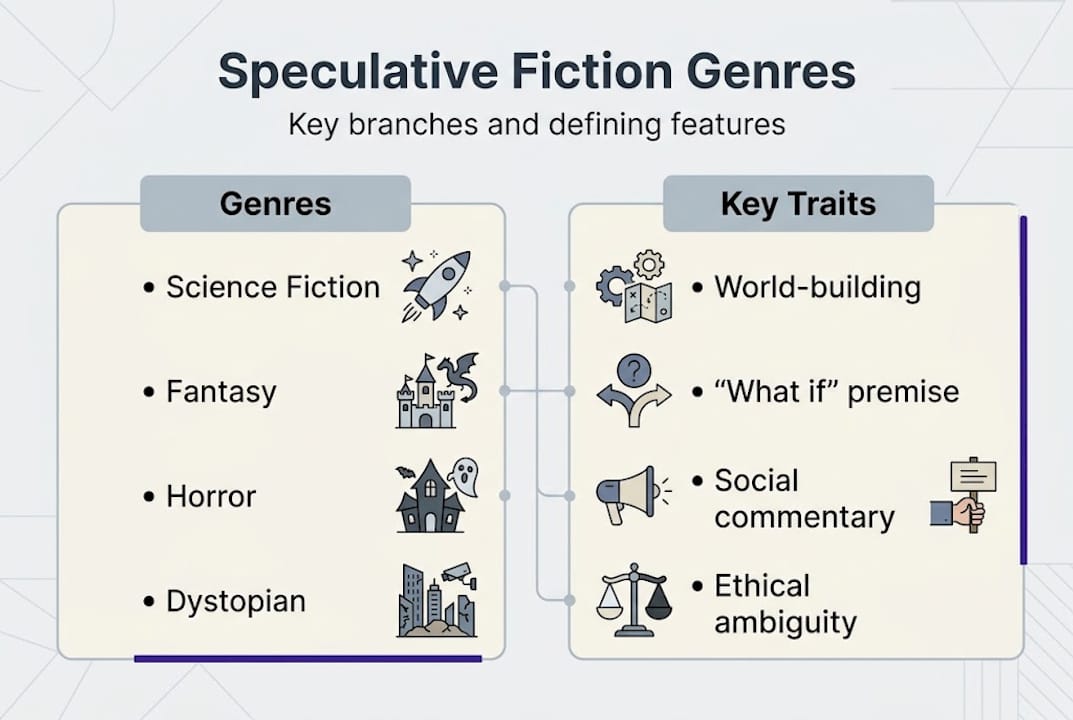
1. World-building as a foundation Speculative fiction stories construct their own internal logic. Whether it is an alien planet, a post-apocalyptic city, or a parallel Earth, the author builds rules that govern that world and then follows them. Readers trust the story because its world is consistent, even when it is wildly unfamiliar.
2. The "what if" premise Every speculative fiction story launches from a single, bold question. What if artificial intelligence became self-aware? What if women lost legal rights overnight? What if a different side had won World War II? That question is not decorative. It is the engine of the entire narrative.
3. Societal and philosophical commentary Speculative fiction rarely exists just for entertainment. It uses imagined scenarios to examine real issues: power, identity, freedom, inequality, and technology. The alien invasion is actually about colonialism. The robot uprising is actually about labor rights. The subtext is almost always about us.
4. Alternative realities and altered timelines These stories place characters in settings that diverge significantly from recorded history or present-day life. That divergence forces both characters and readers to confront what we take for granted about our own reality. As noted in discussions of sci-fi's cultural impact, speculative fiction often explores alternative realities, advanced technology, and imagined futures in ways that reshape how we think.
5. Moral and ethical ambiguity Speculative fiction rarely gives you a clear hero and a clear villain. It forces readers to sit with discomfort, to recognize that good intentions can produce terrible outcomes, and that survival sometimes demands impossible choices.
Pro Tip: Next time you browse a bookstore, flip to the back cover blurb and look for the phrase "in a world where" or any question that challenges a real-world assumption. That's your clearest signal that you're holding a speculative fiction title.
Comparison: Speculative fiction vs. traditional genres
Now that you know the main ingredients of speculative fiction, let's see how it stacks up against more familiar genres through a practical comparison.
| Feature | Speculative fiction | Literary fiction | Mainstream genre fiction |
|---|---|---|---|
| Setting | Imagined or altered reality | Realistic, recognizable world | Real-world settings |
| Central question | What if reality changed? | How do people feel and grow? | How does the plot resolve? |
| Tone | Often philosophical, eerie, or visionary | Introspective, nuanced | Plot-driven, fast-paced |
| Characters | Often archetypal or symbolic | Deeply psychological | Goal-oriented |
| Primary goal | Challenge assumptions | Illuminate human nature | Entertain and satisfy |
The table above makes one thing immediately clear: speculative fiction occupies a fundamentally different space than either of its counterparts. It does not simply tell a story. It interrogates the conditions under which stories are possible at all.
What makes this especially interesting is that speculative fiction blurs boundaries that typically separate literary and genre fiction. A novel like The Handmaid's Tale by Margaret Atwood is deeply literary in its prose and character psychology, yet purely speculative in its premise. 1984 by George Orwell reads as a political thriller but constructs a fully imagined totalitarian world. The Left Hand of Darkness by Ursula K. Le Guin is philosophical science fiction that uses an alien society to dismantle our assumptions about gender.
Notable works that illustrate just how wide the spectrum runs:
- 1984 by George Orwell: dystopian political warning
- Brave New World by Aldous Huxley: biotech-driven social control
- The Handmaid's Tale by Margaret Atwood: feminist dystopia
- The Left Hand of Darkness by Ursula K. Le Guin: anthropological science fiction
- Kindred by Octavia Butler: time travel as a lens on slavery
If you want to explore recommended speculative fiction reads organized by theme and difficulty, starting with those landmark titles is a proven approach.
The cultural and literary impact of speculative fiction
Understanding these genre distinctions makes it easier to see the powerful role speculative fiction has played across history and into the present.
Speculative fiction does not just respond to culture. It anticipates it. Arthur C. Clarke imagined geostationary communication satellites in 1945, more than a decade before Sputnik launched. William Gibson coined the term "cyberspace" in 1984, years before the internet became a household concept. Jules Verne described a vessel remarkably similar to a modern submarine in 1870.
| Book | Prediction | Real-world parallel |
|---|---|---|
| Neuromancer (Gibson, 1984) | Cyberspace and virtual reality | The internet and VR headsets |
| 1984 (Orwell, 1949) | Mass government surveillance | NSA mass surveillance programs |
| Brave New World (Huxley, 1932) | Mood-altering drugs as social control | Widespread antidepressant use |
| The Handmaid's Tale (Atwood, 1985) | State control of reproduction | Ongoing reproductive rights debates |
This predictive quality is not accidental. Because speculative fiction isolates one variable and then follows its consequences to a logical extreme, it functions almost like a thought experiment in novel form. The best authors are not guessing randomly. They are extrapolating carefully from the world they see.
Speculative fiction also creates space for ideas too controversial for mainstream debate. It has been a vehicle for racial justice, feminist theory, queer identity, and anti-colonialism for well over a century. Because the story happens "elsewhere" or "in the future," readers can engage with uncomfortable ideas before their defenses go up.
As observed in research on speculative fiction's influence, the genre often predicts technology and social trends, influencing real-world innovation in ways that ripple far beyond entertainment. Even fan culture itself reflects this: the way readers dress, identify, and form communities around speculative fiction signals a genre that touches identity at a deep level.
Pro Tip: After finishing a speculative fiction novel, try writing one sentence that describes what real-world issue it actually addressed beneath the surface premise. You will almost always find one. This habit builds the kind of critical thinking that building a sci-fi collection over time naturally encourages, and it also sharpens the science fiction's creative benefits you take away from every read.
A fresh perspective: Why speculative fiction matters more than ever
Most commentary on speculative fiction treats it as a clever mirror held up to society. That framing undersells it considerably.
We are living through a period of genuinely rapid change: artificial intelligence reshaping entire industries, climate systems behaving in unprecedented ways, and social structures shifting faster than institutions can process. In that environment, the ability to imagine plausible alternatives to the present is not a luxury. It is a survival skill.
Conventional wisdom still treats speculative fiction as escapism, something you enjoy after the serious business of real life is done. That view has it exactly backward. Engaging seriously with imagined futures trains you to hold uncertainty without panic. It teaches you to ask "what happens next" as a productive question rather than an anxious one.
Reading speculative fiction can unlock new creativity and understanding in ways that nonfiction rarely achieves, because fiction makes you live inside a scenario rather than simply read about it. That lived-in experience is what changes how you think, not just what you know. The most overlooked strength of speculative fiction is exactly this: it does not just inform your worldview. It rebuilds it from the inside out. If there is one genre that should be considered essential reading for navigating a fast-changing world, it is this one, and for creative reasons to read speculative fiction that go well beyond entertainment.
Explore speculative fiction with MunkterProducts.com
If you're ready to dive deeper into the world of speculative fiction, here's where to continue your journey.
At MunkterProducts.com, you will find a curated range of speculative fiction books and merchandise selected with genre enthusiasts in mind. Whether you are just starting out or looking to add standout titles to an existing collection, the site brings together carefully chosen reads and creative products in one place.

From must-read sci-fi novels that cover the classics and modern standouts, to inspired accessories like retro sci-fi tees that let you wear your enthusiasm, there is something here for every kind of speculative fiction fan. Exploring the genre is more rewarding when you do it with the right books in hand.
Frequently asked questions
What subgenres fall under speculative fiction?
Speculative fiction includes science fiction, fantasy, horror, alternate history, dystopian fiction, and more. As a broad literary category, it also extends into slipstream, cli-fi, and magical realism depending on how broadly you define its boundaries.
How does speculative fiction differ from literary fiction?
Speculative fiction focuses on imagined realities and "what if" scenarios, while literary fiction centers on realistic storytelling and character development. Speculative fiction stretches imagination with alternative worlds, future tech, and societal commentary that realistic fiction deliberately avoids.
Why is speculative fiction important in modern culture?
Speculative fiction challenges social norms, predicts technological trends, and inspires innovation. It blends imagination with societal trends, often sparking real-world change in science, policy, and cultural conversation.
What are some classic examples of speculative fiction?
Notable examples include 1984, Brave New World, The Left Hand of Darkness, and The Handmaid's Tale. These speculative fiction classics span dystopian, fantasy, and science fiction genres and remain foundational reading for any enthusiast.