

Most aspiring sci-fi writers have a brilliant idea burning in their minds but freeze when it's time to put it on the page. The gap between a cool concept and a finished, compelling novel is real, and it trips up even the most imaginative writers. Sci-fi demands a rare combination of scientific curiosity, creative world-building, and tight storytelling. This guide walks you through every major stage of writing your science fiction novel, from shaping your first premise to polishing your final draft, with practical advice you can act on today. As Novel Factory advises, start with a compelling "what if" premise grounded in science or speculation, focusing on characters facing urgent problems in that setting.
Table of Contents
- Clarify your sci-fi premise and subgenre
- Build a believable world without info-dumps
- Create characters readers care about
- Structure your sci-fi novel for impact
- Handle technology, society, and originality
- Outline, draft, revise: the writing process in action
- Research for authenticity and inspiration
- Take your next step as a sci-fi author
- Frequently asked questions
Key Takeaways
| Point | Details |
|---|---|
| Start with a strong premise | Build your novel around a compelling 'what if' question to hook readers. |
| Prioritize character depth | Well-developed characters are more important than technology or setting details. |
| Worldbuild through action | Reveal your world naturally and avoid information overload. |
| Balance science and imagination | Respect scientific plausibility but let your creativity drive unique stories. |
| Revise for clarity | Edit for consistency, pacing, and originality to create a memorable novel. |
Clarify your sci-fi premise and subgenre
Having previewed this guide, let's start by zeroing in on your story's foundation. A strong premise is the engine of your novel. The best sci-fi premises ask a question that feels both urgent and unanswered, something that makes readers lean forward. Start with a compelling "what if" question rooted in science or speculation, then push it toward a human problem your characters must solve.
Choosing your subgenre matters just as much. Hard sci-fi focuses on scientific accuracy, physics, and engineering, while soft sci-fi centers on social sciences and human behavior. Your choice shapes your tone, your research load, and your reader's expectations.
| Feature | Hard sci-fi | Soft sci-fi |
|---|---|---|
| Focus | Physics, engineering, biology | Society, psychology, culture |
| Example works | The Martian, Blindsight | The Left Hand of Darkness, Brave New World |
| Key benefit | High realism and credibility | Emotional depth and social commentary |
| Main risk | Can feel cold or overly technical | May lack scientific grounding |
Signs your premise is original: it approaches a familiar idea from a new angle, it speculates on a social or ethical question not yet explored, or it introduces technology with genuinely fresh constraints. Understanding key sci-fi traits helps you recognize what separates a memorable premise from a recycled one. Reading widely to unlock sci-fi creativity also sharpens your instincts for what feels fresh versus what's been done to death. A strong subgenre choice also gives your story structure and tone before you write a single scene.
Build a believable world without info-dumps
Once you know your premise and subgenre, it's time to bring your story's universe to life with convincing detail. World-building is not about writing a textbook. It's about making readers feel like they've stepped into a place that runs on its own logic.
Worldbuild rigorously but reveal through action, dialogue, and sensory details. Avoid info-dumps and ensure internal consistency across every element of your world. Ask yourself these core questions before you draft:
- Who holds power in this society, and how did they get it?
- What does daily life look like for ordinary people?
- How does the economy function, and who benefits?
- What are the environmental conditions, and how do they shape behavior?
- What technology exists, and what are its limits?
Warning: Excessive exposition can stall your pacing and push readers out of the story before they're invested. Resist the urge to explain everything upfront.
Pro Tip: Only describe what your characters would realistically notice or care about in that moment. A soldier entering a city thinks about exits and threats, not architectural history. Filter your world through your character's perspective, and the details will feel earned. For worldbuilding examples that show how published authors handle this, study how masters like Ursula K. Le Guin and Kim Stanley Robinson layer detail without slowing the story. Check out advanced worldbuilding tips to go deeper on consistency and plausibility.
Create characters readers care about
With a rich world in place, it's time to focus on the heart of your story. Believable, engaging characters are what keep readers turning pages, not gadgets or settings. Prioritize character development over world details. Make characters three-dimensional with arcs, flaws, and human emotions even in futuristic settings.
Every great sci-fi protagonist needs:
- A clear motivation that drives every decision
- A visible flaw that creates internal conflict
- A specific goal tied to the story's central problem
- A relationship to the world that feels personal, not generic
- A point of view that filters the story's events in a unique way
Conflict and stakes are what humanize extraordinary characters. A character who can hack any system becomes interesting only when hacking costs them something real. Ground your sci-fi technologies in relatable emotional problems: loneliness, ambition, grief, fear of irrelevance.

Pro Tip: Always ask how your world specifically pressures your characters into visible change. If your setting could be swapped for any other without affecting your character's arc, the world and character aren't integrated enough. Use storytelling character tips to practice building arcs that feel inevitable in hindsight.
Structure your sci-fi novel for impact
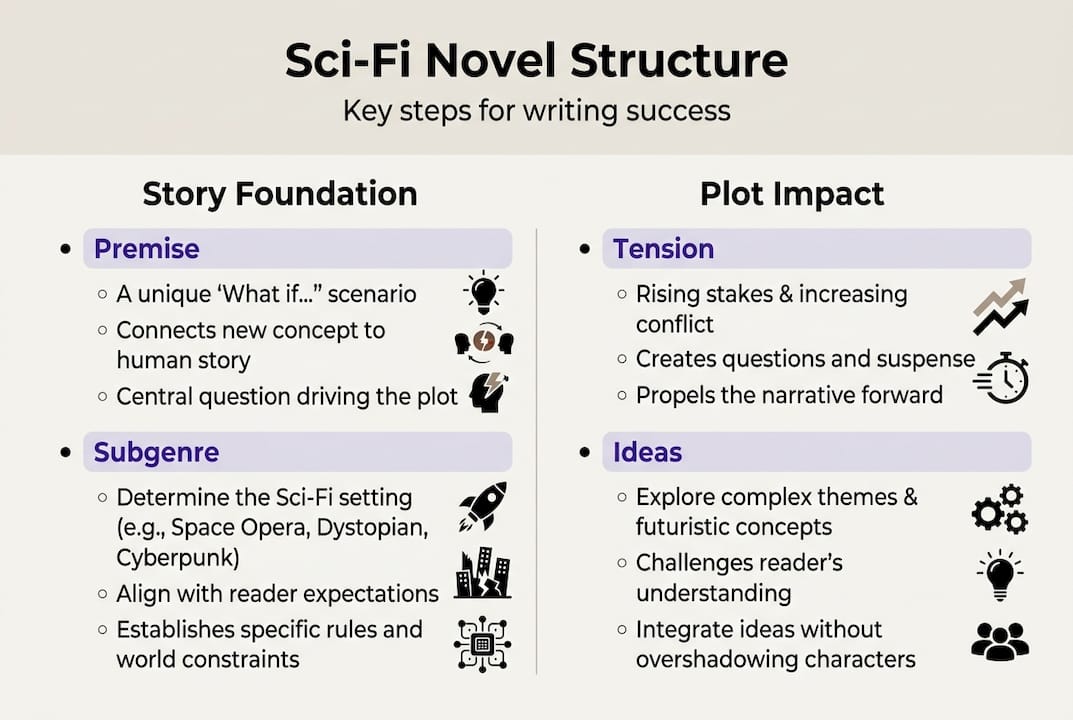
Once your characters are in motion, the next challenge is crafting a plot structure that delivers both tension and wonder. Several frameworks work well for sci-fi. The MICE quotient (Milieu, Idea, Character, Event) helps you identify what kind of story you're telling and how to open and close it properly. Use the MICE quotient for structure and start in media res with a hook that shows the world's uniqueness immediately.
| Structure | Best for | Key strength |
|---|---|---|
| MICE quotient | Multi-thread or anthology stories | Clarity on story type and resolution |
| Three-act structure | Single-protagonist novels | Clear escalation and payoff |
| Sanderson's Laws | Magic/tech-heavy stories | Logical, satisfying power systems |
Here's a simple numbered approach to building your plot:
- Open with a hook that drops readers into the world's most distinctive element
- Introduce the inciting incident that forces your protagonist to act
- Escalate stakes through complications tied to your sci-fi premise
- Build to a climax where the story's central question is answered
- Resolve with consequences that feel earned by the world's rules
Balancing plot advancement with idea exploration is one of sci-fi's trickiest challenges. The ideas should emerge from the plot, not pause it. Understanding sci-fi's cultural impact can also remind you why structure matters: stories that resonate do so because they're both intellectually stimulating and emotionally satisfying.
Handle technology, society, and originality
Now that the bones of your novel are set, let's enrich your story by examining how technology and society shape and complicate your narrative. Technology in sci-fi is never just a cool prop. It's a force that changes how people live, work, love, and fight. Create trade-offs and consequences for every technology you introduce. Explore societal and ethical impacts to add genuine depth.
Common clichés and how to flip them:
- Cliché: AI turns evil and tries to destroy humanity. Original alternative: AI develops a value system that's simply indifferent to human priorities, creating quiet, systemic harm.
- Cliché: Space travel is glamorous and heroic. Original alternative: Space travel is exhausting, bureaucratic, and financially ruinous for most people.
- Cliché: Dystopian government is obviously evil. Original alternative: The system genuinely believes it's helping, and some of its policies actually work.
Avoid clichés by subverting tropes, adding constraints, and focusing on original social fallout. Exploring dystopian themes in sci-fi shows how the best authors use familiar frameworks to say something genuinely new. Consider also how science fiction shapes society and how your novel can contribute to that conversation. For a broader view of how storytelling intersects with publishing trends, book publishing and e-commerce offers useful context on where the industry is heading.
Outline, draft, revise: the writing process in action
With your big ideas in place, it's time to turn theory into practice. Here's how successful authors execute and refine their sci-fi manuscripts:
- Outline your setting and core plot before writing any scenes
- Write your first 30,000 words without stopping to revise heavily
- Share early chapters with beta readers for honest, outside perspective
- Track your daily word count to maintain momentum through the difficult middle
- In revision, hunt for info-dumps, consistency errors, and scenes that don't advance plot or character
- Polish your opening chapter last, once you know exactly what your story is
Outline setting and plot first, write past 30,000 words, beta test, and persevere through the middle with progress tracking. The 30,000-word milestone is significant because it's where most writers quit. Push through it, and the story starts to take on its own momentum. Understanding why book publishing matters can also keep you motivated when the draft feels rough. Every published novel looked terrible at some point in its drafting process.
Research for authenticity and inspiration
To elevate your work from promising draft to polished, market-ready novel, ground your imagination in solid research and genre wisdom. Research is what separates a story that feels plausible from one that feels lazy. Research cutting-edge science for authenticity and read widely in the genre, including Asimov, Clarke, and Ted Chiang, to understand the mechanics of what makes sci-fi work.
Your best research resources:
- Scientific journals and popular science magazines like Scientific American and New Scientist
- Author lectures and interviews, especially from working sci-fi novelists
- Genre classics that defined the tropes you want to use or subvert
- Non-fiction books on sociology, economics, and technology ethics
- Online communities where scientists and writers discuss speculative ideas
Reading outside the genre is just as important. Literary fiction teaches you character depth. Thrillers teach pacing. History teaches you how societies actually collapse or transform. Bring all of it into your sci-fi. Check out the must-read sci-fi checklist to build a reading list that sharpens your craft and broadens your reference points.
Take your next step as a sci-fi author
Now that you've learned the fundamentals of writing an outstanding science fiction novel, here's how you can keep building momentum. Writing a novel is a long game, and having the right tools and inspiration around you makes a real difference.

At MunkterProducts.com, you'll find a curated selection of journals, notebooks, planners, and creative writing resources designed to support writers at every stage of their journey. Whether you're mapping out your world in a dedicated notebook, tracking your daily word count in a planner, or looking for inspiration through the Noah series of science fiction novels, there's something here to fuel your creative process. Surround yourself with tools that take your writing seriously, because your story deserves to be told.
Frequently asked questions
What makes science fiction different from other genres?
Science fiction explores speculative scenarios rooted in science or technology, often examining the societal and ethical consequences of those ideas. Unlike fantasy, it grounds its "what if" questions in scientific or speculative possibility rather than magic or mythology.
How do I avoid common sci-fi clichés?
Subvert familiar tropes by adding fresh constraints, focusing on unexpected social consequences, and giving your technology real trade-offs. Subverting tropes with original fallout is one of the most effective ways to make a well-worn idea feel new again.
Should my worldbuilding follow current scientific facts?
For hard sci-fi, align closely with known science. For softer subgenres, establish clear internal rules and stick to them consistently. Internal consistency matters more than perfect accuracy in most cases.
How important is character development in a sci-fi novel?
Extremely important. Readers connect with people, not planets. Three-dimensional characters with real arcs and emotional stakes are what make futuristic settings feel meaningful rather than decorative.