

TL;DR:
- Journal therapy uses purposeful writing to process emotions and foster personal growth, with guided protocols showing measurable benefits. Research indicates structured journaling improves anxiety, PTSD, and overall mental health modestly, especially when guided prompts are used. Choosing a dedicated, high-quality journal enhances the practice's effectiveness by establishing an intentional ritual.
Journal therapy is the intentional use of reflective writing to process emotions, build self-awareness, and support personal growth. It is not the same as keeping a diary. The single most important thing to understand: guided, purposeful writing produces measurably more benefit than casual journaling. That distinction is backed by decades of research, most notably the Pennebaker expressive writing protocol and the work of the Center for Journal Therapy. For anyone shopping for a handcrafted or guided journal, understanding what journal therapy actually is helps you choose a tool that genuinely supports the practice.
Table of Contents
- What journal therapy is and how it differs from diary keeping
- What the research says about journal therapy
- How to start a journal therapy practice at home
- Techniques that make journaling actually therapeutic
- When journaling helps and when to seek professional support
- How to choose a physical journal for therapeutic writing
- Key Takeaways
- Why the journal you write in actually matters
- Handcrafted journals for your therapeutic writing practice
- Useful sources and further reading
What journal therapy is and how it differs from diary keeping
Journal therapy is the purposeful, structured use of writing to explore internal experience rather than record external events. The Center for Journal Therapy defines it as reflective written records of thoughts and feelings used to support psychological healing and personal growth. Ira Progoff's Intensive Journal method, developed in the 1960s, helped establish it as a stand-alone modality, and training programs have since shaped how practitioners use it today.
The contrast with ordinary diary keeping comes down to intent and structure:
- Diary: "Had lunch with Sarah. Work meeting ran long. Tired."
- Journal therapy: "When the meeting ran over, I felt invisible. What does that say about what I need from my team?"
Key differences at a glance:
- Intent: Diary records events; journal therapy processes internal reactions to them.
- Structure: Diary is free-form; journal therapy uses prompts, exercises, or a defined protocol.
- Guidance: Diary needs none; journal therapy benefits from prompts or a practitioner framework.
- Outcome focus: Diary preserves memory; journal therapy builds insight and emotional clarity.
That shift from recording to reflecting is what makes the practice therapeutic.
What the research says about journal therapy
The most-studied method is the Pennebaker expressive writing protocol: write continuously about your deepest thoughts and feelings regarding a stressful or traumatic experience for 15–20 minutes per session across three to five sessions, typically on consecutive days. Dr. James Pennebaker developed this protocol in the 1980s, and it has since been used in both clinical and non-clinical populations. The VA's Whole Health Library cites it as the most widely used and researched method in clinical practice, linking it to improvements in both physical and psychological health, including possible immune system benefits.
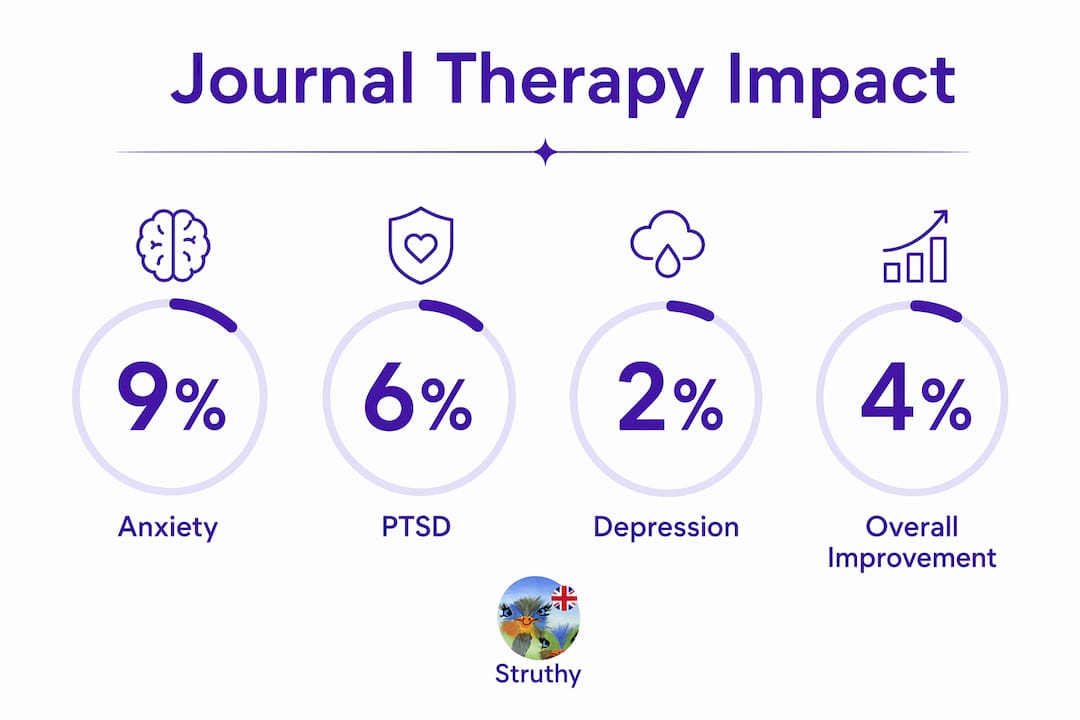
A 2022 meta-analysis published in PMC aggregated effect sizes across multiple studies and found a statistically significant average improvement in mental health scores of about 5%, with stronger effects for anxiety (~9%) and PTSD (~6%) compared with depression (~2%).
What those numbers mean in practice: A 9% improvement in anxiety scores is modest but real, roughly equivalent to the benefit seen from some low-intensity behavioral interventions. The effect for depression is smaller and less consistent, which means journaling alone is unlikely to lift a serious depressive episode. Think of it as a meaningful support tool, not a treatment.
Results vary by condition and by how the journaling is done. Instruction quality matters significantly: guided prompts and cognitive approaches produce more consistent benefits than unstructured venting. Expressive writing can also cause short-term increases in distress before benefits appear, which is why preparation and debriefing are recommended, especially for intense material.
| Condition | Average improvement (meta-analysis) |
|---|---|
| Anxiety | ~9% |
| PTSD | ~6% |
| Depression | ~2% |
| Overall mental health | ~5% |
How to start a journal therapy practice at home
The Pennebaker protocol is the safest, most research-backed starting point for personal use. Here is a simple routine that mirrors it without requiring clinical supervision:
- Choose a consistent time and place. A quiet, undisturbed setting signals to your brain that this is focused work. Same time each day builds the habit faster.
- Set a timer for 15–20 minutes. Do not write for less; do not feel obligated to write for more.
- Pick one experience or emotion to explore. It does not have to be traumatic. A recurring worry, a relationship tension, or a moment of unexpected sadness all work.
- Write without stopping. Ignore grammar, spelling, and style. The goal is honest expression, not polished prose.
- Do this for four consecutive days. The consecutive-days structure is what the research supports.
- Close the session intentionally. Spend two to three minutes doing something grounding: a short walk, a glass of water, a few slow breaths. This is the debriefing step practitioners recommend.
- Review after the four days. Read back what you wrote and note any patterns, surprises, or shifts in how you see the situation.
Pro Tip: Before your first session, write a single sentence about what you hope to understand by the end of four days. It gives the practice direction and makes the review on day five far more useful.
For a larger bank of starting ideas, the journaling prompts library at Munkterproducts covers 60+ prompts organized by growth theme.
Techniques that make journaling actually therapeutic
Writing volume is not what drives benefit. Technique quality is. Four approaches consistently outperform aimless venting:
Cognitive reframing. Write about a difficult event, then write a second entry asking: "What would I tell a close friend in this exact situation?" The third-person distance reduces emotional reactivity and opens up perspective that is hard to access when you are inside the feeling.

Structured thought records. Borrowed from CBT, these prompt you to name the situation, identify the automatic thought, rate your belief in it, list evidence for and against, and write a more balanced response. A guided journal with pre-printed prompts makes this far easier to sustain.
Dialoguing with parts. Write a conversation between yourself and a specific emotion or inner voice. "What does my anxiety actually want me to know right now?" This technique, common in IFS-informed journaling, surfaces insight that direct narration often misses.
Gratitude framing. End each session with two or three specific things that went well, described in detail. Specificity matters here; "I'm grateful for my health" produces less benefit than "I'm grateful that my friend called to check in when I hadn't reached out."
Pro Tip: If you notice yourself writing the same complaint in the same words session after session, that is rumination, not processing. Shift the prompt: instead of "why did this happen to me," try "what does this situation ask of me going forward?"
Guided journals with built-in prompts are particularly useful for avoiding the rumination trap. A blank page invites venting; a structured prompt redirects toward insight. For a deeper look at how guided journals support this kind of writing, Munkterproducts has a practical breakdown of how prompts and structure work together.
When journaling helps and when to seek professional support
Journaling is a self-management tool. It is not a substitute for licensed therapy when symptoms are severe or complex.
"Journaling is most effective when used alongside professional support rather than as a substitute. It cannot replicate the relational and clinical components of professional therapy, particularly for complex trauma, significant depression, or anxiety disorders." — Simply Psychology
Watch for these red flags during or after sessions:
- Mood worsening significantly and not recovering within a day or two
- Intrusive thoughts or images that feel uncontrollable after writing
- Any thoughts of self-harm or suicide
- Functional decline: sleep disruption, withdrawal from daily activities, inability to concentrate
If any of these appear, stop the intensive writing practice and contact a licensed mental health professional. When you do bring journal material to a therapist, share themes and patterns rather than raw unedited entries. Summarizing what you noticed preserves the processed insight and avoids retraumatization in session.
This article is general information, not professional advice. Confirm current guidance with a licensed clinician for your specific situation.
How to choose a physical journal for therapeutic writing
The right journal is not just a preference. Practitioner guidance consistently recommends a dedicated, quality journal to mark the practice as intentional and to increase follow-through. Physical cues, a specific book, a good pen, a consistent place on your desk, help the brain treat the writing session as focused work rather than a casual activity.
What to look for:
- Size: A5 or similar is portable enough for travel but large enough for extended writing. Avoid tiny pocket notebooks for therapeutic sessions.
- Paper quality: Thick, smooth paper prevents bleed-through and makes writing feel less effortful. This matters more than it sounds after 20 minutes of continuous writing.
- Binding: Lay-flat binding (spiral or sewn) keeps the journal open without fighting it. Hardcover protects privacy and signals permanence.
- Guided prompts vs. blank pages: Guided prompts suit beginners and anyone prone to rumination. Blank pages suit experienced writers using the Pennebaker protocol. Many people benefit from both: a guided journal for structured sessions and a blank notebook for free-form expressive writing.
- Privacy features: A journal with a clasp or keepsake box increases the likelihood of honest writing. Knowing the book is secure removes a subtle self-censorship that undermines the whole practice.
Personalized journals also increase adherence because the object itself feels meaningful rather than disposable.
Key Takeaways
Journal therapy works because purposeful, guided writing produces measurably more emotional and psychological benefit than casual diary keeping or unstructured venting.
| Point | Details |
|---|---|
| Guided writing beats venting | Structured prompts and cognitive reframing produce more consistent benefits than aimless emotional release. |
| Pennebaker protocol is the benchmark | Write 15–20 minutes per session for four consecutive days about your deepest thoughts on a stressful experience. |
| Evidence is real but modest | A 2022 meta-analysis found ~9% improvement for anxiety, ~6% for PTSD, and ~2% for depression on average. |
| Know the limits | Journaling is a self-management tool; seek a licensed therapist for severe symptoms, trauma, or suicidal thoughts. |
| Munkterproducts for practice support | Munkterproducts offers handcrafted guided journals and self-help books suited to both structured and expressive writing practices. |
Why the journal you write in actually matters
Most writing about journal therapy focuses entirely on technique and ignores the object itself. That is a mistake. The physical journal is not neutral. A cheap spiral notebook from a gas station sends a signal to your brain: this is disposable, this is casual, this does not matter much. A handcrafted journal with quality paper and a lay-flat binding sends the opposite signal. The ritual starts before you write a single word.
Practitioners who recommend dedicated journals are not being precious about stationery. They are describing a real mechanism: physical cues anchor behavior. The same principle that makes a dedicated workspace more productive than a couch applies here. When the object is beautiful and intentional, the practice becomes more so.
There is also something worth saying about guided prompts specifically. The research is clear that instruction quality drives outcomes. A blank page is a test of self-discipline and technique knowledge most people do not have when they start. A guided journal with thoughtful prompts is not a shortcut. It is scaffolding that makes the evidence-based approach accessible without a therapist in the room.
The gap between "I tried journaling and it didn't do much" and "journaling genuinely changed how I process things" is almost always technique, not effort.
Handcrafted journals for your therapeutic writing practice
If the research convinced you that technique and ritual matter, the next step is finding a journal that supports both. Munkterproducts offers handcrafted journals and guided self-help books built for exactly this kind of intentional writing. Whether you want structured prompts to guide a Pennebaker-style session, a beautifully bound blank journal for free expressive writing, or a compact option you can carry to a quiet café, the range covers different practice styles without compromising on material quality.

The journals are designed as objects worth returning to, which is the single most practical thing a journal can do for your practice. Browse the full collection and find the format that fits how you write at munkterproducts.com.
Useful sources and further reading
The claims in this article draw from primary research and practitioner guidance. For readers who want to go deeper before starting an intensive writing practice:
- Therapeutic Journaling (U.S. Department of Veterans Affairs) — the most accessible plain-language overview of the Pennebaker protocol and its evidence base.
- Efficacy of journaling in the management of mental illness: systematic review and meta-analysis (PMC, 2022) — the primary source for the condition-specific effect sizes cited above.
- Emotional and physical health benefits of expressive writing (Cambridge Core) — a peer-reviewed review of structured expressive writing outcomes.
- Journal Therapy overview (GoodTherapy) — practitioner-facing overview including the Center for Journal Therapy's definition and training context.
- Journaling for mental health and wellness (HelpGuide) — practical guidance on safe use, including when to involve a professional.
For clinical concerns, consult a licensed mental health professional before beginning any intensive expressive writing protocol.