
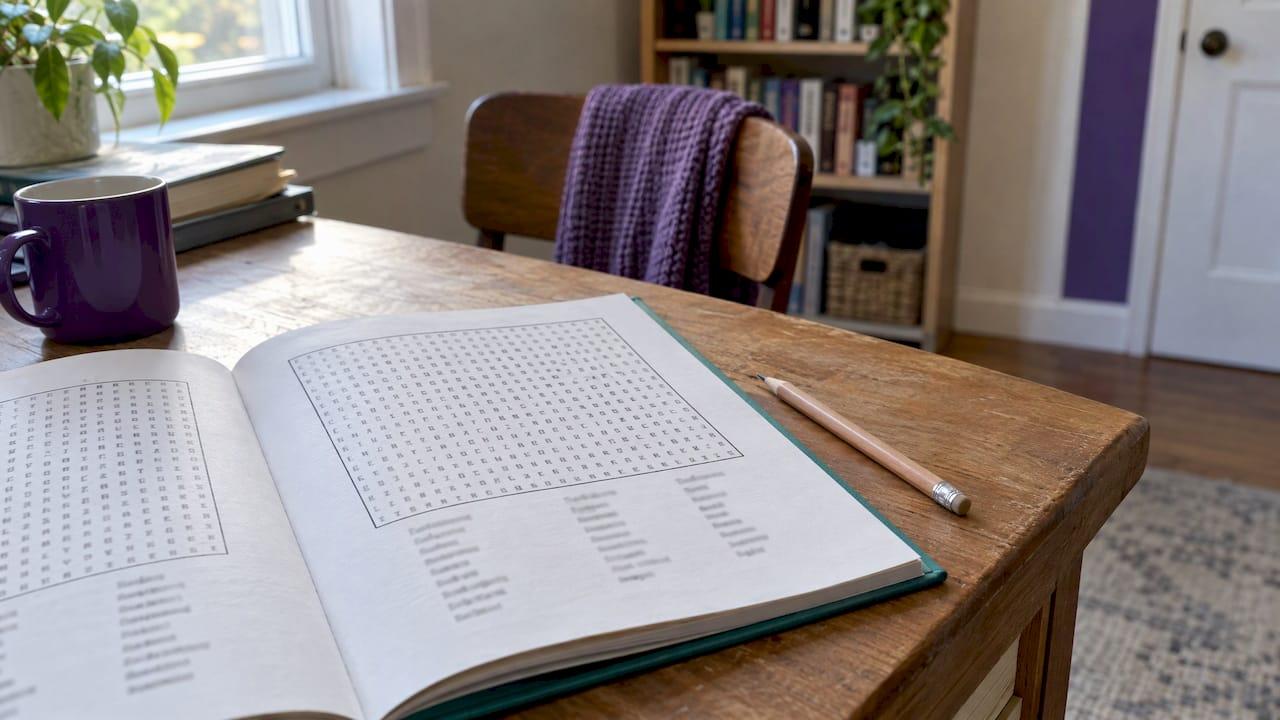
Word search difficulty comes from three things: how big the grid is, how many words are hidden, and which directions those words can run. Easy puzzles use a small grid with words that read left to right or top to bottom. Hard puzzles use a bigger grid, more words, and words that run backward and diagonally. There is no official standard, so the labels "easy", "medium" and "hard" mean slightly different things from one publisher to the next.
This guide shows what each level usually contains, why two puzzles with the same label can feel very different, and how to choose a level for a child, a teenager, a grandparent or yourself.
TL;DR
- Difficulty is set by grid size, word count and word directions. Change any one and the puzzle feels different.
- Easy usually means a grid of about 8×8 to 10×10 and words that run across and down only. Hard adds backward and diagonal words in every direction.
- Levels are not standardized. A "medium" in one book can be an "easy" in another, so check the sample page or description.
- For a child, pick the level where they finish most puzzles with a little effort. For adults, step up when the current level stops slowing you down.
- Theme, print size and word length also change how hard a puzzle feels.
Table of Contents
- What easy, medium and hard mean in a word search
- The three settings that control difficulty
- Other things that make a puzzle feel harder
- Are difficulty levels standardized?
- How to choose the right level
- Moving up a level without losing the fun
- Find your level in our word search books
- Worked examples: same label, different puzzle
- Frequently asked questions
- Sources
What easy, medium and hard mean in a word search
A difficulty label is a bundle of settings. Publishers and puzzle sites pick the bundle, then name it. One free puzzle site lays this out openly: easy uses only across and down, medium adds two diagonals, and hard uses all eight directions, which includes backward and upward words. Another source describes the same three controls working together: grid size, the directions words can run, and how many words share letters.
Here is the typical pattern, based on the figures those pages give:
| Level | Typical grid | Typical word count | Directions |
|---|---|---|---|
| Easy | 8×8 to 10×10 | 6 to 8 | Across and down only |
| Medium | About 10×10 to 12×12 | 10 to 12 | Adds diagonals, read forward |
| Hard | 13×13 or larger | 15 or more | All eight directions, backward too |
| Expert or extreme | 15×15 and up | 20 or more | All eight, with more shared letters |
Treat the table as a guide. One site's table gives 8×8 with 6 words for easy and 13×13 with 15 words for hard. Another runs from 8×8 up to 16×16 across five levels. The numbers differ, but the logic is the same: more space, more words and more directions make a harder search.
Easy: the confidence builder
Easy puzzles suit young children, new solvers and anyone who wants a relaxed half hour. Every word reads the way you read a sentence, so your eyes already know what to do. The grid is small, the list is short, and there are fewer false starts.
Medium: the everyday level
Medium is where most adult solvers settle. Diagonals appear, which means you have to scan in a new direction. The grid is large enough that you cannot spot every word at a glance, but you rarely get stuck for long.
Hard: backward words and crowded grids
Hard is where the challenge changes in kind, not just in size. Backward words are the main reason. We read forward by habit, so a word spelled right to left or bottom to top can sit in plain sight. Add a larger grid and a long word list and you have a puzzle that rewards patience and a method.
The three settings that control difficulty
Grid size
A bigger grid means more letters to scan and more places for a word to hide. Going from 10×10 to 15×15 more than doubles the number of squares, from 100 to 225. That is a bigger jump in effort than the numbers suggest, because your eyes have to cover far more ground.
Number of hidden words
More words means a longer task, but it does not always mean a harder one. Twelve words can be easy or hard depending on where they are placed. Word count mostly affects stamina and the feeling of progress. A short list gives quick wins, which is why it suits children.
Word direction
Direction is the setting that changes difficulty most for the same grid size. From easiest to hardest:
- Left to right and top to bottom.
- Forward diagonals, running down and to the right.
- Backward words, right to left.
- Upward words, bottom to top.
- Backward diagonals, running in any of the remaining directions.
A 10×10 grid with all eight directions is usually harder than a 12×12 grid with two.
Other things that make a puzzle feel harder
The three main settings are not the whole story. Several smaller choices shift the experience.
- Overlapping words. When words cross and share letters, the grid is packed more tightly. There are fewer stray letters to ignore, but the real words are harder to isolate.
- Word length. Short words of three or four letters hide easily in the filler. Long words are easier to spot once you find the first letters, but harder to read in reverse.
- Similar starting letters. A list with several words that begin the same way creates false leads.
- Whether the list is shown. Some expert puzzles show only the lengths of the words. Searching without the full list is a different skill altogether.
- Print size and layout. Small type and tight spacing tire the eyes. Large print makes the same grid far more comfortable, which matters for older solvers. Our guide to large print word search books goes into this, and there is more on why large print helps eyes, mind and mood.
- Theme. Familiar topics such as animals or foods are friendlier than technical vocabulary or unusual spellings. See our word search theme ideas for every age.
Are difficulty levels standardized?
No. There is no industry-wide definition, and each publisher sets its own. Some use three levels, some four or five, and some name levels with words like "Einstein" instead of "expert". One educational publisher describes its puzzles as Level 1, Level 2 and Level 3, with Level 1 the easiest, which tells you the order but not the exact settings.
So a label alone does not tell you much. Before you buy or print, look for these clues:
- A sample page or preview of the interior.
- The grid size, if the listing states it.
- Whether words run backward or diagonally.
- The intended age range.
- Whether the puzzles in the book get harder as you go, or all sit at one level.
If a book gives none of that, the age range and the sample page are your best guides.
How to choose the right level
The aim is a puzzle that feels like a stretch, not a struggle and not a stroll. A simple rule: pick the level where you finish most puzzles, with a few moments of being stuck.
For young children
Start with easy puzzles: small grids, short lists, words that read forward only. Children who are still learning to read do well when the words are short and the theme is something they know. Large print and plenty of space between letters help too. Once a child finishes puzzles comfortably and wants more, move up to a grid with forward diagonals before introducing backward words. Our piece on problem-solving with word search books for kids explains how puzzles build persistence, and the role of themed word searches in learning shows how to match topics to what a child is studying.

For older children and teenagers
Medium puzzles with diagonals are a good starting point. Teens who enjoy a challenge often jump to hard quickly, so a book that mixes levels can be a good fit. If they get frustrated, drop back one level for a few puzzles and then try again.
For adults
Most adults enjoy medium for relaxing and hard for focus. If you find yourself finishing medium puzzles without trying, go up. If you want a real test, our guide to hard word search books for adults and teens covers what to look for.
For older adults
Comfort matters as much as challenge. Choose large print, generous spacing and clear grids. Difficulty can stay at medium or hard, as long as the print is easy on the eyes. Our article on the benefits of word search books for brain health and fun covers why many people keep puzzling for years.
Quick decision guide
| If the solver... | Try this level |
|---|---|
| Is new to word searches or under about 7 | Easy |
| Finishes easy puzzles quickly and wants more | Medium |
| Finds medium relaxing and wants a challenge | Hard |
| Enjoys hard and wants the list hidden | Expert |
| Has tired eyes | Any level, in large print |
Ages are rough. A confident reader of five can handle more than a reluctant reader of nine, so watch the solver, not the birthday.
Moving up a level without losing the fun
Changing one setting at a time keeps the step small. Try this order:
- Stay on the same grid size, but add forward diagonals.
- Increase the grid size a little, keeping directions the same.
- Introduce backward words, starting with horizontal ones.
- Add upward and backward diagonal words.
- Lengthen the word list.
If you want a method for scanning bigger grids, see how to solve word searches faster at any age. Looking for the first letter of a word, then checking all the neighbors, beats scanning line by line.
Our view on difficulty
When I write and design a word search book, difficulty is the first decision, not the last. A puzzle that is too hard teaches a child to put the book down. One that is too easy bores an adult within three pages.
Every product in our catalog is an original work, and we think the best puzzle books are made by one person who cares about the reader, not assembled from a template. That is why our word searches are built around themes people actually enjoy, and why we pay attention to how the page looks and feels, not just the grid.
My advice is to pick a level where you can finish and feel proud, then climb. A book that lets you do that is worth more than one that simply claims to be hard.
Mark
Find your level in our word search books
If you are ready to try a book, our word search books include classic puzzles and our Artful Wordsearch range, all original works by Mark Terry. Worldwide postage is included in the price.

For a wider mix of brain teasers, browse our activity and puzzle books. If you are buying for a child who also likes to draw, our children's colouring books pair well with a puzzle book.
New to the format? Our guide to what a word search book is, with its benefits and types is a good starting point.
Worked examples: same label, different puzzle
Seeing two "medium" puzzles side by side shows why labels mislead.
Puzzle A. A 10×10 grid, 10 words, across, down and two forward diagonals. Words are mostly five to seven letters. Most solvers find nine of the ten in a few minutes.
Puzzle B. A 12×12 grid, 12 to 14 words, diagonals added, two words that overlap. Several words start with the same two letters. The same solver may take twice as long.

Both could be called medium. The first is a gentle medium and the second a firm one. If a book offers a sample page, count the words and look for backward ones. Ten seconds of checking saves a disappointing purchase.
Frequently asked questions
What is the difference between easy and hard word searches?
Easy word searches use a small grid, a short word list and words that run only across and down. Hard ones use a bigger grid, more words, and all eight directions, including backward and diagonal. The extra directions make the biggest difference.
How big is a medium word search grid?
It varies by publisher, but around 10×10 to 12×12 is common, with about 10 to 12 words and diagonals added. Free puzzle sites publish their own figures that fall in this range.
What level should a child start with?
Start with easy: a small grid, a short list of familiar words and forward-only directions. Once they finish puzzles comfortably, add diagonals, then backward words. Choose the level based on how the child responds, not only on age.
Are word search difficulty levels the same in every book?
No. Each publisher sets its own, so one book's medium can match another's easy. Check the sample pages, grid size and age range before you choose.
Does a bigger grid always mean a harder puzzle?
Not always. A large grid with only across and down words can be easier than a small grid with all eight directions. Direction and word overlap matter as much as size.
Sources
- Word Search: free online puzzles, four levels of difficulty
- Word search generator: how to make one people finish
- Word Search: five difficulty levels, from 8×8 to 16×16