
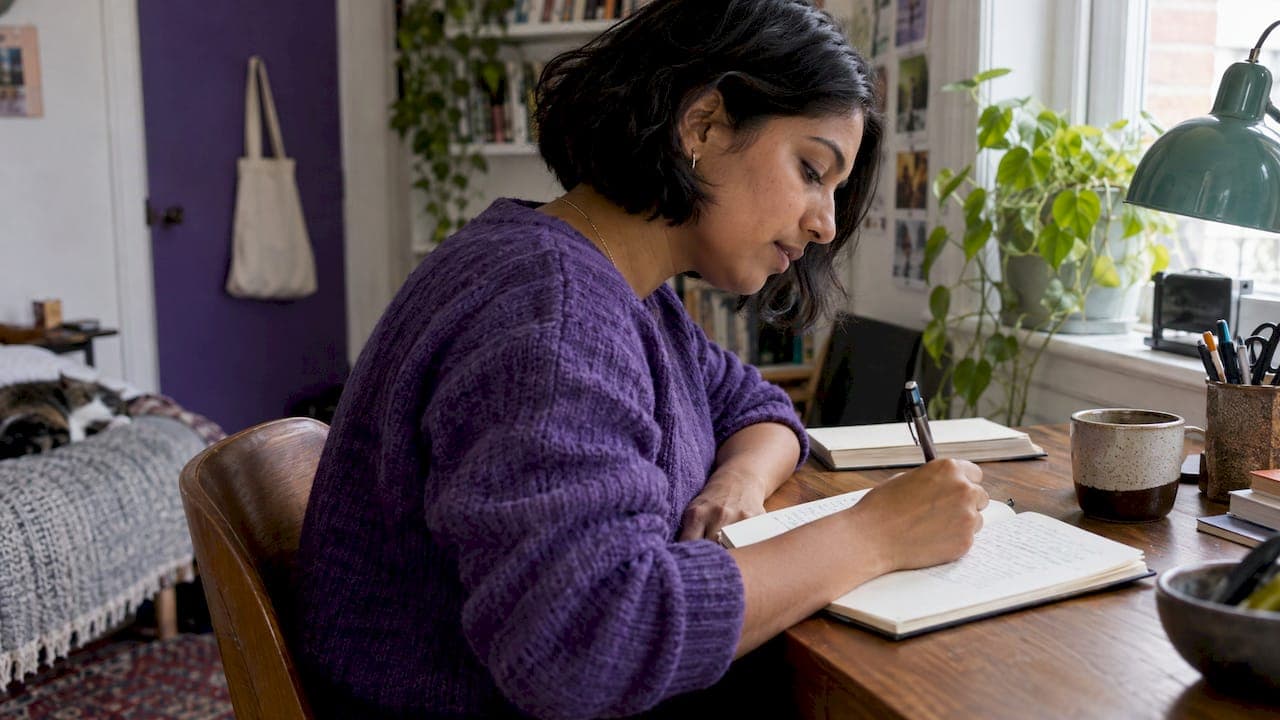
A self-esteem journal is a notebook where you regularly write down your strengths, wins, kind thoughts and the evidence against your inner critic. You can start today with a pen, any notebook, ten minutes and one prompt. This guide shows you how to set it up, which prompts to use, how to keep going, and how to adapt the habit for children and teens.
TL;DR
- A self-esteem journal records good qualities, small wins and kinder thoughts so you notice them instead of overlooking them.
- The NHS suggests writing down negative beliefs, then the evidence against them, and keeping a list of at least five positive things about yourself.
- Start small: a few sentences, a regular time, a quiet spot. Writing fairly regularly is enough; you do not need to write every day.
- Specific prompts work better than vague positivity. Use real examples from your own life.
- If journaling stirs up heavy feelings, pause and talk to someone you trust or your GP.
Table of Contents
- What a self-esteem journal is (and what it is not)
- Why writing things down can help
- How to start a self-esteem journal in 10 minutes
- Self-love journal prompts that build confidence
- A five-minute daily page you can copy
- Guided journal or blank notebook?
- Self-esteem journaling for children and teens
- Our journals, colouring books and activity books
- Our view on why paper journals help
- If journaling brings up difficult feelings
- FAQ
- Sources
What a self-esteem journal is (and what it is not)
A self-esteem journal is a personal place to record thoughts, feelings and experiences with one aim: to build a steadier, fairer sense of your own worth. Positive Psychology describes it as a tool for spotting strengths, recognizing achievements and turning negative thoughts into more balanced beliefs.
It is not a diary of everything that happened, and it is not a place to criticize yourself in writing. The page has a job: to collect evidence that you are capable, kind, improving or simply doing your best. Over time that evidence becomes easy to see.
Three features separate it from an ordinary diary:
- It has a focus. Each entry looks for something specific: a strength, a win, a kind word to yourself.
- It is short. A few lines you will actually finish beat a long entry you dread.
- It is reviewed. Reading back over weeks of entries is where you see patterns you could not see day to day.
Why writing things down can help
Low self-esteem tends to filter what you notice. Compliments slide past, mistakes stick. Writing slows that filter down and puts the other side of the story on paper.
The NHS gives a clear method in its guidance on raising low self-esteem: identify negative beliefs about yourself, write them down, then write evidence that challenges them. It also suggests listing at least five positive things about yourself, adding to the list regularly and keeping it somewhere you can see it. That is, in effect, a self-esteem journal in its simplest form.
The NHS Every Mind Matters thought record works in a similar way. It is a common cognitive behavioural therapy (CBT) exercise with seven prompts that help you capture a situation, examine your thoughts and feelings about it, and begin to challenge and reframe thoughts that are not helping you.
The NHS London Waiting Room service says that journaling for even 15 minutes a day, a couple of times a week can reduce stress and anxiety and build resilience, and that it can help improve self-esteem and self-awareness.
A fair expectation: journaling is a supportive habit, not a quick fix. No page promises a set timeline for change, so judge it by whether the practice feels useful to you over a few weeks.
How to start a self-esteem journal in 10 minutes
Choose your tools, time and place
Pick whatever you will actually reach for. Best For You lists pen and paper, an app, a computer or phone notes as all valid options. Many people find paper slower and calmer, and a notebook you like the look of is easier to open.
Then anchor it to something you already do. BBC Bitesize suggests linking journaling to an existing routine, such as before or after a shower. Good anchors include:
- the first cup of tea in the morning
- the commute home, if you travel by train
- the ten minutes after you brush your teeth at night
Find a spot where you will not be interrupted, set a ten-minute timer, and have one prompt ready before you sit down. Deciding what to write is the step that most often stalls beginners.
Keep it small and imperfect
Best For You advises reminding yourself that it does not have to be perfect, starting with just a few sentences, and accepting that consistent does not have to mean every day. Writing fairly regularly is enough to build the habit. If you miss three days, open the notebook on the fourth and carry on. Do not write an apology to the page.
BBC Bitesize also recommends clarifying your "why" first. Try finishing this sentence on the first page: "I am keeping this journal because..." Your answer is your reason to come back.
Make the first week easy
| Day | What to write | Time |
|---|---|---|
| 1 | Why you are starting, in two sentences | 5 min |
| 2 | One thing you did well today | 5 min |
| 3 | Three qualities a friend would name about you | 5-10 min |
| 4 | One worry, and one piece of evidence against it | 10 min |
| 5 | One kind sentence to yourself | 5 min |
| 6 | Something you handled that was hard | 10 min |
| 7 | Reread the week and underline what surprised you | 10 min |
That is a full week with no day longer than ten minutes.
Self-love journal prompts that build confidence
Specific beats general. The research on journaling for confidence points the same way: writing that draws on real, particular examples tends to help, while vague or forced positivity can fall flat for people with low self-esteem. So aim every prompt at something that actually happened.
Prompts for noticing strengths
- What did I do this week that took effort, even if nobody saw it?
- Which three qualities would my closest friend use to describe me?
- When did I last help someone, and what did that say about me?
- What is something I am good at that I tend to dismiss as "no big deal"?
- What have I got through that I once thought I could not?
The charity Know Your Worth offers free downloadable journaling prompts for growing self-esteem, and notes that identifying our characteristics and strengths can be really helpful. It is a good place to browse for more.
Prompts for self-compassion
- What would I say to a friend who made the same mistake I made today?
- What are five ways I could be kinder to myself this week?
- Which part of me needs patience right now?
- What am I still learning, and what progress can I point to?
- What would a fair, kind observer say about today?
Prompts for challenging the inner critic
These follow the NHS approach of writing a belief and then the evidence against it.
- What is the harshest thing I told myself today? Is it a fact or an opinion?
- What evidence do I have that this thought is not completely true?
- How would I see this situation if it had happened to someone I love?
- What is one thing my inner critic would dismiss but I know is real?
- If this thought is partly true, what is one small, kind next step?
Prompts for gratitude and the future
- What are three things I am grateful for, and why each one?
- Who made me feel valued recently, and what did they do?
- What does a realistic, good day look like for me?
- What do I want to be proud of a year from now?
- What is one small step I can take toward that this week?
Prompts for body image and boundaries
- What does my body let me do that I am glad of?
- Where in my week do I say yes when I mean no?
- What is one boundary I could set that would protect my energy?
- When do I feel most like myself?
- What would I like to let go of this month?
Pick one prompt a session. Do not try to answer them all in order; choose the one that makes you slightly curious.
A five-minute daily page you can copy
A repeatable structure removes the blank-page problem. Here is a simple three-part layout you can rule on any page:
- One win. Something you did, however small. "I answered the email I was avoiding."
- One thought to question. Write the thought, then one fact that does not fit it.
- One kind line. Write a sentence you would say to a friend.
Once a week, add a fourth step: read back through the last seven entries and circle any strength that appears more than once. That repeated word is information about you.
This also echoes the approach the NHS describes: name the belief, set the evidence against it, and build a list of positives you keep adding to. If you want more structure, the ideas in our guide to self reflection journal ideas can be mixed into the same layout, and our practical guide to boosting confidence with journals goes further on building the habit.
Guided journal or blank notebook?
Both work. The difference is how much decision-making each one asks of you.
| Blank notebook | Guided journal | |
|---|---|---|
| Best for | People who like to write freely | People who stall at an empty page |
| Prompts | You choose or bring your own | Built in |
| Flexibility | High | Follows the layout |
| Risk | Skipping days because you do not know where to start | Feeling boxed in if a prompt does not fit |
A good compromise: use a notebook with a clear layout for the structure, and keep a short list of your favorite prompts on the inside cover. If you like a blank page with some character, our notes on why personalized journals work better for you explain how choosing a notebook you like makes the habit easier to keep.
For a more reflective habit that sits alongside self-esteem work, see our self-help journal guide, which covers building clarity into your entries.
If you want a book that has been reviewed by clinicians, the Association for Cognitive Analytic Therapy reviewed Alison Waines' The Self-Esteem Journal, noting that it gives equal weight to emotional, cognitive and behavioural awareness and contains almost fifty exercises to structure your writing and review it.
Self-esteem journaling for children and teens
Children and teens can get a lot from the same idea, but the format should be lighter, more visual and less like homework.
Childline's mood journal page suggests gratitude journaling, writing about your day, answering a daily question, drawing, or writing unsent letters. It says there is no right or wrong way to journal. Its sample questions include "What three things are you proud of?" and "What are five ways you could be kinder to yourself?" It also suggests setting SMART goals that can be shared with a trusted adult, and talking to a trusted adult if a young person is struggling or needs ideas.
The Reading Resilience Network at the University of Reading describes a self-compassion journal for young people. It invites them to write kind words to themselves, note three good things that went well and identify one emotion and what triggered it, with the option to draw instead of write. Young people in their workshops felt drawing helped them see negative emotions as separate from themselves and brought a sense of calm.

The CWWMind journal for Key Stage 3 and above includes a daily mirror exercise where young people say three compliments or encouraging words to themselves aloud.
What parents and guardians can do
- Offer, do not insist. A journal that is checked becomes a performance. Let your child decide what stays private.
- Let them draw. Colouring, doodling and sketching all count.
- Keep it to minutes. Five calm minutes after school or before bed is plenty.
- Write alongside them. Journaling is easier when it is something the household does, not something done to a child.
- Be the trusted adult. If your child shares something worrying, listen first. If they seem persistently low, talk to your GP or their school.
For teens who find a daily habit hard to start, a very short routine helps. These 2-5 minute communication drills for teens show how brief daily practice can stick, and the same principle applies to a few lines of journaling.
Our journals, colouring books and activity books
We publish original books by author Mark Terry, including journals, notebooks, planners and self-help journals, plus colouring books for children, teens and adults. The journals and log books are designed for regular, structured writing, and the colouring books give children a calm, creative way to unwind while they practice noticing what they enjoy and what they are proud of. Postage is included in the price, worldwide.

If you want a creative, screen-free start, browse our journals and self-help log books. For a relaxed activity alongside journaling, try our activity and puzzle books or word search books.
Our view on why paper journals help
Everything we make begins with the idea that a thoughtful page can change how an afternoon feels. When people ask us how to start a self-esteem journal, we say the same thing: make it small, make it yours and make it something you enjoy opening.
We design our journals, notebooks and colouring books around that idea. A well-laid-out page lowers the effort of starting, and a book that feels personal is a book you pick up again. That is why we put care into the look, the structure and the writing prompts, and why each book is an original work rather than a template.
Self-esteem is built in small, specific moments: the email you finally sent, the kind word you gave yourself, the thing you got through. A journal gives those moments somewhere to live. Our guide to why journals matter for mental clarity and growth and our piece on creative journaling workflow explain how we think about the habit.
Mark
If journaling brings up difficult feelings
Writing about yourself can sometimes stir up sadness, anger or old memories. That is a common reaction, not a sign you are doing it wrong. A few ways to look after yourself while you write:
- Stop and change the task. Put the pen down, take a walk, make a drink, or switch to a gentler prompt such as gratitude or a small win.
- Write the thought, then the evidence. The NHS approach is to put a negative belief on paper and set evidence against it, which helps it feel less like a fact.
- Draw instead. The Reading Resilience Network notes drawing can help people see negative emotions as separate from them and feel calmer.
- Talk to someone. Childline's advice for young people is to talk to a trusted adult if they are struggling, and that applies to adults too: a friend, family member or your GP.
The NHS inform self-help guide on self-esteem is based on CBT and is intended for people with mild-to-moderate mental health issues. If your low mood or low self-esteem is severe, lasts for weeks or affects your sleep, work or relationships, speak to your GP. If you ever feel you might harm yourself, call 999 or go to A&E straight away. A journal supports your wellbeing, but it is not a replacement for professional help.
To understand how journaling relates to the wider mindful habits some readers build, see our practical guide to journals in mindfulness and our piece on calming rumination with a self discovery journal.
FAQ
How often should I write in a self-esteem journal?
Write as often as you can keep up without dreading it. Best For You says consistent does not have to mean every day, and writing fairly regularly is enough to build the habit. The NHS London Waiting Room mentions 15 minutes a couple of times a week. Begin with two or three short sessions a week and add more if you enjoy it.
How long does it take for a self-esteem journal to work?
There is no fixed timeline. Self-esteem shifts gradually, and what helps is repeating a habit of noticing your strengths and challenging harsh thoughts. Judge it by how you feel after a few weeks of regular entries, and reread old pages to see what has changed.
What should I write if I cannot think of anything good about myself?
Start with facts rather than feelings. List things you did today, however small, then pick one that took effort. The NHS suggests writing at least five positive things about yourself and adding to the list over time. If it feels impossible, ask what a close friend would say about you and write that down.
Is a self-esteem journal suitable for children?
Yes, in a lighter form. Childline suggests daily questions, gratitude, drawing and unsent letters, and says there is no right or wrong way to journal. Keep sessions short, let your child keep the contents private, and encourage them to talk to a trusted adult if something worries them.
Should I use a guided journal or a blank notebook?
Choose the one you will open. A guided layout takes away the blank-page problem, while a blank notebook gives freedom. Many people use a structured journal and add their own prompts as they go.
Sources
- Self-Esteem Journals, Prompts, PDFs and Ideas
- Raising low self-esteem, NHS
- Thought record CBT exercise, NHS Every Mind Matters
- Journaling, London Waiting Room
- Journalling for mental health, Best For You
- What are the benefits of journaling and how do I do it? BBC Bitesize
- Downloadables, Know Your Worth
- Review of The Self-Esteem Journal, ACAT
- Mood Journal, Childline
- The Self Compassion Journal wellbeing tool, University of Reading
- Young Persons Mental Health Journal, CWWMind
- Self-esteem self-help guide, NHS inform
- 2-5 minute communication drills for teens